


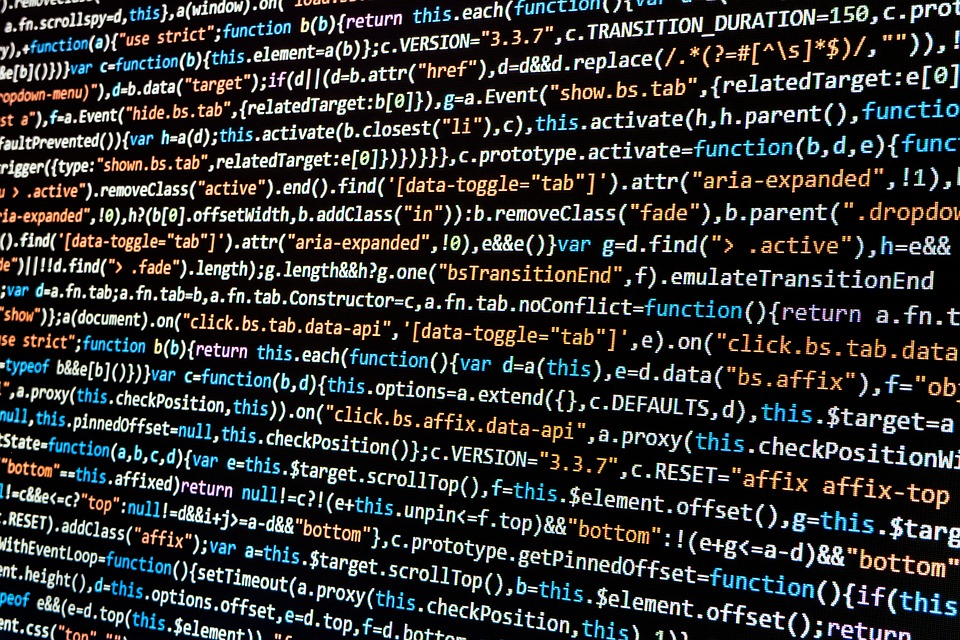
Computer programming or coding is the composition of sequences of instructions, called programs, that computers can follow to perform tasks. It involves designing and implementing algorithms, step-by-step specifications of procedures, by writing code in one or more programming languages. Programmers typically use high-level programming languages that are more easily intelligible to humans than machine code, which is directly executed by the central processing unit. Proficient programming usually requires expertise in several different subjects, including knowledge of the application domain, details of programming languages and generic code libraries, specialized algorithms, and formal logic.
Auxiliary tasks accompanying and related to programming include analyzing requirements, testing, debugging (investigating and fixing problems), implementation of build systems, and management of derived artifacts, such as programs' machine code. While these are sometimes considered programming, often the term software development is used for this larger overall process – with the terms programming, implementation, and coding reserved for the writing and editing of code per se. Sometimes software development is known as software engineering, especially when it employs formal methods or follows an engineering design process. (Full article...)
Selected articles - load new batch
-
👁 Image 1 Haskell (/ˈhæskəl/) is a general-purpose, statically typed, purely functional programming language with type inference and lazy evaluation. Haskell pioneered several programming language features including type classes for type-safe operator overloading and monadic input/output (IO). It is named after logician Haskell Curry. Haskell's main implementation is the Glasgow Haskell Compiler (GHC). Haskell's semantics are historically based on those of the Miranda programming language, which served to focus the efforts of the initial Haskell working group. The last formal specification of the language was made in July 2010, while the development of GHC continues to expand Haskell via language extensions. Haskell is used in academia and industry. As of May 2021[update], Haskell was the 28th most popular programming language by Google searches for tutorials, and made up less than 1% of active users on the GitHub source code repository. (Full article...)
👁 Image
Haskell (/ˈhæskəl/) is a general-purpose, statically typed, purely functional programming language with type inference and lazy evaluation. Haskell pioneered several programming language features including type classes for type-safe operator overloading and monadic input/output (IO). It is named after logician Haskell Curry. Haskell's main implementation is the Glasgow Haskell Compiler (GHC).
Haskell's semantics are historically based on those of the Miranda programming language, which served to focus the efforts of the initial Haskell working group. The last formal specification of the language was made in July 2010, while the development of GHC continues to expand Haskell via language extensions.
Haskell is used in academia and industry. As of May 2021[update], Haskell was the 28th most popular programming language by Google searches for tutorials, and made up less than 1% of active users on the GitHub source code repository. (Full article...) -
👁 Image 2 COBOL (Common Business-Oriented Language; /ˈkoʊbɒl, -bɔːl/) is a compiled English-like computer programming language designed for business use. It is an imperative, procedural, and, since 2002, object-oriented language. COBOL is primarily used in business, finance, and administrative systems for companies and governments. COBOL is still widely used in applications deployed on mainframe computers, such as large-scale batch and transaction processing jobs. Many large financial institutions were developing new systems in the language as late as 2006, but most programming in COBOL today is purely to maintain existing applications. Programs are being moved to new platforms, rewritten in modern languages, or replaced with other software. COBOL's design was started in 1959 by CODASYL and was partly based on the programming language FLOW-MATIC, designed by Grace Hopper. It was created as part of a US Department of Defense effort to create a portable programming language for data processing. It was originally seen as a stopgap, but the Defense Department promptly pressured computer manufacturers to provide it, resulting in its widespread adoption. It was standardized in 1968 and has been revised five times. Expansions include support for structured and object-oriented programming. The current standard is ISO/IEC 1989:2023. COBOL statements have prose syntax such as MOVE x TO y, which was designed to be self-documenting and highly readable. However, it is verbose and uses over 300 reserved words compared to the succinct and mathematically inspired syntax of other languages. (Full article...)COBOL (Common Business-Oriented Language; /ˈkoʊbɒl,-bɔːl/) is a compiled English-like computer programming language designed for business use. It is an imperative, procedural, and, since 2002, object-oriented language. COBOL is primarily used in business, finance, and administrative systems for companies and governments. COBOL is still widely used in applications deployed on mainframe computers, such as large-scale batch and transaction processing jobs. Many large financial institutions were developing new systems in the language as late as 2006, but most programming in COBOL today is purely to maintain existing applications. Programs are being moved to new platforms, rewritten in modern languages, or replaced with other software.
COBOL's design was started in 1959 by CODASYL and was partly based on the programming language FLOW-MATIC, designed by Grace Hopper. It was created as part of a US Department of Defense effort to create a portable programming language for data processing. It was originally seen as a stopgap, but the Defense Department promptly pressured computer manufacturers to provide it, resulting in its widespread adoption. It was standardized in 1968 and has been revised five times. Expansions include support for structured and object-oriented programming. The current standard is ISO/IEC 1989:2023.
COBOL statements have prose syntax such asMOVExTOy, which was designed to be self-documenting and highly readable. However, it is verbose and uses over 300 reserved words compared to the succinct and mathematically inspired syntax of other languages. (Full article...) -
👁 Image 3 Artificial intelligence (AI) is the capability of computational systems to perform tasks typically associated with human intelligence, such as learning, reasoning, problem-solving, perception, and decision-making. It is a field of research in engineering, mathematics and computer science that develops and studies methods and software that enable machines to perceive their environment and use learning and intelligence to take actions that maximize their chances of achieving defined goals. High-profile applications of AI include advanced web search engines, chatbots, virtual assistants, autonomous vehicles, and play and analysis in strategy games (e.g., chess and Go). Since the 2020s, generative AI has become widely available to generate images, audio, and videos from text prompts. The traditional goals of AI research include learning, reasoning, knowledge representation, planning, natural language processing, and perception, as well as support for robotics. To reach these goals, AI researchers have used techniques including state space search and mathematical optimization, formal logic, artificial neural networks, and methods based on statistics, operations research, and economics. AI also draws upon psychology, linguistics, philosophy, neuroscience, and other fields. Some companies, such as OpenAI, Google DeepMind and Meta, aim to create artificial general intelligence (AGI) – AI that can complete virtually any cognitive task at least as well as a human. (Full article...)Artificial intelligence (AI) is the capability of computational systems to perform tasks typically associated with human intelligence, such as learning, reasoning, problem-solving, perception, and decision-making. It is a field of research in engineering, mathematics and computer science that develops and studies methods and software that enable machines to perceive their environment and use learning and intelligence to take actions that maximize their chances of achieving defined goals.
High-profile applications of AI include advanced web search engines, chatbots, virtual assistants, autonomous vehicles, and play and analysis in strategy games (e.g., chess and Go). Since the 2020s, generative AI has become widely available to generate images, audio, and videos from text prompts.
The traditional goals of AI research include learning, reasoning, knowledge representation, planning, natural language processing, and perception, as well as support for robotics. To reach these goals, AI researchers have used techniques including state space search and mathematical optimization, formal logic, artificial neural networks, and methods based on statistics, operations research, and economics. AI also draws upon psychology, linguistics, philosophy, neuroscience, and other fields. Some companies, such as OpenAI, Google DeepMind and Meta, aim to create artificial general intelligence (AGI) – AI that can complete virtually any cognitive task at least as well as a human. (Full article...) -
👁 Image 4 Flowchart of an algorithm to find the greatest common divisor of two numbers. In mathematics and computer science, an algorithm (/ˈælɡərɪðəm/ ⓘ) is a finite sequence of mathematically rigorous instructions, typically used to solve a class of specific problems or to perform a computation. Algorithms are used as specifications for performing calculations and data processing. More advanced algorithms can use conditionals to divert the code execution through various routes (referred to as automated decision-making) and deduce valid inferences (referred to as automated reasoning). In contrast, a heuristic is an approach to solving problems without well-defined correct or optimal results. For example, although social media recommender systems are commonly called "algorithms", they actually rely on heuristics as there is no truly "correct" recommendation. As an effective method, an algorithm can be expressed within a finite amount of space and time and in a well-defined formal language for calculating a function. Starting from an initial state and input, a computation occurs at each step, eventually producing output and terminating. The transition between states can be non-deterministic; randomized algorithms incorporate random input. (Full article...)
👁 In a loop, subtract the larger number against the smaller number. Halt the loop when the subtraction will make a number negative. Assess two numbers, whether one of them is equal to zero or not. If yes, take the other number as the greatest common divisor. If no, put the two numbers in the subtraction loop again. Flowchart of an algorithm to find the greatest common divisor of two numbers.
In mathematics and computer science, an algorithm (/ˈælɡərɪðəm/ ⓘ) is a finite sequence of mathematically rigorous instructions, typically used to solve a class of specific problems or to perform a computation. Algorithms are used as specifications for performing calculations and data processing. More advanced algorithms can use conditionals to divert the code execution through various routes (referred to as automated decision-making) and deduce valid inferences (referred to as automated reasoning).
In contrast, a heuristic is an approach to solving problems without well-defined correct or optimal results. For example, although social media recommender systems are commonly called "algorithms", they actually rely on heuristics as there is no truly "correct" recommendation.
As an effective method, an algorithm can be expressed within a finite amount of space and time and in a well-defined formal language for calculating a function. Starting from an initial state and input, a computation occurs at each step, eventually producing output and terminating. The transition between states can be non-deterministic; randomized algorithms incorporate random input. (Full article...) -
👁 Image 5 R is a programming language for statistical computing and data visualization. It has been widely adopted in the fields of data mining, bioinformatics, data analysis, and data science. The core R language is extended by a large number of software packages, which contain reusable code, documentation, and sample data. Some of the most popular R packages are in the tidyverse collection, which enhances functionality for visualizing, transforming, and modelling data, as well as improves the ease of programming (according to the authors and users). R is free and open-source software distributed under the GNU General Public License. The language is implemented primarily in C, Fortran, and R itself. Precompiled executables are available for the major operating systems (including Linux, MacOS, and Microsoft Windows). (Full article...)
👁 Image
R is a programming language for statistical computing and data visualization. It has been widely adopted in the fields of data mining, bioinformatics, data analysis, and data science.
The core R language is extended by a large number of software packages, which contain reusable code, documentation, and sample data. Some of the most popular R packages are in the tidyverse collection, which enhances functionality for visualizing, transforming, and modelling data, as well as improves the ease of programming (according to the authors and users).
R is free and open-source software distributed under the GNU General Public License. The language is implemented primarily in C, Fortran, and R itself. Precompiled executables are available for the major operating systems (including Linux, MacOS, and Microsoft Windows). (Full article...) -
👁 Image 6 Forth is a stack-oriented programming language and interactive integrated development environment designed by Charles H. "Chuck" Moore and first used by other programmers in 1970. Although not an acronym, the language's name in its early years was often spelled in all capital letters as FORTH. The FORTH-79 and FORTH-83 implementations, which were not written by Moore, became de facto standards, and an official technical standard of the language was published in 1994 as ANS Forth. A wide range of Forth derivatives existed before and after ANS Forth. The free and open-source software Gforth implementation is actively maintained, as are several commercially supported systems. Forth typically combines a compiler with an integrated command shell, where the user interacts via subroutines called words. Words can be defined, tested, redefined, and debugged without recompiling or restarting the whole program. All syntactic elements, including variables, operators, and control flow, are defined as words. A stack is used to pass parameters between words, leading to a Reverse Polish notation style. (Full article...)Forth is a stack-oriented programming language and interactive integrated development environment designed by Charles H. "Chuck" Moore and first used by other programmers in 1970. Although not an acronym, the language's name in its early years was often spelled in all capital letters as FORTH. The FORTH-79 and FORTH-83 implementations, which were not written by Moore, became de facto standards, and an official technical standard of the language was published in 1994 as ANS Forth. A wide range of Forth derivatives existed before and after ANS Forth. The free and open-source software Gforth implementation is actively maintained, as are several commercially supported systems.
Forth typically combines a compiler with an integrated command shell, where the user interacts via subroutines called words.
Words can be defined, tested, redefined, and debugged without recompiling or restarting the whole program. All syntactic elements, including variables, operators, and control flow, are defined as words. A stack is used to pass parameters between words, leading to a Reverse Polish notation style. (Full article...) -
👁 Image 7 Lisp (historically LISP, an abbreviation of "list processing") is a family of programming languages with a long history and a distinctive, fully parenthesized prefix notation. Originally specified in the late 1950s, it is the second-oldest high-level programming language still in common use, after Fortran. Lisp has changed since its early days, and many dialects have existed over its history. Today, the best-known general-purpose Lisp dialects are Common Lisp, Scheme, Racket, and Clojure. Lisp was originally created as a practical mathematical notation for computer programs, influenced by (though not originally derived from) the notation of Alonzo Church's lambda calculus. It quickly became a favored programming language for artificial intelligence (AI) research. As one of the earliest programming languages, Lisp pioneered many ideas in computer science, including tree data structures, automatic storage management, dynamic typing, conditionals, higher-order functions, recursion, the self-hosting compiler, and the read–eval–print loop. The name LISP derives from "List Processor". Linked lists are one of Lisp's major data structures, and Lisp source code is made of lists. Thus, Lisp programs can manipulate source code as a data structure, giving rise to the macro systems that allow programmers to create new syntax or new domain-specific languages embedded in Lisp. (Full article...)Lisp (historically LISP, an abbreviation of "list processing") is a family of programming languages with a long history and a distinctive, fully parenthesized prefix notation.
Originally specified in the late 1950s, it is the second-oldest high-level programming language still in common use, after Fortran. Lisp has changed since its early days, and many dialects have existed over its history. Today, the best-known general-purpose Lisp dialects are Common Lisp, Scheme, Racket, and Clojure.
Lisp was originally created as a practical mathematical notation for computer programs, influenced by (though not originally derived from) the notation of Alonzo Church's lambda calculus. It quickly became a favored programming language for artificial intelligence (AI) research. As one of the earliest programming languages, Lisp pioneered many ideas in computer science, including tree data structures, automatic storage management, dynamic typing, conditionals, higher-order functions, recursion, the self-hosting compiler, and the read–eval–print loop.
The name LISP derives from "List Processor". Linked lists are one of Lisp's major data structures, and Lisp source code is made of lists. Thus, Lisp programs can manipulate source code as a data structure, giving rise to the macro systems that allow programmers to create new syntax or new domain-specific languages embedded in Lisp. (Full article...) -
👁 Image 8 Scala (/ˈskɑːlɑː/ SKAH-lah) is a strongly statically typed high-level general-purpose programming language that supports both object-oriented programming and functional programming. Designed to be concise, many of Scala's design decisions are intended to address criticism of Java. Scala source code can be compiled to JVM bytecode and run on a Java virtual machine (JVM). Scala can also be transpiled to JavaScript to run in a browser, or compiled directly to a native executable using Clang. When running on the JVM, Scala provides language interoperability with Java so that libraries written in either language may be referenced directly in Scala or Java code. Like Java, Scala is object-oriented, and uses a syntax termed curly-brace which is similar to the language C. Since Scala 3, there is also an option to use the off-side rule (indenting) to structure blocks, and its use is advised. Martin Odersky has said that this turned out to be the most productive change introduced in Scala 3. Unlike Java, Scala has many features of functional programming languages (like Scheme, Standard ML, and Haskell), including currying, immutability, lazy evaluation, and pattern matching. It also has an advanced type system supporting algebraic data types, covariance and contravariance, higher-order types (but not higher-rank types), anonymous types, operator overloading, optional parameters, named parameters, raw strings, and an experimental exception-only version of algebraic effects that can be seen as a more powerful version of Java's checked exceptions. (Full article...)
👁 Image
Scala (/ˈskɑːlɑː/ SKAH-lah) is a strongly statically typed high-level general-purpose programming language that supports both object-oriented programming and functional programming. Designed to be concise, many of Scala's design decisions are intended to address criticism of Java.
Scala source code can be compiled to JVM bytecode and run on a Java virtual machine (JVM). Scala can also be transpiled to JavaScript to run in a browser, or compiled directly to a native executable using Clang. When running on the JVM, Scala provides language interoperability with Java so that libraries written in either language may be referenced directly in Scala or Java code. Like Java, Scala is object-oriented, and uses a syntax termed curly-brace which is similar to the language C. Since Scala 3, there is also an option to use the off-side rule (indenting) to structure blocks, and its use is advised. Martin Odersky has said that this turned out to be the most productive change introduced in Scala 3.
Unlike Java, Scala has many features of functional programming languages (like Scheme, Standard ML, and Haskell), including currying, immutability, lazy evaluation, and pattern matching. It also has an advanced type system supporting algebraic data types, covariance and contravariance, higher-order types (but not higher-rank types), anonymous types, operator overloading, optional parameters, named parameters, raw strings, and an experimental exception-only version of algebraic effects that can be seen as a more powerful version of Java's checked exceptions. (Full article...) -
👁 Image 9 Logo endorsed by the C++ standards committee C++ is a high-level, general-purpose programming language created by Danish computer scientist Bjarne Stroustrup. First released in 1985 as an extension of the C programming language, adding object-oriented (OOP) features, it has since expanded significantly over time adding more OOP and other features; as of 1997[update]/C++98 standardization, C++ has added functional features, in addition to facilities for low-level memory manipulation for systems like microcomputers or to make operating systems like Linux or Windows, and even later came features like generic programming (through the use of templates). C++ is usually implemented as a compiled language, and many vendors provide C++ compilers, including the Free Software Foundation, LLVM, Microsoft, Intel, Embarcadero, Oracle, and IBM. C++ was designed with systems programming and embedded, resource-constrained software and large systems in mind, with performance, efficiency, and flexibility of use as its design highlights. C++ has also been found useful in many other contexts, with key strengths being software infrastructure and resource-constrained applications, including desktop applications, video games, servers (e.g., e-commerce, web search, or databases), and performance-critical applications (e.g., telephone switches or space probes). C++ is standardized by the International Organization for Standardization (ISO), with the latest standard version ratified and published by ISO in October 2024 as ISO/IEC 14882:2024 (informally known as C++23). The C++ programming language was initially standardized in 1998 as ISO/IEC 14882:1998, which was then amended by the C++03, C++11, C++14, C++17, and C++20 standards. The next C++23 standard superseded these with new features and an enlarged standard library. Before the initial standardization in 1998, C++ was developed by Stroustrup at Bell Labs since 1979 as an extension of the C language; he wanted an efficient and flexible language similar to C that also provided high-level features for program organization. Since 2012, C++ has been on a three-year release schedule with C++29 as the next planned standard. (Full article...)
C++ is a high-level, general-purpose programming language created by Danish computer scientist Bjarne Stroustrup. First released in 1985 as an extension of the C programming language, adding object-oriented (OOP) features, it has since expanded significantly over time adding more OOP and other features; as of 1997[update]/C++98 standardization, C++ has added functional features, in addition to facilities for low-level memory manipulation for systems like microcomputers or to make operating systems like Linux or Windows, and even later came features like generic programming (through the use of templates). C++ is usually implemented as a compiled language, and many vendors provide C++ compilers, including the Free Software Foundation, LLVM, Microsoft, Intel, Embarcadero, Oracle, and IBM.
C++ was designed with systems programming and embedded, resource-constrained software and large systems in mind, with performance, efficiency, and flexibility of use as its design highlights. C++ has also been found useful in many other contexts, with key strengths being software infrastructure and resource-constrained applications, including desktop applications, video games, servers (e.g., e-commerce, web search, or databases), and performance-critical applications (e.g., telephone switches or space probes).
C++ is standardized by the International Organization for Standardization (ISO), with the latest standard version ratified and published by ISO in October 2024 as ISO/IEC 14882:2024 (informally known as C++23). The C++ programming language was initially standardized in 1998 as ISO/IEC 14882:1998, which was then amended by the C++03, C++11, C++14, C++17, and C++20 standards. The next C++23 standard superseded these with new features and an enlarged standard library. Before the initial standardization in 1998, C++ was developed by Stroustrup at Bell Labs since 1979 as an extension of the C language; he wanted an efficient and flexible language similar to C that also provided high-level features for program organization. Since 2012, C++ has been on a three-year release schedule with C++29 as the next planned standard. (Full article...) -
👁 Image 10 Structured Query Language (SQL) (pronounced /ˌɛsˌkjuˈɛl/ S-Q-L; or alternatively as /ˈsiːkwəl/ ⓘ "sequel") is a domain-specific language used to manage data, especially in a relational database management system (RDBMS). It is particularly useful in handling structured data, i.e., data incorporating relations among entities and variables. Introduced in the 1970s, SQL offered two main advantages over older read–write APIs such as ISAM or VSAM. Firstly, it introduced the concept of accessing many records with one single command. Secondly, it eliminates the need to specify how to reach a record, i.e., with or without an index. Originally based upon relational algebra and tuple relational calculus, SQL consists of many types of statements, which may be informally classed as sublanguages, commonly: data query language (DQL), data definition language (DDL), data control language (DCL), and data manipulation language (DML). (Full article...)Structured Query Language (SQL) (pronounced /ˌɛsˌkjuˈɛl/ S-Q-L; or alternatively as /ˈsiːkwəl/ ⓘ "sequel") is a domain-specific language used to manage data, especially in a relational database management system (RDBMS). It is particularly useful in handling structured data, i.e., data incorporating relations among entities and variables.
Introduced in the 1970s, SQL offered two main advantages over older read–write APIs such as ISAM or VSAM. Firstly, it introduced the concept of accessing many records with one single command. Secondly, it eliminates the need to specify how to reach a record, i.e., with or without an index.
Originally based upon relational algebra and tuple relational calculus, SQL consists of many types of statements, which may be informally classed as sublanguages, commonly: data query language (DQL), data definition language (DDL), data control language (DCL), and data manipulation language (DML). (Full article...) -
👁 Image 11 An illustration of the linking process. Object files and static libraries are assembled into a new library or executable A linker or link editor is a computer program that combines intermediate software build files such as object and library files into a single executable file such as a program or library. A linker is often part of a toolchain that includes a compiler and/or assembler that generates intermediate files that the linker processes. The linker may be integrated with other toolchain tools such that the user does not interact with the linker directly. A simpler version that writes its output directly to memory is called the loader, though loading is typically considered a separate process. (Full article...)
👁 Image An illustration of the linking process. Object files and static libraries are assembled into a new library or executable
A linker or link editor is a computer program that combines intermediate software build files such as object and library files into a single executable file such as a program or library. A linker is often part of a toolchain that includes a compiler and/or assembler that generates intermediate files that the linker processes. The linker may be integrated with other toolchain tools such that the user does not interact with the linker directly.
A simpler version that writes its output directly to memory is called the loader, though loading is typically considered a separate process. (Full article...) -
👁 Image 12 Prolog is a logic programming language that has its origins in artificial intelligence, automated theorem proving, and computational linguistics. Prolog has its roots in first-order logic, a formal logic. Unlike many other programming languages, Prolog is intended primarily as a declarative programming language: the program is a set of facts and rules, which define relations. A computation is initiated by running a query over the program. Prolog was one of the first logic programming languages and remains the most popular such language today, with several free and commercial implementations available. The language has been used for theorem proving, expert systems, term rewriting, type systems, automated planning, and question answering as well as its original intended field of use, natural language processing. (Full article...)Prolog is a logic programming language that has its origins in artificial intelligence, automated theorem proving, and computational linguistics.
Prolog has its roots in first-order logic, a formal logic. Unlike many other programming languages, Prolog is intended primarily as a declarative programming language: the program is a set of facts and rules, which define relations. A computation is initiated by running a query over the program.
Prolog was one of the first logic programming languages and remains the most popular such language today, with several free and commercial implementations available. The language has been used for theorem proving, expert systems, term rewriting, type systems, automated planning, and question answering as well as its original intended field of use, natural language processing. (Full article...) -
👁 Image 13 In computing, a compiler is software that translates computer code written in one programming language (the source language) into another language (the target language). The name "compiler" is primarily used for programs that translate source code from a high-level programming language to a low-level programming language (e.g., assembly language, object code, or machine code) to create an executable program. There are many different types of compilers which produce output in different useful forms. A cross-compiler produces code for a different central processing unit (CPU) or operating system than the one on which the cross-compiler itself runs. A bootstrap compiler is often a temporary compiler, used for compiling a more permanent or better optimized compiler for a language. Related software include decompilers, programs that translate from low-level languages to higher-level ones; programs that translate between high-level languages, usually called source-to-source compilers or transpilers; language rewriters, usually programs that translate the form of expressions without a change of language; and compiler-compilers, compilers that produce compilers (or parts of them), often in a generic and reusable way so as to be able to produce many differing compilers. (Full article...)In computing, a compiler is software that translates computer code written in one programming language (the source language) into another language (the target language). The name "compiler" is primarily used for programs that translate source code from a high-level programming language to a low-level programming language (e.g., assembly language, object code, or machine code) to create an executable program.
There are many different types of compilers which produce output in different useful forms. A cross-compiler produces code for a different central processing unit (CPU) or operating system than the one on which the cross-compiler itself runs. A bootstrap compiler is often a temporary compiler, used for compiling a more permanent or better optimized compiler for a language.
Related software include decompilers, programs that translate from low-level languages to higher-level ones; programs that translate between high-level languages, usually called source-to-source compilers or transpilers; language rewriters, usually programs that translate the form of expressions without a change of language; and compiler-compilers, compilers that produce compilers (or parts of them), often in a generic and reusable way so as to be able to produce many differing compilers. (Full article...) -
👁 Image 14 Python is a high-level, general-purpose programming language that emphasizes code readability, simplicity, and ease-of-writing with the use of significant indentation, "plain English" naming, an extensive ("batteries-included") standard library, and garbage collection. Python supports multiple programming paradigms but with an emphasis on object-oriented programming and dynamic typing. Guido van Rossum began working on Python in the late 1980s as a successor to the ABC programming language. Python 3.0, released in 2008, was a major revision and not completely backward-compatible with earlier versions. Beginning with Python 3.5, capabilities and keywords for typing were added to the language, allowing optional static typing. As of 2026[update], the Python Software Foundation supports Python 3.10, 3.11, 3.12, 3.13, and 3.14, following the project's annual release cycle and five-year support policy. Python 3.15 is currently in the alpha development phase, and the stable release is expected to launch in October 2026. Earlier versions in the 3.x series have reached end-of-life and no longer receive security updates. Python has gained extensive use in the machine learning community. It is widely taught as an introductory programming language. Since 2003, Python has consistently ranked among the top ten most popular programming languages in the TIOBE Programming Community Index, which ranks programming languages based on searches across 24 platforms. (Full article...)
👁 Image
Python is a high-level, general-purpose programming language that emphasizes code readability, simplicity, and ease-of-writing with the use of significant indentation, "plain English" naming, an extensive ("batteries-included") standard library, and garbage collection. Python supports multiple programming paradigms but with an emphasis on object-oriented programming and dynamic typing.
Guido van Rossum began working on Python in the late 1980s as a successor to the ABC programming language. Python 3.0, released in 2008, was a major revision and not completely backward-compatible with earlier versions. Beginning with Python 3.5, capabilities and keywords for typing were added to the language, allowing optional static typing. As of 2026[update], the Python Software Foundation supports Python 3.10, 3.11, 3.12, 3.13, and 3.14, following the project's annual release cycle and five-year support policy. Python 3.15 is currently in the alpha development phase, and the stable release is expected to launch in October 2026. Earlier versions in the 3.x series have reached end-of-life and no longer receive security updates.
Python has gained extensive use in the machine learning community. It is widely taught as an introductory programming language. Since 2003, Python has consistently ranked among the top ten most popular programming languages in the TIOBE Programming Community Index, which ranks programming languages based on searches across 24 platforms. (Full article...) -
👁 Image 15 Fortran (/ˈfɔːrtræn/; formerly FORTRAN) is a third-generation, compiled, imperative programming language designed for numeric computation and scientific computing. Fortran was originally developed by IBM with a reference manual being released in 1956; however, the first compilers only began to produce accurate code two years later. Fortran computer programs have been written to support scientific and engineering applications, such as numerical weather prediction, finite element analysis, computational fluid dynamics, plasma physics, geophysics, computational physics, crystallography and computational chemistry. It is a popular language for high-performance computing and is used for programs that benchmark and rank the world's fastest supercomputers. Fortran has evolved through numerous versions and dialects. The two most important early versions were FORTRAN II and FORTRAN IV. In 1966, the American National Standards Institute (ANSI) developed a standard for Fortran to limit proliferation of compilers using slightly different syntax. Successive versions have added support for a character data type, structured programming (Fortran 77), array programming, modular programming, generic programming (Fortran 90), parallel computing (Fortran 95), object-oriented programming (Fortran 2003), and concurrent programming (Fortran 2008). (Full article...)
👁 Image
Fortran (/ˈfɔːrtræn/; formerly FORTRAN) is a third-generation, compiled, imperative programming language designed for numeric computation and scientific computing.
Fortran was originally developed by IBM with a reference manual being released in 1956; however, the first compilers only began to produce accurate code two years later. Fortran computer programs have been written to support scientific and engineering applications, such as numerical weather prediction, finite element analysis, computational fluid dynamics, plasma physics, geophysics, computational physics, crystallography and computational chemistry. It is a popular language for high-performance computing and is used for programs that benchmark and rank the world's fastest supercomputers.
Fortran has evolved through numerous versions and dialects. The two most important early versions were FORTRAN II and FORTRAN IV. In 1966, the American National Standards Institute (ANSI) developed a standard for Fortran to limit proliferation of compilers using slightly different syntax. Successive versions have added support for a character data type, structured programming (Fortran 77), array programming, modular programming, generic programming (Fortran 90), parallel computing (Fortran 95), object-oriented programming (Fortran 2003), and concurrent programming (Fortran 2008). (Full article...)

![👁 Image 1 Haskell (/ˈhæskəl/) is a general-purpose, statically typed, purely functional programming language with type inference and lazy evaluation. Haskell pioneered several programming language features including type classes for type-safe operator overloading and monadic input/output (IO). It is named after logician Haskell Curry. Haskell's main implementation is the Glasgow Haskell Compiler (GHC). Haskell's semantics are historically based on those of the Miranda programming language, which served to focus the efforts of the initial Haskell working group. The last formal specification of the language was made in July 2010, while the development of GHC continues to expand Haskell via language extensions. Haskell is used in academia and industry. As of May 2021[update], Haskell was the 28th most popular programming language by Google searches for tutorials, and made up less than 1% of active users on the GitHub source code repository. (Full article...)](https://upload.wikimedia.org/wikipedia/en/d/d2/Blank.png)











Selected images
-
👁 Image 1Partial view of the Mandelbrot set. Step 1 of a zoom sequence: Gap between the "head" and the "body" also called the "seahorse valley".Partial view of the Mandelbrot set. Step 1 of a zoom sequence: Gap between the "head" and the "body" also called the "seahorse valley".
-
👁 Image 2Partial map of the Internet based on the January 15, 2005 data found on opte.org. Each line is drawn between two nodes, representing two IP addresses. The length of the lines are indicative of the delay between those two nodes. This graph represents less than 30% of the Class C networks reachable by the data collection program in early 2005.Partial map of the Internet based on the January 15, 2005 data found on opte.org. Each line is drawn between two nodes, representing two IP addresses. The length of the lines are indicative of the delay between those two nodes. This graph represents less than 30% of the Class C networks reachable by the data collection program in early 2005.
-
👁 Image 3This image (when viewed in full size, 1000 pixels wide) contains 1 million pixels, each of a different color.This image (when viewed in full size, 1000 pixels wide) contains 1 million pixels, each of a different color.
-
👁 Image 4Ada Lovelace was an English mathematician and writer, chiefly known for her work on Charles Babbage's proposed mechanical general-purpose computer, the Analytical Engine. She was the first to recognize that the machine had applications beyond pure calculation, and to have published the first algorithm intended to be carried out by such a machine. As a result, she is often regarded as the first computer programmer.Ada Lovelace was an English mathematician and writer, chiefly known for her work on Charles Babbage's proposed mechanical general-purpose computer, the Analytical Engine. She was the first to recognize that the machine had applications beyond pure calculation, and to have published the first algorithm intended to be carried out by such a machine. As a result, she is often regarded as the first computer programmer.
-
Animation of a Non-uniform rational B-spline surface. Modeled and rendered in Cobalt.
-
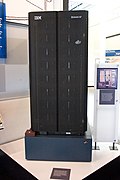
👁 Image 6Deep Blue was a chess-playing expert system run on a unique purpose-built IBM supercomputer. It was the first computer to win a game, and the first to win a match, against a reigning world champion under regular time controls. Photo taken at the Computer History Museum.Deep Blue was a chess-playing expert system run on a unique purpose-built IBM supercomputer. It was the first computer to win a game, and the first to win a match, against a reigning world champion under regular time controls. Photo taken at the Computer History Museum.
-
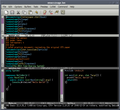
GNOME Shell, GNOME Clocks, Evince, gThumb and GNOME Files at version 3.30, in a dark theme
-
A view of the GNU nano Text editor version 6.0
-
👁 Image 9Grace Hopper at the UNIVAC keyboard, c. 1960. Grace Brewster Murray: American mathematician and rear admiral in the U.S. Navy who was a pioneer in developing computer technology, helping to devise UNIVAC I. the first commercial electronic computer, and naval applications for COBOL (common-business-oriented language).Grace Hopper at the UNIVAC keyboard, c. 1960. Grace Brewster Murray: American mathematician and rear admiral in the U.S. Navy who was a pioneer in developing computer technology, helping to devise UNIVAC I. the first commercial electronic computer, and naval applications for COBOL (common-business-oriented language).
-
👁 Image 10Margaret Hamilton standing next to the navigation software that she and her MIT team produced for the Apollo Project.Margaret Hamilton standing next to the navigation software that she and her MIT team produced for the Apollo Project.
-
A lone house. An image made using Blender 3D.
-
A head crash on a modern hard disk drive
-
👁 Image 13Output from a (linearised) shallow water equation model of water in a bathtub. The water experiences 5 splashes which generate surface gravity waves that propagate away from the splash locations and reflect off of the bathtub walls.Output from a (linearised) shallow water equation model of water in a bathtub. The water experiences 5 splashes which generate surface gravity waves that propagate away from the splash locations and reflect off of the bathtub walls.
-
👁 Image 14Stephen Wolfram is a British-American computer scientist, physicist, and businessman. He is known for his work in computer science, mathematics, and in theoretical physics.Stephen Wolfram is a British-American computer scientist, physicist, and businessman. He is known for his work in computer science, mathematics, and in theoretical physics.
-
An IBM Port-A-Punch punched card
-
Bill Gosper's Glider Gun in action





_in_Dark_theme.png)









Did you know? - load more entries


- ... that the study of selection algorithms has been traced to an 1883 work of Lewis Carroll on how to award second place in single-elimination tournaments?
- ... that it took a particle accelerator and machine-learning algorithms to extract the charred text of PHerc. Paris. 4 without unrolling it?
- ... that NATO was once targeted by a group of "gay furry hackers"?
- ... that Perfectly Imperfect's social media platform has a main feed that is presented in reverse chronological order and is not algorithmically curated?
- ... that both Thackeray and Longfellow bought paintings by Fanny Steers?
- ... that the Gale–Shapley algorithm was used to assign medical students to residencies long before its publication by Gale and Shapley?
Subcategories


WikiProjects


- There are many users interested in computer programming, join them.
Computer programming news
- 3 May 2026 –
- The Russian Ministry of Industry and Trade will restrict supplies of popular computers starting 27 May 2026. (Reporter)
- 15 April 2026 –
- Shoe company Allbirds announces it will be pivoting to providing computing infrastructure for artificial intelligence, with plans to rename itself to "NewBird AI". The company's shares rose nearly 600% on the news. (CNBC)
Topics


Related portals


Associated Wikimedia
The following Wikimedia Foundation sister projects provide more on this subject:
-
Commons
Free media repository -
Wikidata
Free knowledge base -
Wikiquote
Collection of quotations -
Wikisource
Free-content library -
Wikiversity
Free learning tools -
Wiktionary
Dictionary and thesaurus


