This article needs additional citations for verification. Please help improve this article by adding citations to reliable sources. Unsourced material may be challenged and removed. Find sources: "Qalaichi" – news · newspapers · books · scholar · JSTOR (January 2016) (Learn how and when to remove this message) |


سه گردان، قلایچی ، قلایه چی Ghalay-chi | |
| 👁 Image Glazed tile excavated by B. Kargar from Qalaichi in the Urmia Museum. Depicted is a winged sphinx. | |
| Location | Bukan, Iran |
|---|---|
| Region | West Azerbaijan province |
| Coordinates | 36°34′13″N 46°16′31″E / 36.57028°N 46.27528°E / 36.57028; 46.27528 |
| Type | settlement |
| Length | 93m |
| Width | 102m |
| Height | 1507m |
| History | |
| Material | stone, mud brick, baked brick |
| Founded | 9th-7th century BCE |
| Abandoned | ? |
| Periods | Mannean |
| Cultures | Iron Age II and III |
| Associated with | 0 |
| Site notes | |
| Excavation dates | 1985, 1999-2006 |
| Archaeologists | E. Yaghmaei, B.Kargar |
| Condition | plundered, later excavated |
| Ownership | public |
| Public access | accessible |


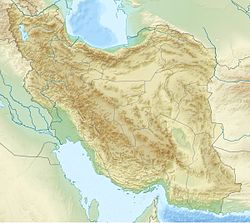

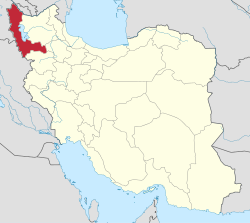
Qalaichi, Ghalay-chi, قلایچی in Persian (UTM 38S 615552 m E 4046795 m N) is an important archaeological site for the Iron Age of north-western Iran. It is a mound 11 metres (36 ft) high, situated about 9 kilometres (5.6 mi) north-west of Bukan City in West Azerbaijan Province 18 kilometres (11 mi) away from the border of Kurdistan province. The site is located near a village from whence it got its name. Hills and mountains surround it; the highest one in the east is the so-called Kal-Tage.
Modern Qalaichi may have been Zirta/Izirta, the capital of the Mannaean Kingdom.[1]: 106 The main period of occupation extended from the 9th to 7th centuries BCE.
Discoveries
[edit]Key archaeological finds include a stele inscribed with an Aramaic text.[2] The stele is dated to around 700 BCE.[1]: 106 It is a fragment consisting of "most likely either a dedicatory or memorial inscription set up by the local ruler."[1]: 105 The use of Aramaic, the lingua franca of the neighboring Assyrian Empire, suggests that Aramaic was prestigious among Mannaean elites around the time the stele was erected, but does not necessarily indicate wider adoption of Aramaic in Mannaea.[3]: 118 The surviving fragment fails to record any personal names, but does record the names of the Urartian god Ḫaldi and the god Hadad from Ancient Semitic religion, as well as a place name rendered as Ztr.[3] This place name was suggested by M. A. Lemaire to correspond to Zirta/Izirta.[1]: 106
In addition, the ancient settlement yielded a large number of glazed objects. Some of these objects are monochrome and the others show complex compositions.[4] The excavated artifacts are now in the collections of Urmia Museum and Tehran National Museum.
References
[edit]- ^ a b c d Sokoloff, Michael (1999). "The Old Aramaic Inscription from Bukān: A Revised Interpretation". Israel Exploration Journal. 49 (1/2): 105–115. ISSN 0021-2059.
- ^ M. A. Lemaire, L'inscription araméenne de Bukân et son intérêt historique, in Comptes rendus des séances de l'Académie des Inscriptions et Belles-Lettres, Année, vol.142,1998: 293-300; E. Yaghmaei, Discovery of a three thousand years old temple at Bukan, Keyhan Newspaper, Thursday, 11 March 1985, 9 (in Persian).
- ^ a b Ephʿal, Israel (1999). "The Bukān Aramaic Inscription: Historical Considerations". Israel Exploration Journal. 49 (1/2): 116–121. ISSN 0021-2059.
- ^ B. Kargar, Qalaychi/Izirtu: a Mannean center, Period Ib, in M. Azarnoush (ed.), Proceedings of International Symposium on Iranian Archaeology: North-western Region, Tehran, 2004, 229–45(in Persian).
External links
[edit]- Mannaean glazed bricks from Bukan Archived 2011-06-28 at the Wayback Machine


- Mannaean glazed bricks from Bukan Archived 2011-06-28 at the Wayback Machine