


Partial or simplified ergolines and lysergamides are analogues of ergolines and lysergamides like the psychedelic drug LSD in which one or more atoms or bonds, for instance within the ergoline ring system, have been removed.[1][2][3][4] Additional substitutions may also be added, for instance on the A ring of the ergoline nucleus.[1][2][3] It is notable that the ergoline ring system contains embedded tryptamine and phenethylamine moieties within its structure, and so some partial ergolines are simple tryptamines, cyclized tryptamines, simple phenethylamines, and/or cyclized phenethylamines.
In terms of pharmacology, partial lysergamides include serotonin and dopamine receptor agonists. Some, like NDTDI (9-nor-LSD), DEMPDHPCA (dides-B,C-LSD), DEIMDHPCA (4-nor-LSD), and LPH-5 ((S)-2C-TFM-3PIP), are serotonin 5-HT2A receptor agonists and have psychedelic-like and/or psychoplastogenic effects. Some, like 8-OH-DPAT, LY-178210 (LY-228729; 4,α-methylene-5-carboxamido-DPT), Bay R 1531 (LY-197206; 4,α-methylene-5-MeO-DPT), and LY-293284 (4,α-methylene-5-acetyl-DPT), are selective serotonin 5-HT1A receptor agonists. Others, like ropinirole, rotigotine, nolomirole, and RU-28251 (4,α-methylene-DPT), are dopamine D2-like receptor agonists. Though limitedly studied, partial ergolines have generally shown markedly reduced potency in terms of hallucinogen-like effects compared to LSD.[5]
Examples of partial lysergamides that are simple tryptamines include N-DEAOP-NMT (9,10-dinor-LSD) and 5-MeO-N-DEAOP-NMT and examples that are simple phenethylamines include N-DEAOP-NMPEA and 25D-NM-NDEAOP. An example of a cyclized tryptamine-like compound is DEIMDHPCA, while examples of cyclized phenethylamines include DEMPDHPCA, DEMPDHPCA-2C-D, and LPH-5. Some, like 8-OH-DPAT and rotigotine, are 2-aminotetralins. Others, like NDTDI and LY-178210, are tricyclic compounds that contain both tryptamine and phenethylamine components. Tochergamine is a simplified analogue of ergometrine that was studied as an oxytocic agent but was abandoned.
-
The tryptamine moiety.
-
The phenethylamine moiety.


List of simplified or partial lysergamides
[edit]| Structure | Name | Chemical name | CAS # |
|---|---|---|---|
| 👁 Image |
Descarboxylysergic acid (DCLA; 9,10-didehydro-6-methylergoline) | (6aR)-7-methyl-6,6a,8,9-tetrahydro-4H-indolo[4,3-fg]quinoline | 51867-17-5 |
| 👁 Image |
NDTDI (9-desmethine-LSD; 9-nor-LSD; 8,10-seco-LSD) | N,N-diethyl-3-(methyl(1,3,4,5-tetrahydrobenzo[cd]indol-4-yl)amino)propanamide | ? |
| 👁 Image |
RU-28251 (4,α-methylene-DPT)[6][7] | N,N-dipropyl-1,3,4,5-tetrahydrobenzo[cd]indol-4-amine | ? |
| 👁 Image |
Bay R 1531 (LY-197206; 4,α-methylene-5-MeO-DPT) | 1,3,4,5-tetrahydro-6-methoxy-N,N-dipropyl-benz[cd]indol-4-amine | 98770-54-8 |
| 👁 Image |
LY-293284 (4,α-methylene-5-acetyl-DPT) | (4R)-6-acetyl-4-(di-n-propylamino)-1,3,4,5-tetrahydrobenz[c,d]indole | 141318-62-9 |
| 👁 Image |
LY-178210 (LY-228729; 4,α-methylene-5-carboxamido-DPT) | 4-(dipropylamino)-1,3,4,5-tetrahydrobenzo[cd]indole-6-carboxamide | 114943-19-0 |
| 👁 Image |
LY-301317 ((R)-4,α-methylene-5-(1,3-oxazol-5-yl)-DPT) | (4R)-6-(1,3-oxazol-5-yl)-N,N-dipropyl-1,3,4,5-tetrahydrobenzo[cd]indol-4-amine | ? |
| 👁 Image |
RU-28306 (4,α-methylene-DMT) | N,N-dimethyl-1,3,4,5-tetrahydrobenzo[cd]indol-4-amine | 73625-11-3 |
| 👁 Image |
6-MeO-RU-28306 (4,α-methylene-5-MeO-DMT)[8][9] | 6-methoxy-N,N-dimethyl-1,3,4,5-tetrahydrobenzo[cd]indol-4-amine | ? |
| 👁 Image |
RU-27849 (4,α-methylene-T) | 1,3,4,5-tetrahydrobenzo[cd]indol-4-amine | 77963-70-3 |
| 👁 Image |
FHATHBIN (4,α-methylene-5-HT; 6-HO-RU-27849) | 6-hydroxy-1,3,4,5-tetrahydrobenzo[cd]indol-4-amine | ? |
| 👁 Image |
6-MeO-RU-27849 (4,α-methylene-5-MT)[10][11][12] | 6-methoxy-1,3,4,5-tetrahydrobenzo[cd]indol-4-amine | ? |
| 👁 Image |
N-DEAOP-NMT (desvinyl-LSD; 9,10-dinor-LSD) | N-(3-diethylamino-3-oxopropyl)-N-methyltryptamine | |
| 👁 Image |
N-DEAOP-NET (desvinyl-ETH-LAD; 9,10-dinor-ETH-LAD) | N-(3-diethylamino-3-oxopropyl)-N-ethyl-5-tryptamine | |
| 👁 Image |
N-DEAOP-5-MeO-NMT | N-(3-diethylamino-3-oxopropyl)-N-methyl-5-methoxytryptamine | |
| 👁 Image |
N-DEAOP-5-MeO-NET | N-(3-diethylamino-3-oxopropyl)-N-ethyl-5-methoxytryptamine | |
| 👁 Image |
10,11-Seco-LSD[13] | 9,10-didehydro-N,N-diethyl-6-methyl-10,11-secoergoline-8β-carboxamide | 2640392-96-5 |
| 👁 Image |
CT-5252 | methyl-12-bromo-8,9-didehydro-2,3β-dihydro-6-methyl-10,11-secoergoline-8-carboxylate | |
| 👁 Image |
10,11-Secoergoline (α,N-tetramethylene-T) | 3-(piperidin-2-ylmethyl)-1H-indole | 5275-05-8 |
| 👁 Image |
FAEFHI | 4-(2-aminoethyl)-1H-indol-5-ol | |
| 👁 Image |
4-API | 4-(2-aminopropyl)indole | 21005-59-4 |
| 👁 Image |
DMAI (4-DMAEI; BD-214) | 4-(N,N-dimethylaminoethyl)indole | 84401-01-4 |
| 👁 Image |
DEAI (4-DEAEI; BD-271) | 4-(N,N-diethylaminoethyl)indole | ? |
| 👁 Image |
DPAI (4-DPAEI; 2-desoxo-2-ene-ropinirole; BD-179) | 4-(N,N-dipropylaminoethyl)indole | 76149-15-0 |
| 👁 Image |
Ropinirole (SK&F-101468) | 4-[2-(dipropylamino)ethyl]-1,3-dihydro-2H-indol-2-one | 91374-21-9 |
| 👁 Image |
7-Hydroxyropinirole (SK&F-89124) | 4-[2-(dipropylamino)ethyl]-7-hydroxy-1,3-dihydroindol-2-one | 81654-62-8 |
| 👁 Image |
DEIMDHPCA (4-desmethylene-LSD; 4-nor-LSD; 3,5-seco-LSD) | (3R)-N,N-diethyl-5-(1H-indol-4-yl)-1-methyl-3,6-dihydro-2H-pyridine-3-carboxamide | 2640392-28-3 |
| 👁 Image |
RU-27251 (3,5-secoergoline)[14] | 4-piperidin-3-yl-1H-indole | 16176-75-3 |
| 👁 Image |
WXVL_BT0793LQ2118[15][16] | 6-fluoro-4-(1-methyl-1,2,5,6-tetrahydropyridin-3-yl)-1H-indole | ? |
| 👁 Image |
Diaza-2C-DFLY | 8-(aminoethyl)-1,5-dihydropyrrolo[2,3-f]indole | |
| 👁 Image |
DEMPDHPCA (dides-B,C-LSD; 1-deaza-2,3,4-trinor-LSD)[17][13] | N,N-diethyl-1-methyl-5-phenyl-3,6-dihydro-2H-pyridine-3-carboxamide | |
| 👁 Image |
DEMPDHPCA-PMA[17] | N,N-diethyl-1-methyl-3-(4-methoxyphenyl)-1,2,5,6-tetrahydropyridine-5-carboxamide | |
| 👁 Image |
DEMPDHPCA-M (DEMPDHPCA-mescaline)[17] | N,N-diethyl-1-methyl-3-(3,4,5-trimethoxyphenyl)-1,2,5,6-tetrahydropyridine-5-carboxamide | |
| 👁 Image |
DEMPDHPCA-NAP[17] | N,N-diethyl-1-methyl-3-(1-naphthyl)-1,2,5,6-tetrahydropyridine-5-carboxamide | |
| 👁 Image |
DEMPDHPCA-2C-D[2] | 1-methyl-3-(1-oxo-1-diethylaminomethyl)-5-(2,5-dimethoxy-4-methylphenyl)-3,6-dihydro-2H-pyridine | |
| 👁 Image |
"Compound XXIII"[3][18][19] | ? | ? |
| 👁 Image |
2C-B-3PIP | 3-(4-bromo-2,5-dimethoxyphenyl)piperidine | ? |
| 👁 Image |
LPH-5 ((S)-2C-TFM-3PIP) | (S)-3-(2,5-Dimethoxy-4-(trifluoromethyl)phenyl)piperidine | 2641630-97-7 |
| 👁 Image |
"Compound 163" or "VIII"[17][20][21] | N,N-diethyl-4-methyl-2,3,4,4a,5,6-hexahydrobenzo(f)quinoline-2-carboxamide | |
| 👁 Image |
Debenzergoline (propyldebenzergoline) | trans-(±)-2,3,4,4a,5,7,9,9a-octahydro-1-propyl-1H-pyrrolo[3,4-g]quinoline | |
| 👁 Image |
N-DEAOP-PEA (PEA-NDEPA) | N-diethylaminocarbonylethylphenethylamine | |
| 👁 Image |
N-DEAOP-NMPEA (PEA-NM-NDEPA; 1-deaza-2,3,4,9-tetranor-LSD)[22] | N-diethylaminocarbonylethyl-N-methylphenethylamine | |
| 👁 Image |
3,4-DMPEA-NDEPA | N-diethylaminocarbonylethyl-3,4-dimethoxyphenethylamine | |
| 👁 Image |
M-NDEPA (mescaline-NDEPA)[23] | N-diethylaminocarbonylethyl-3,4,5-trimethoxyamphetamine | ? |
| 👁 Image |
DOM-NDEPA[24] | N-diethylaminocarbonylethyl-2,5-dimethoxy-4-methylamphetamine | ? |
| 👁 Image |
DOB-NDEPA[25] | N-diethylaminocarbonylethyl-2,5-dimethoxy-4-bromoamphetamine | 260810-30-8 |
| 👁 Image |
DOI-NDEPA[25] | N-diethylaminocarbonylethyl-2,5-dimethoxy-4-iodoamphetamine | 260810-31-9 |
| 👁 Image |
DOTFM-NDEPA[25] | N-diethylaminocarbonylethyl-2,5-dimethoxy-4-trifluoromethylamphetamine | 260810-29-5 |
| 👁 Image |
TMA-2-NDEPA[26] | N-diethylaminocarbonylethyl-2,4,5-trimethoxyphenethylamine | |
| 👁 Image |
25D-NM-NDEAOP (25D-NM-NDEPA) | N-methyl-N-(3-diethylamino-3-oxopropyl)-2,5-dimethoxy-4-methylphenethylamine | |
| 👁 Image |
2-Aminotetralin (2-AT) | 1,2,3,4-tetrahydronaphthalen-2-amine | 2954-50-9 |
| 👁 Image |
CHF-1024 | 5,6-dihydroxy-N-methyl-2-aminotetralin | 39478-89-2 |
| 👁 Image |
Nolomirole (CHF-1035) | 5,6-diisobutyryloxy-N-methyl-2-aminotetralin | 90060-42-7 |
| 👁 Image |
5-OH-DPAT | 5-hydroxy-N,N-dipropyl-2-aminotetralin | 68593-96-4 |
| 👁 Image |
7-OH-DPAT | 7-hydroxy-N,N-dipropyl-2-aminotetralin | 74938-11-7 |
| 👁 Image |
8-OH-DPAT | 8-hydroxy-N,N-dipropyl-2-aminotetralin | 78950-78-4 |
| 👁 Image |
UH-301 | (S)-5-fluoro-8-hydroxy-N,N-dipropyl-2-aminotetralin | 127126-22-1 |
| 👁 Image |
UH-232 | (1S,2R)-5-methoxy-1-methyl-N,N-propyl-2-aminotetralin | 95999-12-5 |
| 👁 Image |
Rotigotine | 6-[propyl(2-thiophen-2-ylethyl)amino]-5,6,7,8-tetrahydronaphthalen-1-ol | 99755-59-6 |
| 👁 Image |
THPC | N,N-diethyl-1-methyl-3,6-dihydro-2H-pyridine-5-carboxamide | 26070-52-0 |
| 👁 Image |
Nikethamide | N,N-diethyl-3-pyridinecarboxamide | 59-26-7 |


_vertical_structure.svg)

_vertical_structure.svg)


_structure.svg)


_structure.svg)


Structural comparisons
[edit]-
LSD (left) and N-DEAOP-NMPEA (right) structures.
-
LSD (left) and N-DEAOP-NMT (right) structures.
-
25D-NM-NDEAOP (left), DOM-NDEPA (middle), and LSD (right) structures.
-
DEMPDHPCA (left) and LSD (right) structures.
-
LSD (left) and 10,11-seco-LSD (right) structures.


,_DOM-NDEPA,_and_LSD_structures.png)


Related compounds
[edit]| Structure | Name | Chemical name | CAS # |
|---|---|---|---|
| 👁 Image |
Chanoclavine (chanoclavine-I) | [9(9a)E]-9-methyl-9,9a-didehydro-7,8-seco-9a-homoergolin-8-ol | 2390-99-0 |
| 👁 Image |
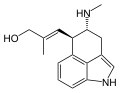
Chanoclavine II | (2E)-2-methyl-3-[(4R,5S)-4-(methylamino)-1,3,4,5-tetrahydrobenzo[cd]indol-5-yl]prop-2-en-1-ol | 1466-08-6 |
| 👁 Image |
Paliclavine | (9R)-6,8-dimethyl-7,8-didehydro-6,7-secoergolin-9-ol | 52052-66-1 |
| 👁 Image |
DLX-0002700 (see DLX-2270)[27][28] | 6-fluoro-N,5-dimethyl-1-azatricyclo[6.3.1.04,12]dodeca-2,4(12),5,7-tetraen-10-amine | ? |
| 👁 Image |
Compound 21 [29][30] | (10S)-3-bromo-N,N-dimethyl-1-azatricyclo[6.3.1.04,12]dodeca-2,4,6,8(12)-tetraen-10-amine | 3091662-68-6 |
| 👁 Image |
2C-B-5-hemiFLY-α6 (BNAP) | 8-bromo-6-methoxy-2a,3,4,5-tetrahydro-2H-naphtho[1,8-bc]furan-4-amine | ? |
| 👁 Image |
DOB-5-hemiFLY (bromo-semi-fly; B-SF; 5-MeO-7-Br-4-APDB) | 1-(7-bromo-5-methoxy-2,3-dihydro-1-benzofuran-4-yl)propan-2-amine | 178557-10-3 |
| 👁 Image |
2C-B-morpholine | 2-(4-bromo-2,5-dimethoxyphenyl)morpholine | 807631-07-8 |
| 👁 Image |
Naxagolide | (4aR,10bR)-4-propyl-2,3,4a,5,6,10b-hexahydrobenzo[h][1,4]benzoxazin-9-ol | 88058-88-2 |
| 👁 Image |
S32504 | (4aR,10bR)-4-propyl-2,3,4a,5,6,10b-hexahydrobenzo[h][1,4]benzoxazine-9-carboxamide | ? |
| 👁 Image |
Pardoprunox | 7-(4-methylpiperazin-1-yl)-3H-1,3-benzoxazol-2-one | 269718-84-5 |
| 👁 Image |
Bifeprunox | 7-[4-(biphenyl-3-ylmethyl)piperazin-1-yl]-1,3-benzoxazol-2(3H)-one | 350992-10-8 |
| 👁 Image |
Quinpirole | (4aR,8aR)-5-propyl-1,4,4a,6,7,8,8a,9-octahydropyrazolo[5,4-g]quinoline | 80373-22-4 |
| 👁 Image |
Quinelorane | (5aR,9aR)-6-propyl-5a,7,8,9,9a,10-hexahydro-5H-pyrido[2,3-g]quinazolin-2-amine | 97466-90-5 |
| 👁 Image |
Quinagolide | N,N-diethyl-N-[(3S,4aS,10aR)-6-hydroxy-1-propyl-1,2,3,4,4a,5,10,10a-octahydrobenzo[g]quinolin-3-yl]sulfamide | 87056-78-8 |
| 👁 Image |
25B-NAcPip | N-(piperidin-1-ylcarbonylmethyl)-4-bromo-2,5-dimethoxyphenethylamine | |
| 👁 Image |
25B-NBOMe | N-(2-methoxybenzyl)-4-bromo-2,5-dimethoxyphenethylamine | 1026511-90-9 |
| 👁 Image |
"Compound 37"[31][2][32] | N-(2-diethylamino-2-oxoethyl)-N-methyl-2-amino-1,2,3,4,4a,8a-hexahydronaphthalene | |
| 👁 Image |
Tochergamine | N,N-diethyl-2-(1,2,3,4-tetrahydronaphthalen-1-ylamino)acetamide |



_structure_vertical.svg)


See also
[edit]- Nor-LSD (disambiguation)
- Seco-LSD
- Secoergoline
- Substituted lysergamide
- Substituted tryptamine
- Substituted phenethylamine
References
[edit]- ^ a b Shulgin AT (1976). "Psychotomimetic Agents". In Gordon M (ed.). Psychopharmacological Agents: Use, Misuse and Abuse. Medicinal Chemistry: A Series of Monographs. Vol. 4. Academic Press. pp. 59–146. doi:10.1016/b978-0-12-290559-9.50011-9. ISBN 978-0-12-290559-9.
The largest number of structural analogs of LSD that have been prepared involve the opening of one or more of the rings of the parent lysergic acid system. The compounds with the piperidine ring (ring D) opened [see (I)] are encountered as natural products in the several Convolvulaceae discussed in Section II,B on ololiuqui. The opening of ring C (by cleavage of the 10-11 bond to the indole "4 position") results in a series of N-α-disubstituted tryptamines. Additionally, analogs are known with the indolic nitrogen replaced with sulfur (benzothiophenes) and with an aliphatic chain (tetralins). A recent review covers this chemistry (Campaigne and Knapp, 1971), but there is apparently no human psychopharmacology as yet known.
- ^ a b c d Nichols DE (May 1973). Potential Psychotomimetics: Bromomethoxyamphetamines and Structural Congeners of Lysergic Acid (Thesis). University of Iowa. p. 23. OCLC 1194694085. Archived from the original on 2025-04-06. Retrieved 2025-06-01.
- ^ a b c Campaigne E, Knapp DR (June 1971). "Structural analogs of lysergic acid". J Pharm Sci. 60 (6): 809–814. doi:10.1002/jps.2600600602. PMID 4942861.
- ^ Nichols DE, Oberlender R, McKenna DJ (1991). "Stereochemical Aspects of Hallucinogenesis". In Watson RR (ed.). Biochemistry and Physiology of Substance Abuse. Vol. 3. Boca Raton, Fla.: CRC Press. pp. 1–39. ISBN 978-0-8493-4463-3. OCLC 26748320.
- ^ Brimblecombe RW, Pinder RM (1975). "Indolealkylamines and Related Compounds". Hallucinogenic Agents. Bristol: Wright-Scientechnica. pp. 98–144 (128). ISBN 978-0-85608-011-1. OCLC 2176880. OL 4850660M. Archived from the original on 2025-05-27. Retrieved 2025-06-02.
Various attempts to simplify the LSD structure by breaking it down into molecular fragments have, with the exception of the tryptamines, generally led to profoundly deleterious effects on the hallucinogenic activity (Campaigne and Knapp, 1971).
- ^ Euvrard, Catherine; Ferland, Louise; Fortin, Michel; Oberlander, Claude; Labrie, Fernand; Boissier, Jacques R. (1981). "Dopaminergic activity of some simplified ergoline derivatives". Drug Development Research. 1 (2): 151–161. doi:10.1002/ddr.430010208. ISSN 0272-4391.
- ^ "N,N-dipropyl-1,3,4,5-tetrahydrobenzo[cd]indol-4-amine". PubChem. Retrieved 21 March 2025.
- ^ "6-methoxy-N,N-dimethyl-1,3,4,5-tetrahydrobenzo[cd]indol-4-amine". PubChem. Retrieved 13 February 2026.
- ^ Flaugh ME, Mullen DL, Fuller RW, Mason NR (September 1988). "6-substituted 1,3,4,5-tetrahydrobenz[cd]indol-4-amines: potent serotonin agonists". J Med Chem. 31 (9): 1746–1753. doi:10.1021/jm00117a013. PMID 2457705.
- ^ https://pubchem.ncbi.nlm.nih.gov/compound/11138151
- ^ https://doi.org/10.1007/3-540-45564-7_1
- ^ Mukherjee, Joydeep; Menge, Miriam (2000). "Progress and Prospects of Ergot Alkaloid Research". New Products and New Areas of Bioprocess Engineering. Vol. 68. Berlin, Heidelberg: Springer Berlin Heidelberg. p. 1–20. doi:10.1007/3-540-45564-7_1. ISBN 978-3-540-67362-0. Retrieved 13 June 2026.
- ^ a b WO 2021076572, David E. Olson; Lee Dunlap & Florence Wagner et al., "Ergoline-like compounds for promoting neural plasticity", published 22 April 2021, assigned to Delix Therapeutics, Inc. and The Regents of the University of California
- ^ "4-(Piperidin-3-yl)-1H-indole". PubChem. Retrieved 24 March 2025.
- ^ "6-fluoro-4-(1-methyl-3,6-dihydro-2H-pyridin-5-yl)-1H-indole". PubChem. Retrieved 26 May 2026.
- ^ Lyu J, Kapolka N, Gumpper R, Alon A, Wang L, Jain MK, Barros-Álvarez X, Sakamoto K, Kim Y, DiBerto J, Kim K, Tummino TA, Huang S, Irwin JJ, Tarkhanova OO, Moroz Y, Skiniotis G, Kruse AC, Shoichet BK, Roth BL (March 2024). "AlphaFold2 structures template ligand discovery". bioRxiv 10.1101/2023.12.20.572662.
- ^ a b c d e Mangner TJ (1978). Potential Psychotomimetic Antagonists. N,n -diethyl-1-methyl-3-aryl-1, 2, 5, 6-tetrahydropyridine-5-carboxamides (Ph.D. thesis). University of Michigan. doi:10.7302/11268. Archived from the original on 30 March 2025.
Table 1. Human psychotomimetic potencies of LSD analogs. [...]
- ^ Plieninger, Hans (1953). "Die Synthese von Modellsubstanzen für die Lysergsäure I. Mitteilung". Chemische Berichte. 86 (1): 25–31. doi:10.1002/cber.19530860106. ISSN 0009-2940. Retrieved 2 June 2025.
Die Synthese der 1.6-Dimethyl-5-[4-methoxy-phenyl]-pyridin- carbonsäure-(3), ihres Tetrahydro- und Hexahydro-Derivates, sowie einer Reihe anderer uterusaktivor Amine Wird beschrieben. [...] Da die Verbindungen V und VI auf den Kaninchenuterus in situ auch nur eine verhaltnismäßig schwache Wirkung ausüben, wurde versucht, der LysergsäureeKonstitution näherzukommen. Bekanntlich tritt bei den hydrierten Mutterkornalkaloiden die Uteruswirkung zugunsten der sympaticolytischen Wirkung zurück. In der Annahme, daß die Uteruswirksomkeit auch bei unseren Modellsubstanzen durch die Doppelbindung in 3.4-Stellung gesteigert wird, haben wir die Verbindung XIV und XV nach dem folgenden Formelschema synthetisiert. Vorher hotten wir vergeblich versucht, die Pyridine Verbindung X bzw. ihr Methosulfat partiell zu hydrieren. [...] Die Einwirkung von p-Methoxy-phenyl-magnesiumbromid11) auf einen Überschuß an Ketoester führt zu dem nicht kristallisierenden tert. Alkohol XIV, wobei die größere. Reaktionsfähigkeit der Ketogruppe gegenüber der Estergruppe ausgenützt wird. Durch Wasserabspaltung mittels Thionylchlorids in Pyridin12) erhält man in mäßiger Ausbeute ein schön kristallisiertes Oxalat der Formel XV bzw. XVI. Eine Entscheidung, in welcher Richtung die Wasserabspaltung erfolgt ist, steht vorläufig noch aus. Die Verbindung zeigte sich in ihrer pharmakologischen Wirkung den gesättigten Derivaten V und VI deutlich überlegen.
- ^ "COc1ccc(cc1)C2=CC(CN(C)C2C)C(O)=O". MolView. Retrieved 2 June 2025.
- ^ Horii Z, Kurihara T, Yamamoto S, Ninomiya I (November 1967). "Studies on ergot alkaloids and related compounds. XIV. Synthesis of N-alkyl-4-methyl-2,3,4,4a,5,6-hexahydrobenzo[f]quinoline-2-carboxamides and stereochemistry of diethyl 4-methyl-1-oxo-1,2,3,4,4a,5,6,10b-octahydro-benzo[f]quinoline-2,2-dicarboxylate". Chem Pharm Bull (Tokyo). 15 (11): 1641–1650. doi:10.1248/cpb.15.1641. PMID 5583819.
Our previous report1) introduced the synthesis of a potent oxytocic ethyl 4-methyl-2,3,4,4a,5,6-hexahydrobenzo[f]quinoline-2-carboxylate (VII). Recently, Ohta and his coworkers also prepared V] by a convenient method starting from the Mannich product (II). However, they did not deal with the stereochemistry of the compounds involved. In the course of work searching for compounds with potent activity related to lysergic acid, we now wish to describe two routes of preparations of diethyl-, n-butyl- and 2-hydroxyisopropylamide derivatives of VI, which can be regarded as LSD25 analogs lacking only a pyrrole ring, and also discuss the stereochemistry of this series of compounds. [...] Of these amide derivatives, the diethylamide (VIII) was also prepared by an alternative route as follows. [...] Experimental. [...] N,N-Diethyl-4-methyl-2,3,4,4a,5,6-hexahydrobenzo(f)quinoline-2-carboxamide (VIII)—[...]
- ^ "1829 - PiHKAL·info". Isomer Design. 26 February 2025. Retrieved 24 March 2025.
- ^ Norris PE, Blicke FF (December 1952). "Potential ergot substitutes: esters and amides of beta-amino acids". J Am Pharm Assoc. 41 (12): 637–639. doi:10.1002/jps.3030411204. PMID 13022416.
Six esters and amides of derivatives of β-alanine which are related to lysergic acid have been prepared and tested for oxytocic activity. None of these products possess a significant oxytocic activity. [...] The purpose of this investigation was to synthesize amides and also esters of compounds (II–V) which represent fragments of the lysergic acid molecule in the hope that some of these products might possess oxytocic activity. Various modified fragments of the lysergic acid molecule have been synthesized previously; it was claimed that some of the compounds are active oxytocics (1—7). [...] Pharmacologic data indicated that none of the esters or amides of compounds II—V which were prepared possess a significant oxytocic action when compared to the clinically used oxytocics. However, the diethylamide of N-methyl-N-[β′-(3-indolyl)-ethyl]-β-alanine (IIIc) appeared to have an oxytocic activity approximately ten times stronger than that of the diethylamide of N-methyl-N-(β′-phenethyl)-β-alanine (IIc).
- ^ "PiHKAL·info - M-NDEPA". Isomer Design. 28 February 2025. Retrieved 24 March 2025.
- ^ "PiHKAL·info". DOM-NDEPA. 28 February 2025. Retrieved 24 March 2025.
- ^ a b c Schulze-Alexandru, Meike; Kovar, Karl-Artur; Vedani, Angelo (1999). "Quasi-atomistic Receptor Surrogates for the 5-HT2A Receptor: A 3D-QSAR Study on Hallucinogenic Substances" (PDF). Quantitative Structure-Activity Relationships. 18 (6): 548–560. doi:10.1002/(SICI)1521-3838(199912)18:6<548::AID-QSAR548>3.0.CO;2-B. ISSN 0931-8771. Retrieved 1 April 2025.
Table 3. New phenylalkylamine and tryptamine congeners. Cf. also Figure 5. [...] Figure 5. Molecular structures of the new 5-HT2A congeneric ligands. Cf. also Table 3. [...] Table 4. Predicted binding affinities of new compounds, index by substance classes. [...]
- ^ "TMA-2-NDEPA". Isomer Design. 28 February 2025. Retrieved 24 March 2025.
- ^ "6-fluoro-N,5-dimethyl-1-azatricyclo[6.3.1.04,12]dodeca-2,4(12),5,7-tetraen-10-amine". PubChem. Retrieved 2 April 2026.
- ^ "Mixed serotonin receptor binders for treatment of psychotic disorders". Google Patents. 20 December 2024. Retrieved 2 April 2026.
- ^ Sabnis RW. Novel Mixed Serotonin Receptor Binder Compounds as 5‑HT2C Agonists for Treating Psychotic Disorders. ACS Med Chem Lett. 2025 Jul 29;16(8):1505-1506. doi:10.1021/acsmedchemlett.5c00427 PMID 40832520
- ^ https://pubchem.ncbi.nlm.nih.gov/compound/176415137
- ^ Marini-Bettolo, G. B., Chiavarelli, S., & Bovet, D. (1951). Synthetic Sympatholytic Substances of the Ergotamine Series. I. Nitrogen-Substituted Derivatives of the dl-1, 2, 3, 4-Tetrahydro-2-Naphthylamine-Containing Amino and Amido Functional Groups. Gazz. Chim. Ital, 80, 281–298. https://scholar.google.com/scholar?cluster=2759784031777399013
- ^ "PiHKAL·info". search. 26 February 2025. Retrieved 24 March 2025.