
| This is the talk page for discussing improvements to the Cherry blossom article. This is not a forum for general discussion of the subject of the article. |
Article policies
|
| Find sources: Google (books · news · scholar · free images · WP refs) · FENS · JSTOR · TWL |
| Archives: 1 |
| 👁 Good articles | Cherry blossom has been listed as one of the Agriculture, food and drink good articles under the good article criteria. If you can improve it further, please do so. If it no longer meets these criteria, you can reassess it. Review: February 22, 2024. (Reviewed version). |


| 👁 Image | This 👁 Image level-5 vital article is rated GA-class on Wikipedia's content assessment scale. It is of interest to the following WikiProjects: | ||||||||||||||||||||||||||||||||||||||||||||||||||
| |||||||||||||||||||||||||||||||||||||||||||||||||||




| 👁 Image | A fact from Cherry blossom appeared on Wikipedia's Main Page in the Did you know column on 7 March 2024 (check views). The text of the entry was as follows:
|


|
Archives | |
|


Why is this article titled "Cherry blossom"?
[edit]Why is this article titled "Cherry blossom"? It should probably be titled "Japanese cherry". The article is defining the tree, not the blossom. A blossom is a flower that blooms on a tree. One admires the cherry blossoms, i.e. the flowers of the cherry tree.
It would seem popular usage has begun to refer to the trees themselves as "cherry blossoms". However, we don't call apple trees "apple blossoms", nor peach trees "peach blossoms". My theory is that "sakura" has been glossed as "cherry blossom" so often that people learning about Japan with little botanical knowledge have begun to refer to the trees themselves as "cherry blossoms". Encyclopedia Britannica properly refers to the trees as "cherries" or "cherry trees" and uses the term "ornamental" to describe the ornamental ones. There are also many gardener blogs and articles that claim that "cherry trees" and "cherry blossom trees" are different species of cherry.
This seems to be an arbitrary definition. I searched 19th century sources on Google Books, and there were only three books mentioning "cherry blossom tree", all in reference to Japanese cherries. There were a multitude more books referring to "Japanese cherries" or "Japanese cherry trees". All references to "cherry blossoms" I saw referred to the flowers of the tree. Wikipedia is a major source of information for many people and can influence the language, so I would suggest that we preserve the traditional distinction. The opening sentence "A cherry blossom also known as Japanese cherry or Sakura is a flower of many trees of genus Prunus or Prunus subg. Cerasus." is painful to read as it says that a cherry blossom is a flower, but is synonymous with Japanese cherry, the name of a tree. I propose we maintain the following distinction throughout the article:
blossoms, cherry blossoms, etc. -- refer to the flowers/blossoms
Japanese cherry, Japanese cherry tree, etc. -- refer to the tree
It's fine to say "a cherry blossom" or "cherry blossoms" in a context where "a flower", "a bundle of flowers" or "the flowers" would make sense as well. Many instances in this article use it correctly, but there are some instances where "cherry blossom" is used where a word for a tree ought to be used. For example,
"Books from that period recorded more than 200 varieties of cherry blossoms" ought to be "Books from that period recorded more than 200 varieties of flowering cherries" — Preceding unsigned comment added by 2600:6C64:507F:AA6C:197F:FBFB:AF5B:62A0 (talk) 15:16, 14 April 2022 (UTC)[]
- I think some of the above issues were fixed by recent copy editing.
- Portions of the text may have originally been translated from Japanese, with "sakura" replaced by "cherry blossom". I updated the lead section to explain that "sakura" can mean either the tree or the flowers. "Japanese cherry" could be used as a translation when "sakura" means the tree, but I don't think that would sound right in long sections about Japanese culture. Also, "Japanese cherry" seems to (increasingly?) be used as a common name for a particular species of tree, rather than meaning all sakura trees (I also tried to clarify this a bit in the lead section).
- "cherry blossom tree", "ornamental cherry tree" and "sakura tree" sound ok to me, in context. Having some variety in the phrasing possibly helps readability. KaiaVintr (talk) 02:50, 18 January 2024 (UTC)[]
Replace/Add Image
[edit]-
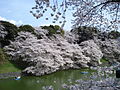
Original - Sakura at Tokyo Imperial Palace
-
👁 Replacement - Sakura within a field of Phlox subulata at Yachounomori Garden in Tatebayashi, GunmaReplacement - Sakura within a field of Phlox subulata at Yachounomori Garden in Tatebayashi, Gunma

%E3%81%A8%E8%8A%9D%E6%A1%9C(%E3%81%97%E3%81%B0%E3%81%96%E3%81%8F%E3%82%89).jpg)

Apparently there seems to be some resistance replacing the old image with the new image (both linked above). Initially I boldly added an image that I thought was supperior image of an ornamental use of a Sakura and replaced the image, which was reverted with the comment that the plant in the background was not a Sakura, which almost all the Sakura images on the page include other non-Sakura plants and objects so I re-added the image back. It was again reverted stating consensus must be reached to replace it. So lets discuss it. — raeky (talk | edits) 02:36, 8 October 2009 (UTC)[]
- responding to the comment in the recent edit why I swapped the image instead of just adding another: I was looking at it more like that there was already an over abundance of images, and one more might be too much. — raeky (talk | edits) 02:45, 8 October 2009 (UTC)[]
- Then how about to create a gallery like rose and Wisteria and make the article neat? Oda Mari (talk) 04:51, 8 October 2009 (UTC)[]
- Maybe or elimiate a few of the lower quality images. Some of the other images that might be removed/replaced/gallery'd I put below in a gallery with my comments. Maybe this would be a good opportunity to review the pictures in the article and look for new ones, I'm willing to rework/suggest new pictures for the article or change the arrangement of them if the work would be welcome. From my inital expereince of just trying to add an image is any indication this article may be too protected by it's editors? — raeky (talk | edits) 06:36, 8 October 2009 (UTC)[]
- Then how about to create a gallery like rose and Wisteria and make the article neat? Oda Mari (talk) 04:51, 8 October 2009 (UTC)[]
-
noisy, distracting background, not very high EV
-
Sakura not the focal point, not really contributing to the article?
-
👁 pretty picture, might deserve better placement in the article if one/both of the others are removed, otherwise it's just adding redundancy.pretty picture, might deserve better placement in the article if one/both of the others are removed, otherwise it's just adding redundancy.
-
Sakura makes up a very minor aspect of this image, great shot of the castle though.

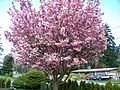


I stand by my earlier opinion that the field of moss pink in the background is too striking/distracting for an introductory picture, a casual reader might well think it's sakura as well and that cherry trees come in that flourescent shade as well. (Indeed, it's called shibazakura or "grass sakura" in Japanese, but scientifically it's entirely unrelated.) That said, it's fine for the gallery, and I'm no huge fan of the original. File:Newark cherry blossoms.jpg is quite striking, demonstrating the effect of cherry flowers en masse nicely, and would make a good replacement. I also agree that the first two pics in the gallery above are eminently disposable. Jpatokal (talk) 09:06, 8 October 2009 (UTC)[]
- So promote File:Newark_cherry_blossoms.jpg to lead, remove Image:Ornamental Cherry Tree In Full Bloom.JPG and File:Shidare sakura flowers.JPG (I also think File:Castle Himeji sakura01 adjusted.jpg should go too), create a gallery with some of the better remaining images? — raeky (talk | edits) 09:22, 8 October 2009 (UTC)[]
- I'd like some more opinion on if the Phlox in the background of File:Sakura and Moss Pink - 桜(さくら)と芝桜(しばざくら).jpg is too misleading to what Sakura is given the caption as well. — raeky (talk | edits) 09:26, 8 October 2009 (UTC)[]
- I think the color of moss pink is too loud and mars the color of cherry blossom. The purple at the bottom and the green in the middle are also disturbing. As for the Newark cherry blossoms, it surely is a striking photo, but it looks like a Commons:Prunus pendula or a double flowering cherry tree and IMHO it is not a typical cherry blossom image. And most importantly the color is too dark. When refer to the color of the cherry blossom, sakura-iro, is pale pink. See this traditional Japanese color page. #6 is sakura-iro/cherry blossom pink. And see the photos here. I hope you'll understand why I think, no matter how striking the Newark image is, the photo is not appropriate to use as a lead image. Oda Mari (talk) 15:15, 8 October 2009 (UTC)[]
- What you describe as "typical" is the classic someiyoshino (ソメイヨシノ) color, but it's by no means the only type of sakura, and this article isn't about the species anyway. Since the first image is someiyoshino (or at least something close to it), I think it's OK for the second to be a different variety. Part of the pinkness of the Newark pic, though, is caused by color balance -- the entire image is shifted to the red. Jpatokal (talk) 16:11, 8 October 2009 (UTC)[]
- I agree with Jpatokal, this page isn't about a specific species or color, it's about the blossom's of a cherry tree, all species, also the Newark image is color shifted to the red. I'll put it in photoshop and see about correcting the color balance. — raeky (talk | edits) 17:35, 8 October 2009 (UTC)[]
- Ok I tweaked the color balance some to be less red shifted, still pretty pink but looks better. — raeky (talk | edits) 17:40, 8 October 2009 (UTC)[]
- I agree with Jpatokal, this page isn't about a specific species or color, it's about the blossom's of a cherry tree, all species, also the Newark image is color shifted to the red. I'll put it in photoshop and see about correcting the color balance. — raeky (talk | edits) 17:35, 8 October 2009 (UTC)[]
- I'm going to boldly take on reworking the images later today (if not today then soon as I get time) per the discussion here unless theres any objections to doing that? — raeky (talk | edits) 17:07, 19 October 2009 (UTC)[]
- IMHO, tweaking the dolor balance is a dirty trick. Oda Mari (talk) 17:21, 19 October 2009 (UTC)[]
- I didn't change it unaturally I used a natural white point (girl with white pants) and a natural black point (black shirt) to establish the two white & black points on the color correction, that didn't unnaturally change the colors but made them more natural since it corrected any white balance issues the camera had when it took it. I'm well experienced in doing this kind of work, thanks. — raeky (talk | edits) 17:25, 19 October 2009 (UTC)[]
- IMHO, tweaking the dolor balance is a dirty trick. Oda Mari (talk) 17:21, 19 October 2009 (UTC)[]
Edible or inedible?
[edit]In the last paragraph of section 5 (Cultivars), a sentence reads:
All wild varieties of cherry blossom trees produce small, unpalatable fruit or edible cherries.
The grammar of this sentence suggests the cherries are inedible and does not distinguish fruit from cherries. I don't know how to improve it, and am asking for an expert to do so.
Please excuse the lack of markup code. Though I do know how, a gremlin has infested my keyboard.
Cwilsyn
Cwilsyn (talk) 02:21, 2 June 2022 (UTC)[]
Cherry blossom
[edit]Shillong is India's Cherry blossom hub during the months of winter. Every year in the month of November, there's an international cherry blossom held in Shillong. November is also the best time to visit Meghalaya as the weather and temperatures are perfect- cold but not too cold! 202.142.104.194 (talk) 09:28, 13 February 2023 (UTC)[]
- If you have a WP:CITE we can use that. Invasive Spices (talk) 22:21, 13 February 2023 (UTC)[]
P. cerasoides blooms twice a year
[edit]P. cerasoides blooms twice a year. I was very confused by edit under India section which says it blooms only in autum, this is not true but it blooms twice a year. I grew up in Manipur in India and have seen it bloom during both season, in January-March and later in Aug-October-Sept.
Here is the science journal study also saying the same V Kurniawan et al 2021. https://iopscience.iop.org/article/10.1088/1755-1315/948/1/012047/pdf
I will update that section based on this source.17:56, 16 May 2023 (UTC) — Preceding unsigned comment added by 117.198.113.19 (talk)
Date of Origin of Hanami
[edit]The section "Flower viewing in Japan" has this near the end, which contradicts other information in the article (and the Hanami article):
- The custom of hanami dates back many centuries in Japan. The 8th-century chronicle Nihon Shoki (日本書紀) records hanami festivals being held as early as the 3rd century AD.
Is there controversy about how old the practice of Hanami actually is? If so, it should probably be mentioned. Otherwise, since the above text has no reference and is out of place in the article text, I think it should be removed. KaiaVintr (talk) 00:49, 13 January 2024 (UTC)[]
Global variations in blooming season
[edit]I noticed that someone had cut and pasted text from the Spring (season) article into the "Australia" section here, and I'm guessing that they wanted to see an explanation of the September-October date-range for the Cowra festival. I'm removing that text, since it was confusing in this context, but I'm adding a paragraph to the "Blooming season" section acknowledging the variation.
If anyone knows of any sources discussing how Japanese cherry trees adapt their blooming seasons when transplanted to different parts of the world, that would be very useful information I think! KaiaVintr (talk) 21:18, 14 January 2024 (UTC)[]
- Most, if not all, of the studies done on cross-continental transplants focus on survivability of the targeted species, disregarding bloom or fruiting periods.[1][2] I wasn't able to find anything regarding transplants of cherry blossoms; you may have better luck if you have a good understanding of Japanese and have access to research libraries in that language. Sorry if this wasn't much help. Reconrabbit 18:30, 15 January 2024 (UTC)[]
Splitting off list of countries
[edit]As stated in the GA review above, in order to keep this article focused, the section "By country and region" should be split off into its own article. I am unsure what the best title for such an article would be. Will update this with something to substitute in its place - maybe renaming the section to "Global cultivation" or an equivalent with a brief paragraph on the incentives and history for developing ornamental cherry blossoms outside of Japan. Reconrabbit 18:17, 20 February 2024 (UTC)[]
- I proposed a title, but it's not important, as the article can easily be moved if people find a better title. Suggest we just get on with it. Chiswick Chap (talk) 19:12, 20 February 2024 (UTC)[]
Did you know nomination
[edit]- The following is an archived discussion of the DYK nomination of the article below. Please do not modify this page. Subsequent comments should be made on the appropriate discussion page (such as , or Wikipedia talk:Did you know), unless there is consensus to re-open the discussion at this page. No further edits should be made to this page.
The result was: promoted by Lightburst talk 18:28, 1 March 2024 (UTC)[]
| DYK toolbox |
|---|
- ... that during World War II, the cherry blossom was used symbolically in Japanese propaganda, as in "falling cherry petals as young soldiers' sacrifice for the emperor"? Source: Emiko,Ohnuki-Tierney, Emiko (2002). Kamikaze, Cherry Blossoms, and Nationalisms. pp. 9–10. [3]
- Reviewed:
- Comment: Unsure if the source formatting is correct
Improved to Good Article status by Reconrabbit (talk). Self-nominated at 15:51, 25 February 2024 (UTC). Post-promotion hook changes for this nom will be logged at Template talk:Did you know nominations/Cherry blossom; consider watching this nomination, if it is successful, until the hook appears on the Main Page.[]
| General: Article is new enough and long enough |
|---|

| Policy: Article is sourced, neutral, and free of copyright problems |
|---|
|
| Hook: Hook has been verified by provided inline citation |
|---|
| QPQ: Done. |


QPQ not needed. 👁 Image


AGF on the source. (it's formatted fine!) Generalissima (talk) 08:00, 29 February 2024 (UTC)[]
Practice of cultivating ornamental cherry trees was centered in Japan?
[edit]That statement (Practice of cultivating ornamental cherry trees was centered in Japan) is simply not true at all. In Korea and China, both countries have just as many centuries if not millenniums of appreciation and cultivation of cherry blossoms. I looked at the source and one is a blog and the other is a book written by a Japanese cherry blossom scholar. While Japan may be more famous at least in western pov for its cherry blossoms culturally, both Korea and China's extensive cultivation and long history of appreciating these flowers, also make them a significant contributor to the global population of cherry blossom trees. Why is the article making it seem like China and Korean Cherry Blossom centuries of heritage is non-existent and nothing compared to Japan. This article needs a major revamp and a proper review on its bias. 49.180.5.114 (talk) 13:42, 4 April 2024 (UTC)[]
- The debate on whether China, Korea, or Japan cultivated cherry blossoms has been a fairly recent development. If you have historical sources that depict these cultivations before the 20th century then they are welcome, but the history of Japanese cherry blossoms is documented in detail, not to mention the fact that there are specimens several hundreds of years old in Japan and no such thing documented outside of the islands (as far as I am aware). Reconrabbit 14:09, 4 April 2024 (UTC)[]
- Many of the cherry trees that people admire in streets and parks are cultivars. And many of these are based on the Japanese Oshima cherry. It is only in recent years that China and South Korea have shown an interest in developing cherry cultivars, and historically it is Japan that has developed by far the largest number of cherry varieties. It was only after the Second World War that cherry trees became increasingly popular in China and Korea, and large numbers of the general public began to go to see the cherry blossoms. China received technical advice on cherry blossom cultivation from Japan after the war and planted many cherry trees introduced from Japan.[4][5][6] [7][8][9] In addition, most of the cherry trees planted in Korea are of Japanese origin, brought from Japan, and they have recently announced a plan to replace Japanese cherry trees with Korean varieties.[10][11]--SLIMHANNYA (talk) 23:37, 4 April 2024 (UTC)[]
- There's historic records of cherry blossoms growing in China for 2 thousand years during song and Tang Dynasty where they were deliberately sought for and grown in royal palace gardens. [12] And Modern day China and Korea do have unique festivals and culture in cultivating the trees. Creating the most varieties isn't the same thing as being the first to cultivate it or placing a lot of cultural significance to it. Considering the origin is in the Himalayas and Japan is faraway from the Himalayas. It's obvious that the first people to cultivate it wasn't the Japanese but later brought it to the Japanese who travelled and did cultural exchanges with China or Korea. China may not even be the first country to cultivate it. It could be India or Nepal to be the first. Nobody actually knows because it's a long time ago. But claiming that both China and Korea somehow didn't deliberately grow Cherry blossoms is just dubious. Cherry blossoms already hold deep cultural and symbolic importance in various East Asian countries, including Korea, and China, each with its own unique traditions and practices surrounding these beautiful flowers. While Japan may be more widely recognized today for its cherry blossom festivals and cultural associations with hanami (cherry blossom viewing), it's essential to recognize the contributions of other major countries to the cultivation and appreciation of cherry blossoms. For those who know little of the subject, I recommend you read this book. Japanese Flowering Cherries by Kuitert Wybe. Unlike the links that you guys give and nobody is able to read the source and have to trust your word on it. My link is transparent and able to have pdf downloaded so you can read the whole book. It backs me on the above. [13]49.180.5.114 (talk) 02:33, 5 April 2024 (UTC)[]
- Many of the cherry trees that people admire in streets and parks are cultivars. And many of these are based on the Japanese Oshima cherry. It is only in recent years that China and South Korea have shown an interest in developing cherry cultivars, and historically it is Japan that has developed by far the largest number of cherry varieties. It was only after the Second World War that cherry trees became increasingly popular in China and Korea, and large numbers of the general public began to go to see the cherry blossoms. China received technical advice on cherry blossom cultivation from Japan after the war and planted many cherry trees introduced from Japan.[4][5][6] [7][8][9] In addition, most of the cherry trees planted in Korea are of Japanese origin, brought from Japan, and they have recently announced a plan to replace Japanese cherry trees with Korean varieties.[10][11]--SLIMHANNYA (talk) 23:37, 4 April 2024 (UTC)[]
- I been to both Japan and China and it's not even an argument that Cherry blossoms are definitely abundant in China and most likely more so given that China geography is larger overall by multitudes and it's found from the south to northern regions and it's rare to go to any big city today and not find a garden full of Cherry blossoms. It's obvious that not only is there more people viewing the cherry blossoms there but it has some of the world's largest cherry blossom gardens in the world. One garden for example has a vast 700,000 trees. [14] I already added sources [15] showing that many different regions have different Cherry blossoms in China and yet it's been removed because certain people don't like having it mentioned that Cherry blossoms are abundantly found in China too. And also none of the sources in the article says that Cherry blossom are "especially common in Japan" compared to rest of Asia. So it's unsourced to give such undue emphasis to a country that undoubtedly has less cherry blossoms than China given the small size of their overall country. 49.180.5.114 (talk) 02:36, 5 April 2024 (UTC)[]
- You are confusing wild species with cultivars. Toshio Katsuki, an authority on cherry blossoms, clearly states that there are wild cherry trees in China, but most of them are relatively small-flowered varieties, and historically few cherry varieties have been cultivated for ornamental purposes. According to him, cherry species suitable for cherry blossom viewing were almost unknown in China due to their limited range. In Japan, on the other hand, the Jamasakura and Oshima cherry trees were widely distributed and were the most suitable varieties for cherry blossom viewing, which is why the culture of cherry blossom viewing developed in Japan. He also says that many cultivarss have been developed from the Oshima cherry, which is endemic to Japan. This has been confirmed by genetic studies of many cherry trees. Originally, the Oshima cherry was only native to the Izu Islands, but when it was introduced to Honshu, Japan, it became widespread and various cultivars have been created throughout history. For example, many of the double-flowered cherry trees found around the world are cultivars developed from the Oshima cherry, which is endemic to Japan. The Yoshino and Kanzan cherries were also developed from the Oshima cherry.
- And if you look at some of the sources I have listed here, you will see that many Chinese cherry blossom parks were created under Japanese technical guidance and with the introduction of various varieties from Japan. The famous cherry blossoms in Wuhan are also mostly Japanese.--SLIMHANNYA (talk) 03:19, 5 April 2024 (UTC)[]
- Okay guess this isn't a forum so not interested in debating on stuff that's a bit hard to prove like who was the first to cultivate it. So instead I am just going to be brief and say that my statement you reverted, is not original research nor untrue and I can prove it. I wrote that; cherry blossom have deep cultural and symbolic significance in China and Korea. I didn't think it was necessary to add a source to an obvious fact. But in China and Korea and Japan, cherry blossoms have cultural significance as symbols of beauty, renewal and symbolize the transience of life. They all share that aspect as it is a major theme in Buddhism.[16][17] You can also see cherry blossoms depicted admiration in Chinese art, poetry. Tang Dynasty ll renowned poet Bai Juyi (772–846 AD) poem "Seeing Off Yuan'er at Jingming Pavilion". In South Korea, Cherry blossom festivals are held throughout the country during the spring season, drawing tourists and locals alike to admire the blooming trees and enjoy outdoor activities. These are facts and can be proven easily. Hence I ask you to restore it back in as it's sufficiently true enough. 49.180.5.114 (talk) 04:38, 5 April 2024 (UTC)[]
Sakura cheese
[edit]@Jonathan Deamer, can you clarify on the addition of sakura cheese to the list of food products? While the item itself is probably notable on its own the actual incorporation of sakura into the cheese is confused. The cited source states that the cheese is wrapped in a mountain cherry blossom leaf, but the linked article states that it is instead a bamboo leaf and does not describe how the plant is included in the cheese. Many other sources describe the cheese as "matured on a cherry blossom leaf" or "with a pickled cherry blossom in the center" though some of these seem to be circular references back to Wikipedia. Do you have more info on this to clarify? Reconrabbit 13:33, 20 May 2024 (UTC)[]
- @Reconrabbit Sorry for slow reply, but thanks for this! I'm afraid it's not entirely clear to me either. I've added the cheese to this article solely on the basis of "flavoured by leaves of mountain cherry trees" in the cited source. But I do agree the linked article could do with a re-write. If you think its inclusion here is dubious, please do remove. Jonathan Deamer (talk) 08:13, 28 June 2024 (UTC)[]
- I will probably remove the link from here. The process of finding a clear, useful definition is confounded by a langauage barrier and marketing. Anyone who can find a good source on the manufacturing process (if there is one consistent one that describes "sakura cheese" as something that actually uses sakura) is welcome to add it... I'm just uncertain on the ones we have and those I could find. Reconrabbit 16:39, 28 June 2024 (UTC)[]
- "Confounded by a language barrier and marketing" is a good way to put it, well said! Jonathan Deamer (talk) 19:44, 29 June 2024 (UTC)[]
- I will probably remove the link from here. The process of finding a clear, useful definition is confounded by a langauage barrier and marketing. Anyone who can find a good source on the manufacturing process (if there is one consistent one that describes "sakura cheese" as something that actually uses sakura) is welcome to add it... I'm just uncertain on the ones we have and those I could find. Reconrabbit 16:39, 28 June 2024 (UTC)[]
HuffPo Contributors Platform is not a reliable source.
[edit]https://en.m.wikipedia.org/w/index.php?redirect=no&title=Wikipedia:HUFFPOCON
While the information is probably correct, the now defunct contributors platform is self-publishing and is not a good source here. Dplre (talk) 01:52, 8 April 2025 (UTC)[]
More images
[edit]Pinging @HartOve as a recent contributor but this goes out to every editor that wants to add more images of cherry blossoms: There are already enough photos on this page. A far better place for cherry blossoms in specific locations would be Cherry blossom cultivation by country. -- Reconrabbit 14:29, 13 May 2025 (UTC)[]
Washington cherry tree story
[edit]@Reconrabbit I wasn't trying to claim the two events were related, just adding a link to a famous relevant story. Can you think of a better way to include this information?
Alternatively, it could go in another article, but this is a bit of a weird situation because we have cherry, cherry blossom, and Prunus subg. Cerasus as three separate articles, with "cherry tree" redirecting to cherry, so I'm not sure where this would go. – Closed Limelike Curves (talk) 01:20, 8 April 2026 (UTC)[]
- If it belongs anywhere, Cherry#Antiquity seems appropriate. Adding it to the lead of this article doesn't really make sense since the story isn't mentioned in the body and I don't know where it would belong (since the cultural and symbolic significance is largely tied to Japan). The cherry trees of the early United States period are unlikely to be the ornamental varieties described here. -- Reconrabbit 13:28, 8 April 2026 (UTC)[]
- Wikipedia good articles
- Agriculture, food and drink good articles
- GA-Class level-5 vital articles
- Wikipedia level-5 vital articles in Biology and health sciences
- GA-Class vital articles in Biology and health sciences
- Etymology Task Force etymologies
- GA-Class Food and drink articles
- Low-importance Food and drink articles
- WikiProject Food and drink articles
- GA-Class Japan-related articles
- High-importance Japan-related articles
- WikiProject Japan articles
- GA-Class plant articles
- High-importance plant articles
- WikiProject Plants articles
- Wikipedia Did you know articles