|
VOOZH | about |
|
VOOZH | about |
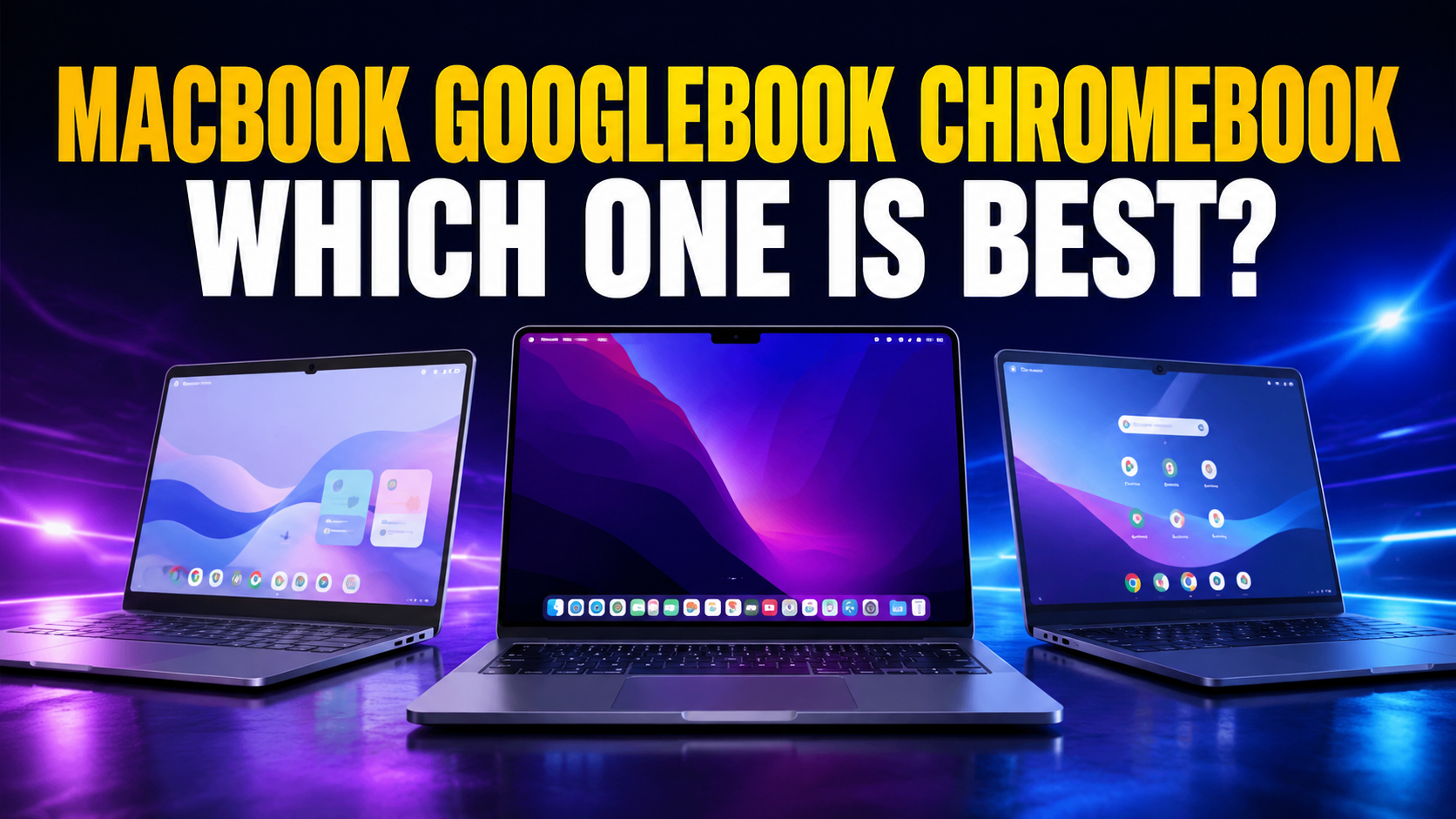
In 2026 you have three real choices when buying a laptop built around AI. There’s the Apple MacBook Air M5 at $1,099, the brand-new Google Googlebook shipping in fall 2026 with Gemini Intelligence built on Google’s just-launched Gemini 3.5 model, and the legacy Chromebook at $200 to $700. Google announced Googlebook at the Android Show on May 12, 2026 and positioned it as the premium successor to Chromebook, then used Google I/O 2026 (May 19) to unveil Gemini 3.5 as the model that will power Aluminium OS. The old “MacBook vs Chromebook” question now has a new third option that didn’t exist two weeks ago.
In this comparison we’ll break down what each laptop actually does in 2026, what AI capability you get on day one, what each costs, and which one is right for students, creators, professionals, and casual users. We’ll also cover Aluminium OS (Google’s new Android plus ChromeOS hybrid), how Apple Intelligence stacks up against Gemini 3.5, and why most Mac owners can match Googlebook’s AI features today without buying anything new.
- MacBook Air M5 starts at $1,099 with a Neural Accelerator on every GPU core, 18-hour battery, 16GB RAM, and Wi-Fi 7.
- Googlebook ships fall 2026 through Acer, Asus, Dell, HP, and Lenovo, powered by Google’s just-launched Gemini 3.5. Pricing not yet announced. Runs Aluminium OS, Google’s new Android-plus-ChromeOS hybrid.
- Chromebook is not dead, but it slides down a tier. Googlebook replaces it at the premium end. Chromebook stays the budget play at $200 to $700.
- MacBook Neo at $599 ($499 with education pricing) is Apple’s direct answer to Chromebook pricing and the cheapest entry into the Mac ecosystem.
- For Mac users who want Gemini, Claude, ChatGPT, Grok, and DeepSeek on day one, Fello AI delivers all five models for $9.99/month without swapping hardware.
A Googlebook is Google’s new line of premium AI-native laptops launching in fall 2026. The device is built around Gemini Intelligence, the operating-system-level AI layer powered by Gemini 3.5, Google’s flagship model unveiled at I/O 2026, and runs Aluminium OS, a hybrid operating system that combines Android with ChromeOS. Hardware partners include Acer, Asus, Dell, HP, and Lenovo. Google has not disclosed pricing or detailed specs yet, and early reporting suggests multiple chip options beyond Intel. The signature design element is the glowbar, an exterior status bar Google calls “both functional and beautiful” and is using as the visual identifier of the Googlebook brand.
The hero feature is the Magic Pointer, an AI-powered cursor that surfaces contextual Gemini suggestions wherever you point on the screen. Point at a calendar date and Gemini drafts a meeting. Highlight an image and Gemini visualises it in another context. Googlebook also brings generative UI widgets (custom dashboards built from natural language prompts), Android phone app mirroring with Quick Access to phone files, and on-device agentic Gemini that can complete multi-step tasks across apps.
No. Googlebook is the premium AI-first successor to Chromebook, not a rename. Chromebook stays the budget ChromeOS line you already know. Googlebook is positioned above it as Google’s MacBook competitor, with premium hardware, Aluminium OS instead of stock ChromeOS, and Gemini 3.5 baked into the operating system from day one.
Googlebook ships in fall 2026. Google has not announced prices for any of the partner devices yet, but the positioning as a premium AI laptop with Acer, Asus, Dell, HP, and Lenovo hardware suggests pricing in line with mid-to-high Windows ultrabooks rather than budget Chromebooks. Google’s official site (googlebook.com) is the canonical source for updates as launch nears.
Aluminium OS is Google’s new desktop operating system, built on the Android tech stack with a real desktop window manager, taskbar, virtual desktops, and Gemini 3.5 integrated at every layer. It’s the technical foundation of Googlebook. Google’s stated long-term goal is for Aluminium OS to replace ChromeOS entirely, although the existing Chromebook line continues in parallel for now. The platform is designed to span laptops, detachables, tablets, and small-form-factor PCs, with a fall 2026 release alongside Googlebook hardware.
The MacBook in 2026 means one of two Apple laptops. The MacBook Air M5 launched in March 2026, and the MacBook Neo (Apple’s new sub-$600 entry-level Mac) shipped on March 11, 2026. Both run macOS Tahoe with Apple Intelligence, Apple’s on-device AI system that handles writing tools, image generation, summaries, and the rebuilt Siri. The MacBook lineup is the established benchmark Googlebook is targeting.
Apple’s mainstream laptop, starting at $1,099. The M5 chip ships with a 10-core CPU and a next-generation GPU with a Neural Accelerator on every GPU core, which Apple says delivers up to 4x faster on-device AI than the M4. Other improvements include 16GB unified memory as standard, 512GB SSD base storage (double the M4 starting point), 18-hour battery life, Wi-Fi 7, a 12MP Center Stage camera, and a 13.6-inch Liquid Retina display. macOS Tahoe adds Live Translation in Messages, a faster Siri, and improved Apple Intelligence features.
The MacBook Neo is Apple’s cheapest Mac, priced at $599 ($499 with education pricing). Released March 11, 2026, Neo is also the first Mac since the Apple Silicon transition to ship with an A-series chip (the A18 Pro) instead of an M-series. Base configuration is 8GB unified memory and 256GB SSD. It still runs macOS Tahoe with Apple Intelligence, just on lower-tier hardware. If your only objection to MacBook has been price, Neo removes the excuse.
Here’s the full side-by-side. We’ve included MacBook Neo as a fourth column because most “MacBook vs Chromebook” buyers are price-shopping, and Neo materially changes the answer.
| Feature | MacBook Air M5 | MacBook Neo | Googlebook (fall 2026) | Chromebook |
|---|---|---|---|---|
| Starting price | $1,099 | $599 ($499 edu) | TBC, premium tier | $200 to $700 |
| OS | macOS Tahoe | macOS Tahoe | Aluminium OS (Android + ChromeOS) | ChromeOS |
| AI assistant | Apple Intelligence | Apple Intelligence | Gemini Intelligence (Gemini 3.5) | Gemini (web) |
| Signature AI feature | On-device Siri 2.0 + Live Translation | On-device Siri 2.0 | Magic Pointer + gen UI widgets | Web-based Gemini |
| Chip | Apple M5 (10-core CPU, Neural Accelerator in each GPU core) | Apple A18 Pro | Multiple chip options (not Intel-only) | Varies (low-power x86 / ARM) |
| RAM (base) | 16GB unified | 8GB unified | TBC | 4GB to 8GB |
| Battery life | 18 hours | TBC | TBC | 10 to 12 hours |
| Multi-model AI access | Yes via Fello AI | Yes via Fello AI | Gemini only at launch | Limited |
| Hardware makers | Apple | Apple | Acer, Asus, Dell, HP, Lenovo | Many |
| Available | Now | Now | Fall 2026 | Now |
This is where the three laptops actually differ in 2026. Specs converge over time; AI strategy does not.
Apple Intelligence is privacy-first and on-device by default. Cloud tasks run on Apple’s own Private Cloud Compute hardware where, by Apple’s design, no one (including Apple) can read what you sent. You get Writing Tools across every app, Image Playground, Genmoji, smart replies, notification summaries, and a substantially upgraded Siri 2.0 on macOS Tahoe. The M5’s Neural Accelerator handles all of it locally on the MacBook Air, which is why Apple says on-device AI is up to 4x faster than M4. With iOS 27 (confirmed for WWDC 2026 on June 8), Apple is also opening Extensions to let third-party AI models like Claude and Gemini plug directly into Siri, ending OpenAI’s exclusive integration. Our WWDC 2026 preview has the full breakdown.
Gemini Intelligence on Googlebook flips the priorities. Google’s bet is that an AI assistant should be proactive and agentic, which means it sees what’s on your screen, takes context from your apps, and executes multi-step tasks without you asking. The underlying model is Gemini 3.5, Google’s flagship unveiled at I/O 2026, and it powers Magic Pointer, generative UI, and the agentic Chrome integration. Magic Pointer makes the cursor itself a query. Generative UI lets you describe a homescreen widget in plain English and Gemini builds it. Gemini in Chrome can navigate websites and complete actions (book a ticket, fill a form) on your behalf. The trade-off is that almost all of this runs against Google’s servers, with the privacy posture that implies. There’s also the question of model exclusivity, since Googlebook ships with Gemini and only Gemini.
Chromebook in 2026 is the laptop where AI is bolted on, not built in. You get web Gemini in Chrome and a handful of Google Workspace AI features, but no native AI cursor, no on-device model, and no agentic tooling. For students and casual users this is fine. For anyone wanting AI as a primary input method, it’s already a tier behind.
| Tier | Best pick | Price |
|---|---|---|
| Budget | Chromebook (legacy) | $200 to $400 |
| Budget Mac | MacBook Neo (education) | $499 |
| Budget Mac (standard) | MacBook Neo | $599 |
| Premium ChromeOS (today) | Chromebook Plus | $500 to $700 |
| Premium AI laptop (mainstream) | MacBook Air M5 | $1,099 |
| Premium AI laptop (fall 2026) | Googlebook | TBC |
The honest read is that MacBook Neo at $599 wipes out the price argument for buying Chromebook over Mac. You give up some battery and ruggedness; you gain the entire Apple ecosystem, macOS apps, and Apple Intelligence on day one. The MacBook Air M5 at $1,099 is the default recommendation for anyone who wants a laptop they’ll still love in five years. Googlebook’s price is the unknown that will decide whether it’s a real MacBook alternative or a Chromebook Plus replacement.
You don’t have to wait for fall 2026 to get Gemini on a Mac, and you don’t have to give up Apple Silicon to do it. The Fello AI app for macOS gives you Gemini, ChatGPT, Claude, Grok, and DeepSeek in a single native app for $9.99/month (one price, all models, including DeepSeek which most competitors don’t include). That covers the Gemini Intelligence-class capability Googlebook is selling on Mac hardware you already own, plus four other top-tier models you couldn’t get on Googlebook at launch even if you wanted to. Fello AI has a 4.7-star rating with 25,000+ reviews across stores. For a deeper Mac-specific comparison, see our ChatGPT vs Claude vs Gemini on Mac breakdown.
The answer depends on who you are. Here’s the short version for each buyer.
Students and college users. MacBook Neo at $499 with education pricing is the right answer for almost everyone. You get macOS, Apple Intelligence, the full app ecosystem, and a five-year device. Chromebook still works for cloud-only schoolwork and large district deployments where IT manageability matters; check our best AI apps for iPhone guide if your school is iOS-heavy.
Creators and AI power users. MacBook Air M5 wins today. The Neural Accelerator handles on-device AI four times faster than M4, you have 18 hours of battery, and pairing it with Fello AI gives you every flagship model on one machine. Googlebook is worth watching for fall, but premium creative apps remain stronger on macOS.
Professionals and business users. MacBook Air M5 or MacBook Pro. The ecosystem, build quality, and software lock-in are still the right bets. For security-conscious fleets, researchers recently demonstrated a Claude Mythos exploit targeting Apple’s M5 chip, which is worth understanding before a large rollout but doesn’t change the deployment recommendation. Googlebook is too new to bring into a fleet on day one.
Casual users and home laptops. MacBook Neo or a $300 Chromebook. If you live in Google Workspace and never install an app, a Chromebook is fine. If you want longevity, the Neo is the better $100 spend.
Anyone curious about Gemini Intelligence. Don’t buy a Googlebook on launch. Wait six months for pricing, real reviews, and Aluminium OS to stabilise. Until then, run Gemini on your existing Mac. Our best AI models for Mac in 2026 guide has the current rankings.
The MacBook is still the right default in 2026. Apple Silicon, macOS Tahoe, Apple Intelligence, and the 18-hour battery on the M5 cover most of what Googlebook is promising for fall, and the MacBook Neo at $599 closes the price gap that used to send budget buyers to Chromebook. Googlebook is the most interesting laptop launch of the year and worth watching, especially now that Gemini 3.5 has shipped and the Aluminium OS story has its model, but launching a brand-new OS, a new chip strategy, and a new AI cursor in one device usually takes a generation to settle. Buy a Mac now, add Fello AI for $9.99/month, and you have the multi-model AI laptop Google is promising for fall, today.
Stay ahead with expert AI insights trusted by top tech professionals!
Join thousands of AI fans & professionals benefiting from exclusive tips and insights from industry leaders.