|
VOOZH | about |
|
VOOZH | about |
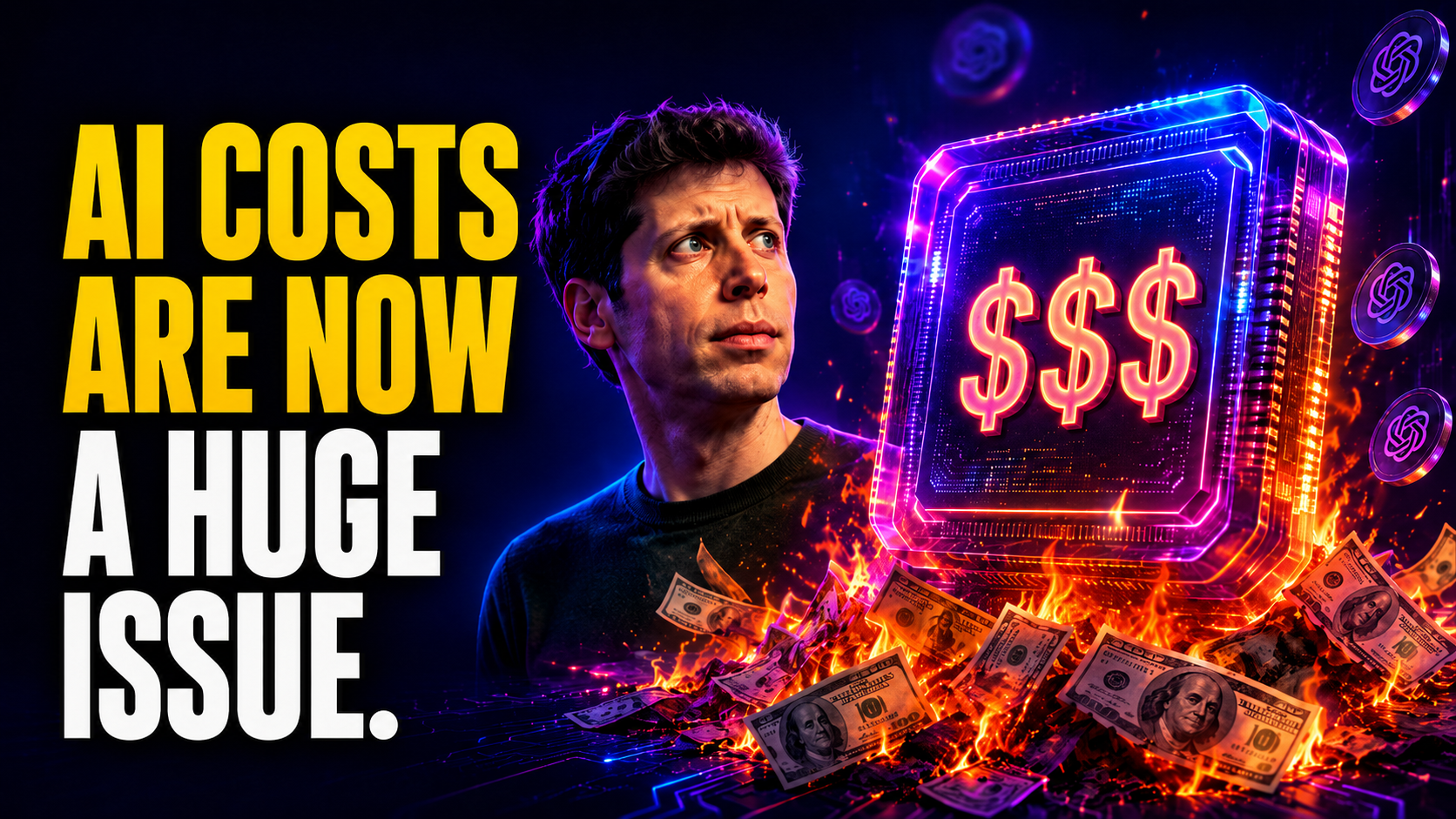
Six months ago, nobody at OpenAI was worried about money. Sam Altman just said so out loud. At the start of 2026, the cost of running AI “never came up,” he told a room full of enterprise customers. “People were totally happy with the amount they were spending.”
Then he dropped the line that’s now ricocheting around the industry. Today, AI costs are “a huge issue.”
JUST IN: Sam Altman says AI budgeting has suddenly become a “huge issue” for companies.
— Polymarket (@Polymarket) June 4, 2026
That is a remarkable thing for the CEO of the most valuable AI company on earth to admit in public. And it gets better, because the numbers he revealed in the same breath are genuinely hard to believe.
Speaking at an OpenAI enterprise event on Tuesday, Altman pulled back the curtain on the company’s single biggest customer. That one account burns through roughly 100 billion tokens a month.
For context, that is about 75 billion words. Per month. From one organization.
A token is the basic unit AI models read and write, very roughly three quarters of a word. Every question you ask and every answer you get is measured in tokens, and every token costs money. So 100 billion of them is not a usage stat. It is a small fortune.
NEW: Sam Altman reveals OpenAI’s top “token leader” uses 100,000,000,000 tokens per month — and still isn’t the highest user in the world.
— Polymarket (@Polymarket) June 2, 2026
Here is the twist that made the room laugh. That 100-billion-token whale is not even the biggest spender on the planet.
Altman admitted OpenAI found someone outside the company spending even more, and called it a personal “embarrassment.” Read that again. The company that sells the tokens, runs a token leaderboard internally, and has employees flexing their totals on social media, got out-spent by an outsider.
When the people selling the product are competing to consume the most of it, you start to understand how the bills got so big.
The growth curve is the part that should make every finance team nervous.
Six and a half years ago, OpenAI’s top user went through about 100,000 tokens a month. At the time, Altman said, that person was “very likely the token leader in the world.”
Today that same 100,000 tokens is roughly the per-capita global average. The average person now uses what the single heaviest user on earth used six years ago. And the new leader at OpenAI sits at 100 billion a month.
That is a one-million-fold increase. Not in total industry usage, in what a single top user consumes.
The abstract numbers are wild. The real-world receipts are worse.
| Who | Token spend | What it cost |
|---|---|---|
| OpenAI’s top customer | 100 billion / month | The headline figure |
| Peter Steinberger (OpenClaw) | 603 billion in 30 days | ~$1.3 million in one month |
| One OpenAI employee | 210 billion in a week | Reported by the New York Times |
| McKinsey & Company | 100 billion / month | Crossed the milestone as a client |
| Uber engineering | Entire 2026 budget | Gone in four months |
Peter Steinberger, the creator behind OpenClaw, posted a screenshot of 603 billion tokens spent in 30 days, racking up around $1.3 million in a single month. OpenAI ended up covering the bill after he joined the company.
Meanwhile the rest of the corporate world is slamming on the brakes. Amazon shut down its internal token leaderboard. Uber set hard token caps after its COO said the spending had become impossible to justify, having torched its full-year 2026 AI budget in four months. Individual engineers there were running up $150 to $2,000 a month each.
Altman even quoted the meme doing the rounds among his customers: “My company spent my entire 2026 budget in Q1, can you make this more efficient?”
The speed of the shift is the real story.
For most of the AI boom, prices were artificially low. The big labs priced their models below what it actually costs to run them, eating the loss to grab market share. OpenAI reportedly spends around $1.35 for every $1 it earns, and its losses come mostly from inference, the cost of answering all those billions of daily requests, not from training new models.
That works fine when usage is modest. But once agentic tools arrived, the AI that runs in loops, calls itself repeatedly, and works autonomously, token consumption stopped growing linearly and started multiplying. Add the fact that companies finally got real visibility into their bills, and the comfortable silence of January turned into the panic of June.
The kicker is what Altman says is coming next. He pointed to “constant running proactive AI,” always-on agents that work in the background without being prompted. If today’s budgets are blowing up on AI you have to ask, wait until you are paying for AI that never stops.
While OpenAI was burning tokens, a rival quietly passed it.
For the first time since the AI race began, Ramp’s May 2026 spending index showed Anthropic overtaking OpenAI in US business adoption, 34.4% to 32.3%. The engine behind it was a single product, Claude Code, the fastest-growing thing Anthropic has ever shipped.
There is a catch worth naming. These companies make more money when you spend more tokens, which means they are quietly incentivized to nudge you toward their most expensive models even when a cheaper one would do the job perfectly. The cost crisis is not an accident. It is baked into the business model.
Here is the practical part. You do not need a McKinsey-sized budget to use frontier AI, and you definitely do not need to stack five separate subscriptions to get there.
A few levers that genuinely move the needle:
This is exactly the problem Fello AI was built to solve. Instead of juggling multiple pricey AI subscriptions, Fello AI bundles every major model, Claude, GPT, Gemini, DeepSeek, Llama, Perplexity, and more, into one lightweight native app for Mac, iPhone, and iPad. You pick the right model for each task in a single interface, and you stop paying four times over for capability you use one at a time.
When the people running the AI labs are openly admitting costs are out of control, the smart move for everyone else is to get deliberate about what they pay for.
Sam Altman just told the world that the cost of AI went from a non-issue to a “huge issue” in roughly five months. His own top customer spends 100 billion tokens a month, and someone out there spends even more. Companies are capping budgets, killing leaderboards, and burning a year of spend in a quarter.
The era of cheap, subsidized AI is ending. The winners from here will not be whoever spends the most. They will be whoever spends the smartest.
You can try every major AI model in one place, without the stack of subscriptions, at Fello AI.
Stay ahead with expert AI insights trusted by top tech professionals!
Join thousands of AI fans & professionals benefiting from exclusive tips and insights from industry leaders.