|
VOOZH | about |
|
VOOZH | about |
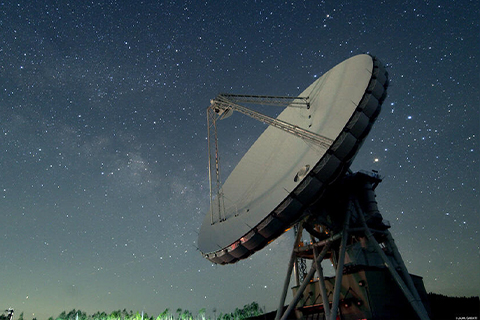
This is a new ground station built in Saku City, Nagano Prefecture for the purpose of enabling telecommunications with deep space exploration probes. *Deep space: The Japanese Radio Law defines Deep Space as the universe more than 2 million kilometers away from Earth. |
To secure operational capacity for JAXA to independently achieve innovative results from deep space exploration by newly enabling the receiving of Ka-band while continuing to cope with X-band communication, which has been used for a long time for deep space missions.
While decreasing the antenna diameter from 64m, the new antenna will improve its reception capacity. We will develop a comprehensive system combining a high-precision tracking antenna and transmitter-receiver against the harsh environment including solar radiation and wind pressure.
| Name | GREAT:GRound station for deep space Exploration And Telecommunication |
|---|---|
| Scheduled time of operation start | Japan Fiscal Year 2019 |
| Construction site | 1905-1 Tateshina, Maeyama, Saku City, Nagano Pref. East longitude 138 degrees and 21 minutes North latitude 36 degrees and 8 minutes Altitude 1580 m Area : 8 hectare (80000 square meters) |
| Design life | Over 20 years |
| Antenna method | Cassegrain antenna with shaped reflector |
| Diameter | 54m |
| Weight | 2100 tons or less |
| Mounting system | Az-El |
| Power supply method | Focused beam power supply method |
| Frequency | For tracking and controlling explorers X-band transmission (7145MHz~7235MHz) X-band reception (8400MHz~8500MHz) Ka-band reception (31800MHz~32300MHz) For geodetic VLBI X-band reception (8200MHz~8700MHz) |
| Transmission performance | X-band transmission gain : 69.62dBi or more X-band transmission power : 20 kW or more (EIRP will be 142.62 dBm or more.) |
| Reception performance | X-band G/T : 53.35 dB/K or more at an elevation angle of 15 to 80 degrees Ka-band G/T : 59.33 dB/K or more at an elevation angle of 15 to 80 degrees The above G/T is an effective G/T value that includes propagation loss (the sum of losses caused by atmospheric absorption and precipitation) |