|
VOOZH | about |
|
VOOZH | about |
|
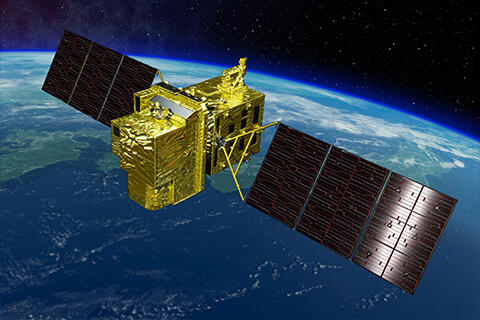
Satellites offer a wide variety of valuable services. These include communications and weather observation, which are essential to modern life, as well as astronomical observation and space development. Japanese satellites now in orbit are performing missions in a wide range of areas. For example, they have been playing an important role in assessing and analyzing abnormal weather patterns. For the purpose of planetary exploration, plans are under way for sending probes to the Moon and Mars. |
|
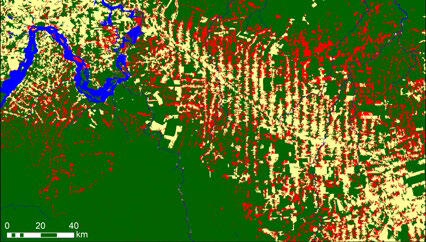
Earth observation satellites have the advantage of being able to measure the concentration of greenhouse gases and monitor the forest cover globally, and thus the utilization of satellite data is included in the United Nations Intergovernmental Panel on Climate Change (IPCC) guidelines. Through cooperation with environmental agencies around the world, JAXA will contribute to the Paris Agreement by improving the accuracy of the data that can be used as scientific evidence to support the understanding of greenhouse gas emission and absorption. |
|
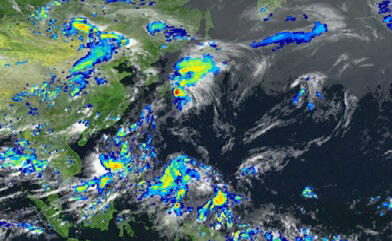
GSMaP is a highly accurate, high-resolution and near real-time map of global precipitation developed with data from satellites including GPM Core Observatory and SHIZUKU. The map is used in various fields such as rainfall monitoring, flood prediction, drought monitoring, agriculture and education. |
The operation status of satellites/probes is basically categorized into the following phases: “Under development”, “In Operation”, “Latter Phase In Operation” ,“Post operation” and “Transferred”.
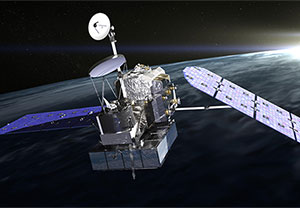
Taking over from SHIZUKU and IBUKI-2 to enhance the functionality and performance of water cycle variation observations and greenhouse gas observations
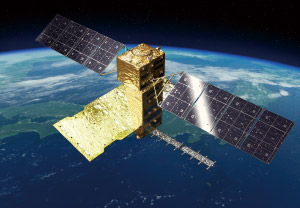
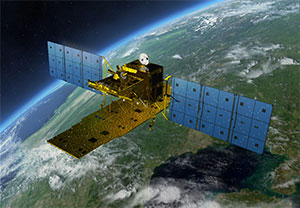
Taking over from DAICHI-2 to enhance the functionality and performance
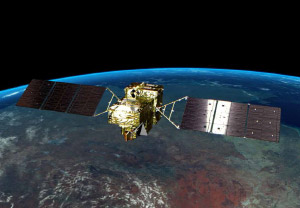
Helping to improve predictions for changes in weather
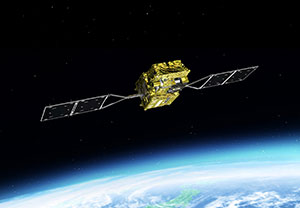
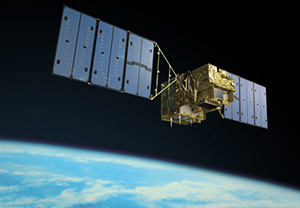
Taking over from IBUKI to enhance the functionality and performance of greenhouse gas observations
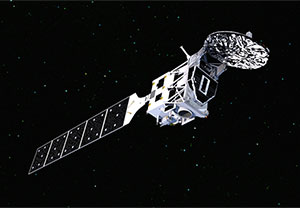
Forecasting future global climate
Observing All Environmental Changes on Earth for Present and Future Generations
The Earth needs a health check
Global Precipitation Observation at Three Hour Intervals with GPM Core Satellite and Constellation Satellites
"IBUKI": Global efforts to protect the environment.
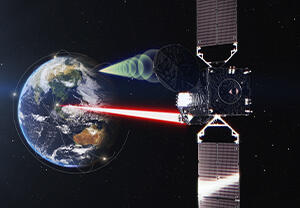
Laser Utilizing Communication System (LUCAS) to handle an increase in acquired data volume
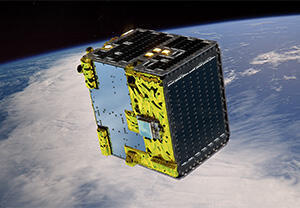
The Innovative Satellite Technology Demonstration-2
To establish Japan’s geodetic origin through accurate land surveying from space.
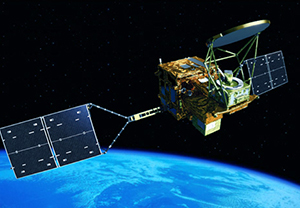
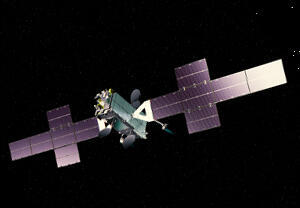
Engineering Test Satellite-9 is a demonstration satellite to achieve next generation geostationary satellite
| Missions | Launch date~End of mission |
|---|---|
| RApid Innovative payload demonstration SatellitE-2(RAISE-2) | 2021/11/09~2023/04/07 |
| DAICHI-3(ALOS-3) | 2023/03/07(*Launch Date) As a result of a failed rocket launch, the "ALOS-3" was unable to be deployed into orbit. |
| Innovative Satellite Technology Demonstration-3(RAISE-3) | 2022/10/12(*Launch Date) As a result of a failed rocket launch, the "RAISE-3" was unable to be deployed into orbit. |
| Small Demonstration Satellite-4 (SDS-4) | 2009/01/23~2019/12/02(*JAXA and SKY Perfect JSAT Conclude an Agreement on the Transfer of the Small Demonstration Satellite-4) |
| RAPid Innovative payload demonstration Satellite (RAPIS-1) | 2019/01/18~2020/06/24 |
| TSUBAME(SLATS) | 2017/12/23~2019/10/01 |
| MICHIBIKI(QZSS) | 2010/09/11~2017/02/28(*QZS-1 off to the Cabinet Office's Control) |
| Small Demonstration Satellite-1(SDS-1) | 2009/01/23~2010/09/08 |
| KIZUNA(WINDS) | 2008/02/23~2019/02/27 |
| KIKU-8(ETS-VIII) | 2006/012/18~2017/01/10 |
| DAICHI(ALOS) | 2006/01/24~2011/05/12 |
| KIRARI(OICETS) | 2005/08/24~2009/09/24 |
| KODAMA(DRTS) | 2002/09/10~2017/08/05 |
| Aqua/AMSR-E | 2002/05/04~2015/12/04 |
| Micro-LabSat | 2002/12/14~2006/09/27 |
| TSUBASA(MDS-1) | 2002/02/04~2003/09/27 |
| Midori II(ADEOS-II) | "2002/12/14~2003/10(*Earth Observation Operation of Midori-II) " |
| KAKEHASHI(COMETS) | 1998/02/21~1999/08/06 |
| TRMM | 1997/011/28~2015/06/16 |
| KIKU-7(ETS-VII) | 1997/011/28~2002/10/30 |
| MIDORI(ADEOS) | 1996/08/17~1997/06/30 |
| Himawari-5(GMS-5) | 1995/03/16~1995/06/21(*GMS-5 was transferred to Japan Meteorological Agency.) |
| KIKU-6(ETS-VI) | 1994/08/28~1996/07/09 |
| FUYO-1(JERS-1) | 1992/02/11~1998/10/12 |
| Yuri-3(BS-3b) | 1991/08/25~1998/11/30 |
| Yuri-3(BS-3a) | 1990/08/28~1998/04/20 |
| Momo-1b(MOS-1b) | 1990/02/7~1996/04/17 |
| Himawari-4(GMS-4) | 1989/09/06~2000/02/24 |
| Sakura-3b(CS-3b) | 1988/09/16~1996/05/31 |
| Sakura-3a(CS-3a) | 1988/02/19~1995/11/30 |
| KIKU-5((ETS-V) | 1987/08/27~1997/09/12 |
| Momo-1(MOS-1) | 1987/02/19~1995/11/29 |
| Yuri-2b(BS-2b) | 1986/02/12~1991/10/24 |
| Himawari-3(GMS-3) | 1984/08/03~1995/06/23 |
| Yuri-2a(BS-2a) | 1984/01/23~1989/April |
| Sakura-2b(CS-2b) | 1983/08/06~1990/01/23 |
| Sakura-2a(CS-2a) | 1983/02/04~1990/12/03 |
| KIKU-4((ETS-III) | 1982/09/03~1985/03/08 |
| Himawari-2(GMS-2) | 1981/08/11~1987/11/20 |
| KIKU-3((ETS-IV) | 1981/02/11~1984/12/24 |
| Ayame-2(ECS-b) | "1980/02/22~1980/02/25 " |
| Ayame(ECS) | "1979/02/6~2/2/9 " |
| UME-2(ISS-b) | 1978/02/16~1983/02/23 |
| Yuri(BS) | 1978/04/08~1982/January |
| KIKU-2((ETS-II) | 1977/02/23~1990/12/10 |
| Himawari(GMS) | 1977/07/14~1989/06/30 |
| Sakura(CS) | 1977/12/15~1985/11/25 |
| UME(ISS) | 1976/02/29~1976/04/02 |
| KIKU-1((ETS-I) | 1975/09/09~1982/04/28 |