On this page
WMMA guide for AMD RDNA 4 architecture GPUs - part 1
Originally posted:

Hui Zhang
Fused GEMMs for RDNA 4 architecture GPUs
GEMM (General Matrix Multiply) fusion is a commonly used optimization technique widely employed to accelerate deep learning applications, notably including Flash Attention and Neural Texture Compression. This article explores practical approaches to implementing GEMM fusion on AMD RDNA™ 4 architecture graphics cards.
1. Problem description
When executing two unfused GEMM operations, each kernel loads matrix A and matrix B from global memory, computes the product, and stores the result matrix D back to memory.
In the fused implementation, the main computational loops of both GEMMs execute sequentially within a single kernel. The output matrix D from the first GEMM resides in the register file and is directly reused as matrix A for the second GEMM, eliminating one round-trip to global memory.
This example computes the following:
- First GEMM: D₀ = α₀ × A₀ × B₀
- Second GEMM: D₁ = α₁ × D₀ × B₁ + β₁ × C₁
2. WMMA layout in RDNA 4
To implement fused GEMMs effectively, one must first understand the Wide Matrix Multiply Accumulate (WMMA) layout in the RDNA 4 architecture. Using the Matrix Cores of AMD RDNA 4 architecture GPUs provides a comprehensive introduction to this topic.
The following illustrates the WMMA layout in RDNA 4. All data types—including FP16, INT8, and INT4—utilize this unified layout:
| Matrix | Position | Dimensions |
|---|---|---|
| A | Lower left | M rows × K columns |
| B | Upper right | K rows × N columns |
| D | Lower right | M rows × N columns |
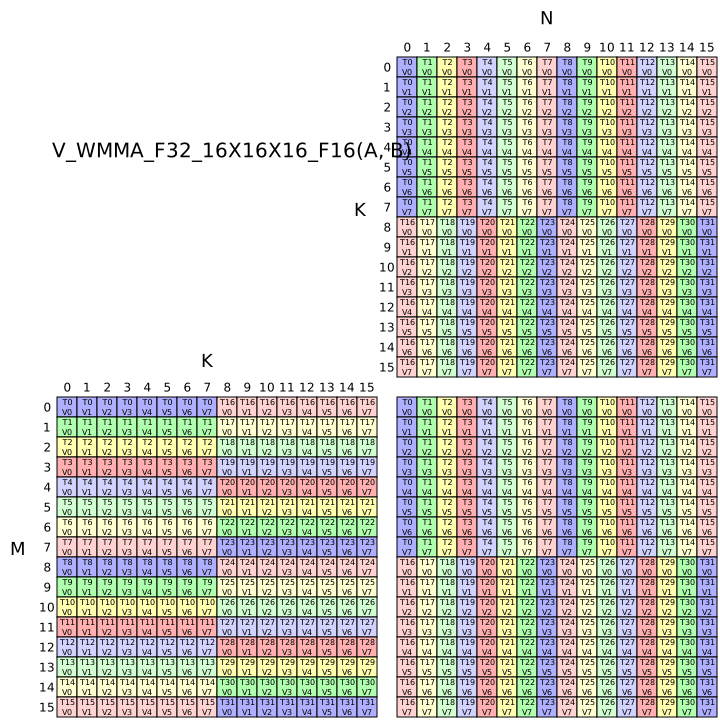
Both matrix A and B are K-major, with each thread holding 8 contiguous elements. This layout enables efficient 128-bit vectorized loads.
Matrix D, however, is M-major. Based on the example presented above, matrix D₀ must serve as matrix A₁ in the subsequent GEMM. Since A₁ requires N-major layout, the primary challenge in implementing fused GEMMs on RDNA 4 lies in efficiently transposing D₀ from M-major to N-major format.
3. Transpose matrix D
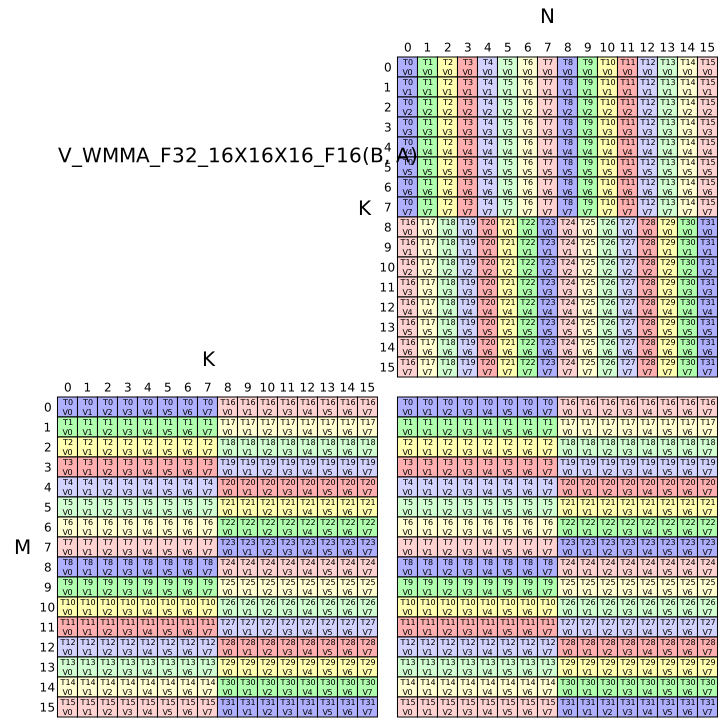
The most straightforward approach to transposing matrix D is to swap the positions of matrices A and B. Since both M and N equal 16, the resulting D matrix retains its 16×16 dimensions but switches from M-major to N-major layout, enabling it to serve directly as matrix A in the subsequent GEMM.
The following illustrates the WMMA trans layout in RDNA 4, achieved by swapping matrices A and B:
| Matrix | Position | Dimensions |
|---|---|---|
| B | Lower left | M rows × K columns |
| A | Upper right | K rows × N columns |
| D | Lower right | M rows × N columns |
4. Sample code
The following sample code demonstrates the implementation of fused GEMMs on RDNA 4, including verification against hipBLAS for correctness validation.
#defineHIPBLAS_V2#include<random>#include<hip/hip_runtime.h>#include<hip/hip_fp16.h>#include<hipblas/hipblas.h>#include<thrust/host_vector.h>#include<thrust/device_vector.h>constexprint MMA_M =16, MMA_N =16, MMA_K =16;constexprint M0_M =2, M0_N =3, M0_K =2;constexprint M1_M = M0_M, M1_N =3, M1_K = M0_N;constexprint WMMA_DATA_WIDTH =8;usingfrag_type_f16=_Float16__attribute__((ext_vector_type(WMMA_DATA_WIDTH)));usingfrag_type_f32=float__attribute__((ext_vector_type( WMMA_DATA_WIDTH)));__global__ voidfused_gemm_TN(const __half* a0, const __half* b0, const __half* b1, float* c1) {constint lIdx = threadIdx.x;constint lane = lIdx % MMA_K;constint laneGroup = lIdx / MMA_K;frag_type_f16 a0_frag[M0_M][M0_K];frag_type_f16 b0_frag[M0_N][M0_K];frag_type_f32 c0_frag[M0_M][M0_N] = {};constexprint m0_stride_m = MMA_M * M0_K * MMA_K;constexprint m0_stride_n = MMA_N * M0_K * MMA_K;constexprint m0_stride_k = MMA_K;constexprint m0_stride_mma_m = M0_K * MMA_K;constexprint m0_stride_mma_n = M0_K * MMA_K;for(int m =0; m < M0_M; ++m) {for(int k =0; k < M0_K; ++k) {int block_idx = m * m0_stride_m + k * m0_stride_k;int lane_idx = lane * m0_stride_mma_m;int lane_group_idx = laneGroup * WMMA_DATA_WIDTH;a0_frag[m][k] =reinterpret_cast<const frag_type_f16&>(a0[block_idx + lane_idx + lane_group_idx]);}}for(int n =0; n < M0_N; ++n) {for(int k =0; k < M0_K; ++k) {int block_idx = n * m0_stride_n + k * m0_stride_k;int lane_idx = lane * m0_stride_mma_n;int lane_group_idx = laneGroup * WMMA_DATA_WIDTH;b0_frag[n][k] =reinterpret_cast<const frag_type_f16&>(b0[block_idx + lane_idx + lane_group_idx]);}}for(int m =0; m < M0_M; ++m) {for(int n =0; n < M0_N; ++n) {for(int k =0; k < M0_K; ++k) {c0_frag[m][n] =__builtin_amdgcn_wmma_f32_16x16x16_f16_w32_gfx12(b0_frag[n][k], a0_frag[m][k], c0_frag[m][n]);}}}static_assert(M0_M == M1_M, "M0's M must equal to M1's M");static_assert(M0_N * MMA_N == M1_K * MMA_K, "M0's N must equal to M1's K");frag_type_f16 a1_frag[M1_M][M1_K];for(int m =0; m < M1_M; ++m) {for(int k =0; k < M1_K; ++k) {for(int ele =0; ele < WMMA_DATA_WIDTH; ++ele) {a1_frag[m][k][ele] =__float2half(c0_frag[m][k][ele]);}}}frag_type_f16 b1_frag[M1_N][M1_K];frag_type_f32 c1_frag[M1_M][M1_N] = {};constexprint m1_stride_n = MMA_N * M1_K * MMA_K;constexprint m1_stride_k = MMA_K;constexprint m1_stride_mma_n = M1_K * MMA_K;for(int n =0; n < M1_N; ++n) {for(int k =0; k < M1_K; ++k) {int block_idx = n * m1_stride_n + k * m1_stride_k;int lane_idx = lane * m1_stride_mma_n;int lane_group_idx = laneGroup * WMMA_DATA_WIDTH;b1_frag[n][k] =reinterpret_cast<const frag_type_f16&>(b1[block_idx + lane_idx + lane_group_idx]);}}for(int m =0; m < M1_M; ++m) {for(int n =0; n < M1_N; ++n) {for(int k =0; k < M1_K; ++k) {c1_frag[m][n] =__builtin_amdgcn_wmma_f32_16x16x16_f16_w32_gfx12(b1_frag[n][k], a1_frag[m][k], c1_frag[m][n]);}}}constexprint c1_stride_m = MMA_M * M1_N * MMA_N;constexprint c1_stride_n = MMA_N;constexprint c1_stride_mma_n = M1_N * MMA_N;for(int m =0; m < M1_M; ++m) {for(int n =0; n < M1_N; ++n) {int block_idx = m * c1_stride_m + n * c1_stride_n;int lane_idx = lane * c1_stride_mma_n;int lane_group_idx = laneGroup * WMMA_DATA_WIDTH;reinterpret_cast<frag_type_f32&>(c1[block_idx + lane_idx + lane_group_idx]) = c1_frag[m][n];}}}template <typenameT, typenameRNG>voidgen_rand_data(T*data, size_tn, RNG&rng) {std::normal_distribution<float>nd(-100, 100);for (size_t i =0; i < n; ++i) {float v =nd(rng) *0.01f;data[i] = v;}}intmain(intargc, char*argv[]) {static_assert(MMA_M ==16, "MMA_M must be 16 for GFX12");static_assert(MMA_N ==16, "MMA_N must be 16 for GFX12");static_assert(MMA_K ==16, "MMA_K must be 16 for GFX12");static_assert(WMMA_DATA_WIDTH ==8, "WMMA_DATA_WIDTH must be 8 for GFX12");int M0 = M0_M * MMA_M, N0 = M0_N * MMA_N, K0 = M0_K * MMA_K;int M1 = M0, N1 = M1_N * MMA_N, K1 = N0;thrust::host_vector<__half>h_A0(M0 * K0);thrust::host_vector<__half>h_B0(N0 * K0);thrust::host_vector<__half>h_B1(N1 * K1);thrust::host_vector<float>h_C1(M1 * N1);std::mt19937 rng(2025);gen_rand_data(h_A0.data(), h_A0.size(), rng);gen_rand_data(h_B0.data(), h_B0.size(), rng);gen_rand_data(h_B1.data(), h_B1.size(), rng);thrust::device_vector<__half> d_A0 = h_A0;thrust::device_vector<__half> d_B0 = h_B0;thrust::device_vector<__half> d_B1 = h_B1;thrust::device_vector<float> d_C1 = h_C1;fused_gemm_TN<<<dim3(1), dim3(32, 1, 1), 0, 0>>>(d_A0.data().get(), d_B0.data().get(), d_B1.data().get(), d_C1.data().get());auto err =hipDeviceSynchronize();printf("err = %d, str = %s\n", err, hipGetErrorString(err));err =hipGetLastError();printf("err = %d, str = %s\n", err, hipGetErrorString(err));h_C1 = d_C1;thrust::device_vector<__half>d_C0_blas(M0 * N0);thrust::device_vector<float>d_C1_blas(M1 * N1);hipblasHandle_t handle;hipblasCreate(&handle);floatalpha(1.0f);floatbeta(0.0f);hipblasStatus_t ret =hipblasGemmEx(handle, HIPBLAS_OP_T, HIPBLAS_OP_N, N0, M0, K0,&alpha, d_B0.data().get(), HIP_R_16F, K0,d_A0.data().get(), HIP_R_16F, K0, &beta,d_C0_blas.data().get(), HIP_R_16F, N0,HIPBLAS_COMPUTE_32F, HIPBLAS_GEMM_DEFAULT);if (ret == HIPBLAS_STATUS_SUCCESS) {ret =hipblasGemmEx(handle, HIPBLAS_OP_T, HIPBLAS_OP_N, N1, M1, K1,&alpha, d_B1.data().get(), HIP_R_16F, K1,d_C0_blas.data().get(), HIP_R_16F, K1, &beta,d_C1_blas.data().get(), HIP_R_32F, N1,HIPBLAS_COMPUTE_32F, HIPBLAS_GEMM_DEFAULT);if (ret == HIPBLAS_STATUS_SUCCESS) {constexprfloat threshold =0.001;int diff_num =0;thrust::host_vector<float> h_C1_blas = d_C1_blas;for(int i =0; i < M1 * N1; ++i) {float diff =std::abs(h_C1[i] - h_C1_blas[i]);if(diff > threshold) {printf("%f%f\n", h_C1[i], h_C1_blas[i]);diff_num++;}}if(!diff_num) {printf("Fused GEMM has same result as two BLAS GEMM.\n");}} else {printf("hipblas err = %d, str = %s\n", ret, hipblasStatusToString(ret));}} else {printf("hipblas err = %d, str = %s\n", ret, hipblasStatusToString(ret));}hipblasDestroy(handle);return0;}5. Conclusion
Fused GEMMs with swapped matrices A and B on AMD RDNA 4 architecture GPUs produce results consistent with hipBLAS, with precision loss within acceptable tolerances. This confirms the viability of the transposition-via-swapping approach for implementing fused GEMMs on RDNA 4.
This technique has been deployed in Llama.cpp to implement Flash Attention on RDNA 4, serving as a real-world validation of the approach.
Footnotes
Links to third party sites are provided for convenience and unless explicitly stated, AMD is not responsible for the contents of such linked sites and no endorsement is implied. GD-97.
Hui Zhang
Zhang Hui is a Member of Technical Staff in the AMD Devtech team where he focuses on helping developers utilize AMD CPU cores efficiently and make deep learning solutions for AMD AI products.