Author's Note: Gemini 3.1 Flash-Lite Preview has launched with an impressive output speed of 380 tok/s and a super low cost of $0.25/M. This article provides an in-depth analysis of its 5 core advantages, benchmark data, competitor comparisons, and API integration methods.
Google DeepMind officially released Gemini 3.1 Flash-Lite Preview on March 3, 2026—the fastest and most cost-effective model in the Gemini 3 series. Based on the Gemini 3 Pro architecture, it achieves an output speed of approximately 380 tokens/s, making its first token response 2.5x faster than Gemini 2.5 Flash and its overall output speed 45% higher.
Core Value: This article will help you fully understand this newly launched lightweight model from 5 dimensions—performance benchmarks, cost comparison, functional features, applicable scenarios, and API integration—so you can decide if it's right for your business needs.
Gemini 3.1 Flash-Lite Preview Core Specs at a Glance
Here are the core technical parameters extracted from Google AI's official documentation and DeepMind's model card:
| Parameter | Gemini 3.1 Flash-Lite Preview | Description |
|---|---|---|
| Model ID | gemini-3.1-flash-lite-preview |
Use this ID for API calls |
| Architecture Base | Gemini 3 Pro | Inherits Pro-level multimodal architecture |
| Context Window | 1,048,576 tokens (1M) | Equivalent to ~1,500 A4 pages |
| Max Output | 65,536 tokens (64K) | Supports long text generation |
| Output Speed | ~380 tokens/s | Ranks 2nd among 132 models |
| Input Price | $0.25 / million tokens | Lowest in the Gemini 3 series |
| Output Price | $1.50 / million tokens | 1/8th the cost of the Pro version |
| Knowledge Cutoff | January 2025 | Consistent with Gemini 3 Pro |
| Status | Preview | Preview version; official release pending |
It's worth noting that Gemini 3.1 Flash-Lite Preview is built on the Gemini 3 Pro architecture, meaning it retains Pro-level multimodal understanding capabilities in a "scaled-down" package. Google positions it as the preferred model for "high-frequency, lightweight tasks."
🎯 Integration Tip: Gemini 3.1 Flash-Lite Preview is now available on APIYI (apiyi.com) at the same price as Google's official offering. Top up $100 and get $10 free, with discounts starting at 20% off. Access over 400 Large Language Models in one place.
Gemini 3.1 Flash-Lite Preview: 5 Core Advantages
Advantage 1: Blazing-Fast Inference – 380 tok/s Output Speed
Gemini 3.1 Flash-Lite Preview boasts an output speed of approximately 380 tokens/s. According to Artificial Analysis benchmark data, this ranks it 2nd out of 132 mainstream models. Compared to the previous generation Gemini 2.5 Flash at 249 tok/s, that's a performance boost of about 45%.
The improvement in Time to First Token (TTFT) is even more impressive—it's 2.5 times faster than Gemini 2.5 Flash. This is a game-changer for applications requiring instant feedback, like chatbots or real-time translation.
Advantage 2: Extremely Low Cost – Input at Just $0.25/M Tokens
Within the Gemini 3 series, Flash-Lite is priced at just 1/8th the cost of the Pro version. Here's the breakdown:
| Model | Input Price | Output Price | Blended Rate (3:1) |
|---|---|---|---|
| Gemini 3.1 Flash-Lite | $0.25/M | $1.50/M | $0.56/M |
| Gemini 3 Pro | $2.00/M | $12.00/M | $4.50/M |
| Claude 4.5 Haiku | $1.00/M | $5.00/M | $2.00/M |
| GPT-5 mini | $0.15/M | $0.60/M | $0.26/M |
Flash-Lite strikes an excellent balance between price and performance. While not the absolute cheapest, its combination of 380 tok/s output speed and a 1M token context window offers incredible value for money.
Advantage 3: Million-Token Context Window
A context window of 1,048,576 tokens means you can process in a single request:
- Roughly 1,500 pages of A4 text
- An entire code repository
- Hours of audio or video content
This is a rare configuration for a lightweight model. In comparison, GPT-5 mini supports only 128K, and Claude 4.5 Haiku supports 200K.
Advantage 4: Full Multimodal Input Support
Despite being positioned as a lightweight model, Gemini 3.1 Flash-Lite Preview supports 5 input modalities:
- Text: Core capability
- Image: Image content analysis and understanding
- Audio: Speech transcription and analysis
- Video: Video content understanding
- PDF: Document parsing and summarization
It only outputs text, but for most data processing and analysis tasks, that's more than sufficient.
Advantage 5: Thinking Mode Support
Remarkably for a lightweight model, Gemini 3.1 Flash-Lite Preview supports Thinking Mode (Extended Reasoning), which is almost unique among its peers. When enabled, the model performs step-by-step reasoning, significantly boosting accuracy in tasks like scientific knowledge and mathematical calculations.
🎯 Platform Recommendation: Want to quickly test Gemini 3.1 Flash-Lite Preview's Thinking Mode performance? You can invoke it directly via APIYI at apiyi.com, which offers a unified interface supporting 400+ mainstream Large Language Models.
Gemini 3.1 Flash-Lite Preview Benchmark Data
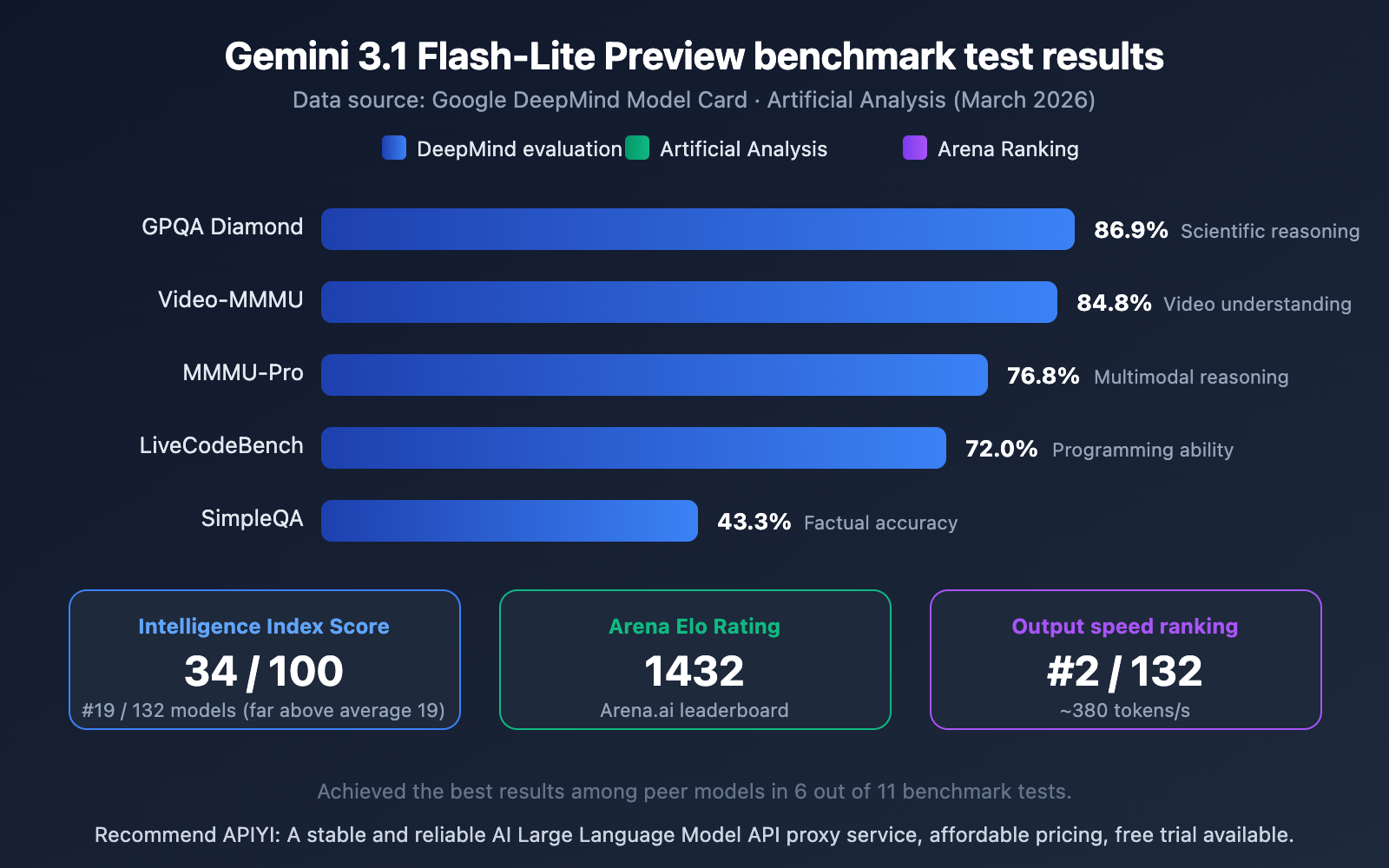
The following data is sourced from the Google DeepMind model card and Artificial Analysis evaluations:
👁 gemini-3-1-flash-lite-preview-fastest-lightweight-model-guide-en 图示
Interpreting the Gemini 3.1 Flash-Lite Preview Benchmarks
Looking at the data, Flash-Lite's performance among lightweight models is quite impressive:
- GPQA Diamond 86.9%: Leads its peers in scientific knowledge and reasoning.
- Video-MMMU 84.8%: Showcases its multimodal strength in video understanding.
- MMMU-Pro 76.8%: Excellent performance in multimodal reasoning.
- Arena Elo 1432: A high score on the Arena.ai leaderboard, proving its real-world usability is strong.
- Intelligence Index 34/100: Far exceeds the peer average of 19, ranking 19th out of 132 models.
Out of 11 benchmark tests, Flash-Lite achieved best-in-class results in 6 of them, which is an outstanding performance for a lightweight model.
🎯 Practical Testing Advice: Benchmark data is for reference only; actual results vary by use case. We recommend testing in real-world scenarios via APIYI at apiyi.com. The platform offers free credits and supports quick comparisons between multiple models.
Gemini 3.1 Flash-Lite Preview vs. Competitors
👁 gemini-3-1-flash-lite-preview-fastest-lightweight-model-guide-en 图示
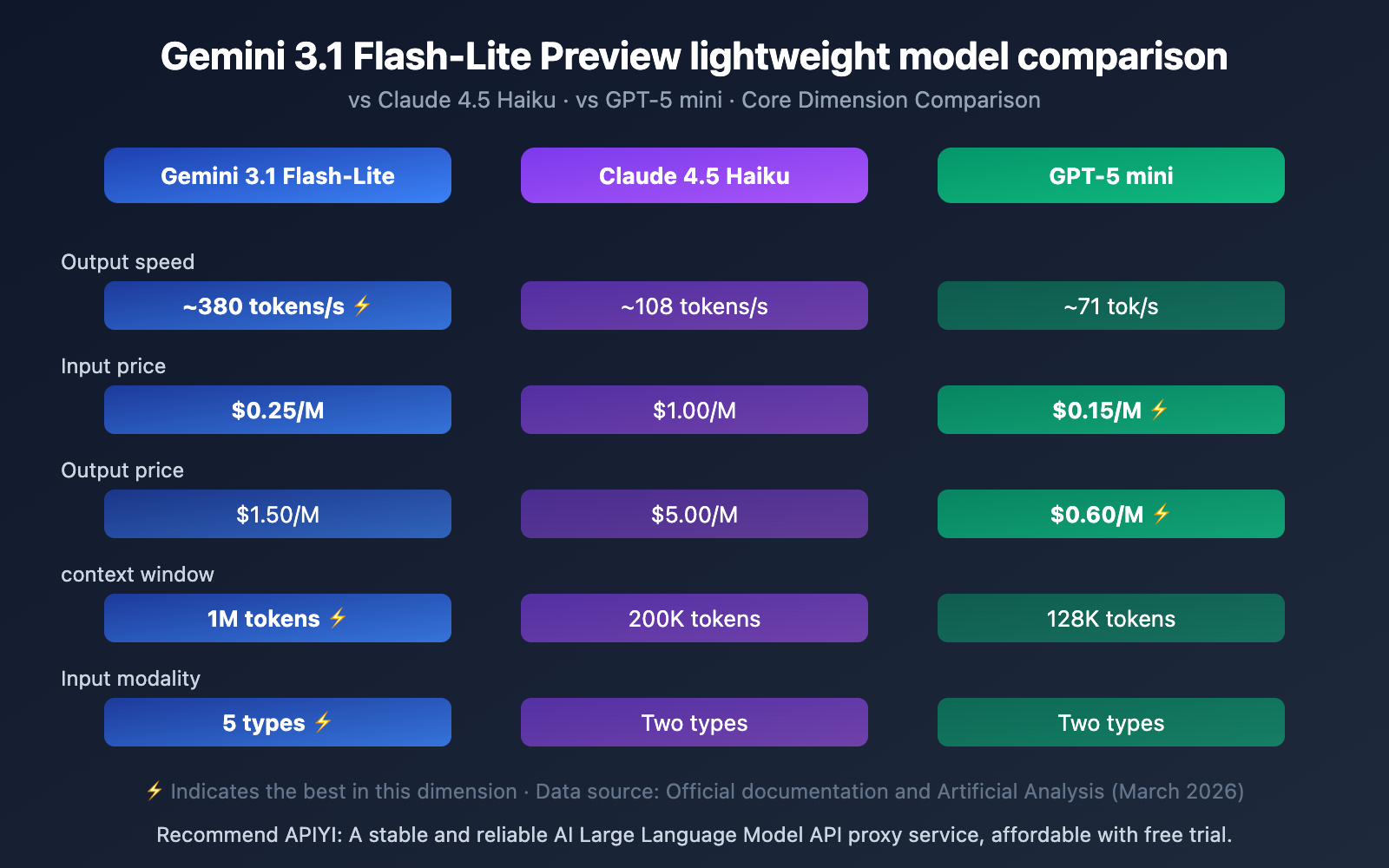
| Comparison Dimension | Gemini 3.1 Flash-Lite | Claude 4.5 Haiku | GPT-5 mini |
|---|---|---|---|
| Output Speed | ~380 tok/s ⚡ | ~108 tok/s | ~71 tok/s |
| Input Price | $0.25/M | $1.00/M | $0.15/M ⚡ |
| Output Price | $1.50/M | $5.00/M | $0.60/M ⚡ |
| Context Window | 1M tokens ⚡ | 200K tokens | 128K tokens |
| Multimodal Input | 5 types ⚡ | 2 types | 2 types |
| Thinking Mode | ✅ | ❌ | ❌ |
| Function Calling | ✅ | ✅ | ✅ |
| Batch API | ✅ | ✅ | ✅ |
Comparison Summary:
- Speed First: Flash-Lite's 380 tok/s is 3.5x faster than Haiku and 5.4x faster than GPT-5 mini.
- Cost First: GPT-5 mini has lower absolute prices, but Flash-Lite's speed advantage can offset the cost difference.
- Features First: Flash-Lite clearly leads in context length (1M) and multimodal support (5 types).
🎯 Recommendation: Which lightweight model you choose depends on your specific scenario. We recommend doing a practical comparison test via APIYI at apiyi.com. The platform supports a unified interface for all the models above, making it easy to switch and evaluate quickly.
Getting Started with Gemini 3.1 Flash-Lite Preview
Minimal Example
Here's the simplest code to call the Gemini 3.1 Flash-Lite Preview via the APIYI platform—you can run it in just 10 lines:
from openai import OpenAI

client = OpenAI(
 api_key="YOUR_API_KEY",
 base_url="https://vip.apiyi.com/v1"
)

response = client.chat.completions.create(
 model="gemini-3.1-flash-lite-preview",
 messages=[{"role": "user", "content": "Explain quantum computing in one sentence."}]
)
print(response.choices[0].message.content)
Suggestion: Get an API Key and free testing credits via APIYI at apiyi.com to quickly verify how Gemini 3.1 Flash-Lite Preview performs in your specific scenario. Recharge $100 or more and get $10 free, with discounts as low as 20% off.
Gemini 3.1 Flash-Lite Preview Use Cases
Recommended Use Cases
| Use Case | Description | Why Choose Flash-Lite |
|---|---|---|
| Large-Scale Translation | Multilingual content translation workflows | 380 tok/s ultra-fast output + low cost |
| Content Moderation | Classifying and filtering user-generated content | High-frequency calls + controllable costs |
| Data Extraction | Extracting and organizing structured data | Supports JSON Schema output |
| Agent Routing | Acting as a routing layer to distribute requests | Ultra-low latency + Function Calling |
| Document Processing | Parsing and summarizing PDFs/long documents | 1M context window + multimodal input |
| Audio Transcription | Speech-to-text and analysis | Native audio input support |
Not Recommended Use Cases
- Complex Creative Writing: Pro-level models have an advantage in deep creative tasks.
- Image/Audio Generation: Flash-Lite only supports text output.
- Real-time Streaming Conversations: Does not support Live API.
- Scenarios Requiring Highest Reasoning Accuracy: For tasks demanding ultimate accuracy, Gemini 3.1 Pro is recommended.
🎯 Scenario Suggestion: Unsure which model is best for your use case? You can quickly switch and compare between Gemini 3.1 Flash-Lite, Claude Haiku, and GPT-5 mini via APIYI apiyi.com to find the optimal solution.
Frequently Asked Questions
Summary
The key takeaways for Gemini 3.1 Flash-Lite Preview:
- Blazing Speed: ~380 tokens/sec output speed, ranking 2nd among 132 models. Its first token response time is 2.5x faster than 2.5 Flash.
- High Cost-Effectiveness: Input $0.25/M, Output $1.50/M, which is just 1/8th the cost of Gemini 3 Pro. Ideal for high-frequency, large-scale calls.
- Comprehensive Features: 1M context window + 5 input modalities + Thinking Mode + Function Calling. It's the most fully-featured lightweight model available.
- Pro-Level DNA: Built on the Gemini 3 Pro architecture, delivering strong performance on benchmarks like GPQA Diamond (86.9%).
For AI applications requiring large-scale, low-cost, and high-speed processing, Gemini 3.1 Flash-Lite Preview is currently one of the most noteworthy lightweight models.
We recommend testing it quickly via APIYI at apiyi.com. The platform's pricing matches Google's official rates, with a promotion of $10 bonus for every $100 top-up, and discounts as low as 20% off. It's a one-stop solution for accessing over 400 Large Language Models.
📚 References
-
Google AI Official Model Documentation: Complete technical specifications for Gemini 3.1 Flash-Lite Preview.
- Link:
ai.google.dev/gemini-api/docs/models/gemini-3.1-flash-lite-preview - Description: Official API documentation containing the latest parameters and feature lists.
- Link:
-
Google DeepMind Model Card: Benchmark data and safety evaluations.
- Link:
deepmind.google/models/model-cards/gemini-3-1-flash-lite/ - Description: Official model card with detailed benchmark scores and training information.
- Link:
-
Artificial Analysis Evaluation: Independent third-party performance and pricing analysis.
- Link:
artificialanalysis.ai/models/gemini-3-1-flash-lite-preview - Description: Includes independent evaluation data on output speed, TTFT, intelligence index, etc.
- Link:
-
Google Official Blog: Gemini 3.1 Flash-Lite Announcement.
- Link:
blog.google/innovation-and-ai/models-and-research/gemini-models/gemini-3-1-flash-lite/ - Description: Official announcement article detailing product positioning and core features.
- Link:
Author: APIYI Technical Team
Technical Discussion: Feel free to discuss in the comments. For more resources, visit the APIYI Documentation Center atdocs.apiyi.com.