|
VOOZH | about |
|
VOOZH | about |
Open security scanner for AI supply chain and infrastructure: agents, MCP, cloud, GPU, runtime.
10K+
Open security scanner and self-hosted control plane for AI/MCP infrastructure.
agent-bom follows package, agent, MCP, credential-name, cloud, runtime, and
skill evidence into one reachability-backed AI BOM, then tells humans and AI
agents which exposure path to fix first.
Blast radius is the core idea:
CVE -> package -> MCP server -> agent -> credentials -> tools
This container is the quickest way to run the same scanner, MCP tools, runtime surfaces, and self-hosted operator path described in the main repository README.
agent-bom is one product with two deployable container images:
agentbom/agent-bom — API/runtime image for CLI, API, scanner jobs, gateway, proxy, and MCP server modeagentbom/agent-bom-ui — UI companion image for the self-hosted control planeKeep the split. The Python runtime surfaces and the Node UI have different runtime, patch cadence, and scaling characteristics. They are companion images, not separate products.
Pilot on one workstation:
curl -fsSL https://raw.githubusercontent.com/msaad00/agent-bom/main/deploy/docker-compose.pilot.yml -o docker-compose.pilot.yml
docker compose -f docker-compose.pilot.yml up -d
# Dashboard -> http://localhost:3000
Production in your own cluster from a checked-out repo:
helm upgrade --install agent-bom deploy/helm/agent-bom \
 --namespace agent-bom --create-namespace \
 -f deploy/helm/agent-bom/examples/eks-production-values.yaml
References:
Start with one lane. The scanner, API, UI, gateway, proxy, and MCP tools all feed the same evidence model.
| Lane | Start with | Produces |
|---|---|---|
| Scan locally | docker run --rm agentbom/agent-bom:latest agents --demo | findings, SARIF, SBOM, HTML, graph exports |
| Send evidence to a control plane | docker compose -f docker-compose.pilot.yml up -d | fleet inventory, scan jobs, graph state, compliance exports |
| Enforce runtime behavior | agent-bom proxy or agent-bom mcp server from this image | MCP tools, audit JSONL, policy blocks, runtime alerts |
Discover and scan your AI agent environment
docker run --rm agentbom/agent-bom:latest agents
Workstation posture summary
docker run --rm agentbom/agent-bom:latest agents --posture
Pre-install CVE check
docker run --rm agentbom/agent-bom:latest check [email protected]
Scan a project directory
docker run --rm -v "$(pwd):/workspace" agentbom/agent-bom:latest agents -p /workspace
Export AI BOM (CycloneDX / SPDX)
docker run --rm -v "$(pwd):/workspace" agentbom/agent-bom:latest agents -p /workspace -f cyclonedx -o /workspace/ai-bom.json
IaC misconfiguration scan
docker run --rm -v "$(pwd):/workspace" agentbom/agent-bom:latest iac /workspace
The promoted self-hosted rollout is a scoped operator stack, not one forced runtime monolith. Teams typically deploy only the surfaces they need:
The API is the source of truth for auth, tenant resolution, RBAC, quotas, SCIM posture, fleet inventory, graph selectors, policy, secret posture, and audit. UI displays that posture from the API instead of inventing a parallel role or tenant model. MCP Gateway consumes the same tenant, policy, audit, secret-manager, and lifecycle posture model as the API. CLI and local MCP modes stay low-friction, but label local/dev behavior clearly when they are not enterprise-controlled.
Helm, EKS examples, Docker metadata, and GitHub Actions should expose the same environment variable names, fail-closed defaults, and required checks. The runtime image and UI image are separate deployment units for scaling and patch cadence, not separate security products.
agent-bom already supports OpenTelemetry as a real interoperability surface:
/v1/tracesPolicy is native by default. The shipped gateway and proxy use the repo's JSON policy engine, not an embedded OPA/Rego runtime. That is intentional: one shared policy model across scan, gateway, proxy, and runtime, without adding an extra policy binary to the operator stack.
The right enterprise story is:
agent-bom is designed to run inside your own AWS account, VPC, EKS cluster,
IAM boundary, databases, and SSO stack.
Recommended shape:
agent-bom proxy sidecars or local wrappers for the MCP workloads that need inline enforcementEverything stays in your infrastructure by default; optional egress for DB refresh, enrichment, SIEM, OTLP, and webhooks is operator-controlled.
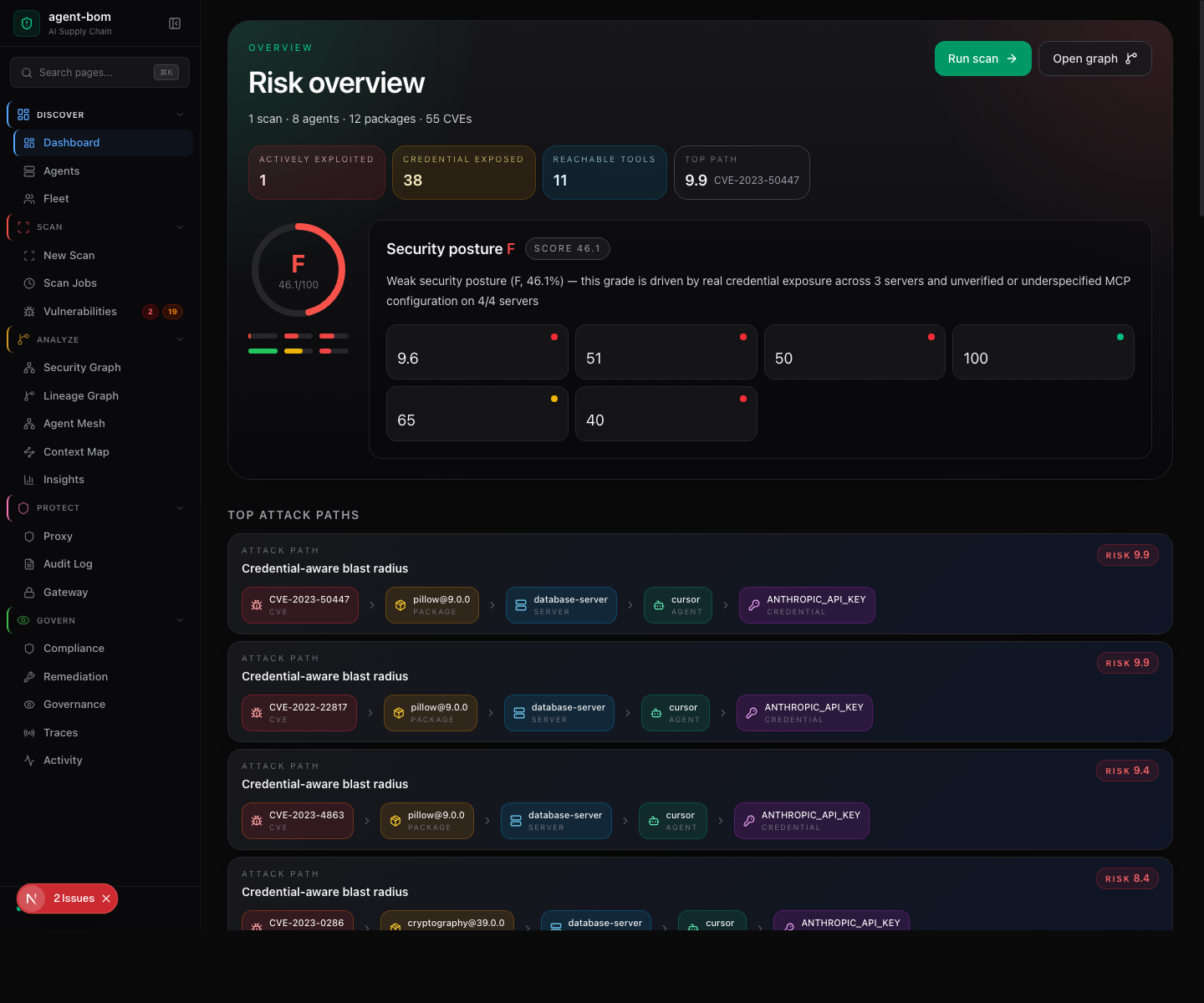
AGENT_BOM_DISABLE_DOCS=1 so /docs, /redoc, and /openapi.json are not exposed as unauthenticated helper routesAGENT_BOM_API_LOCAL_PATH_SCANS=disabled; enable API-local filesystem scans only for an explicit single-tenant mounted workspaceDashboard overview:
👁 agent-bom dashboard overview
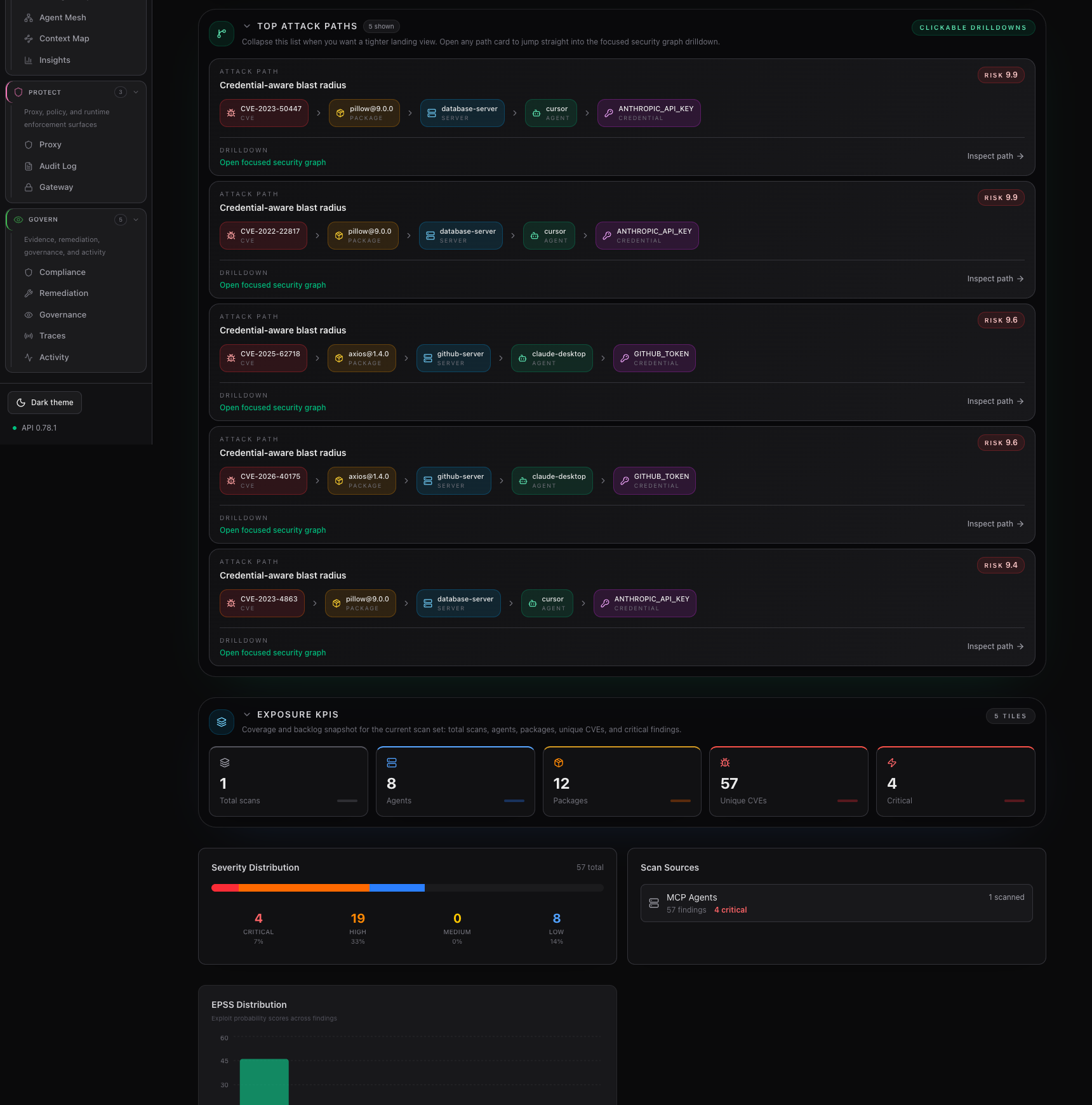
Attack paths and exposure:
👁 agent-bom dashboard attack paths and exposure
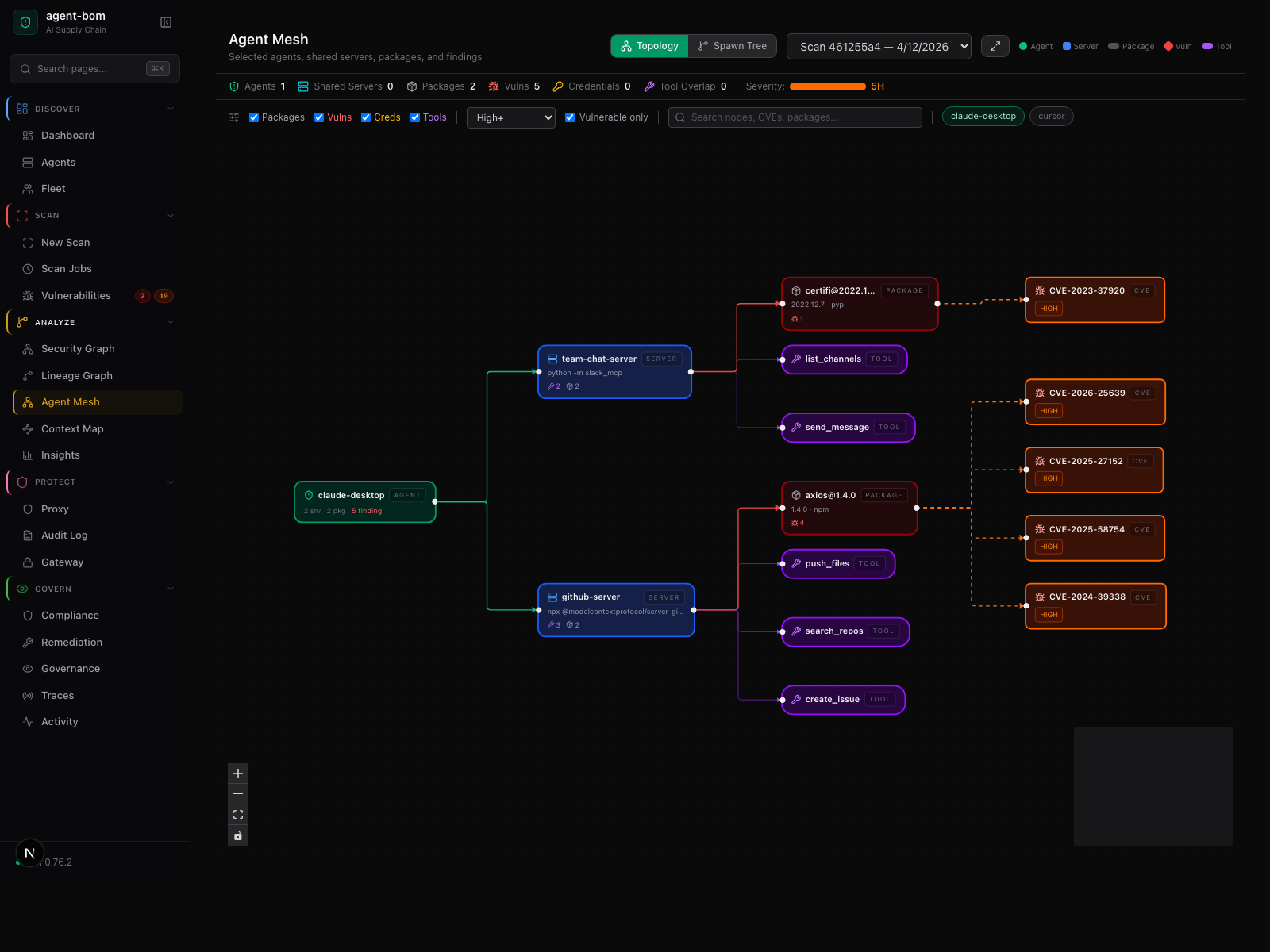
Focused agent mesh graph:
| Tag | Description |
|---|---|
latest | Most recent stable release |
0.88.5 | Current stable version (pinned) |
Published images:
agentbom/agent-bom — main runtime image for CLI scans, API/control-plane
jobs, gateway, proxy-adjacent entrypoints, and MCP server modeagentbom/agent-bom-ui — standalone Next.js browser UI image for
self-hosted deployments that run the UI separately from the APIFor local Docker Compose examples, the repo may use local-built image aliases
such as agent-bom:latest and agent-bom-ui:latest. Those are compose-facing
names for local builds from this repo, not a second published product line.
Content type
Image
Digest
sha256:c0e559d0b…
Size
78.6 MB
Last updated
about 6 hours ago
Requires Docker Desktop 4.37.1 or later.