India is all set to send its third mission to the moon with an aim to achieve what its predecessor could not. The mission is set to “demonstrate end-to-end capability in safe landing and roving on the lunar surface”. A successful soft landing will make India the fourth country, after the United States, Russia, and China, to achieve the feat. The position remains vacant after the missions from Israel and India in 2019 crash-landed and the spacecraft carrying a lander-rover from Japan and a rover from UAE failed in 2022. The first moon rocket, Chandrayaan-1, was launched in 2008, and was successfully inserted into lunar orbit.
While the objectives of the Chandrayan 3 remain the same, scientists at the Indian Space Research Organisation (Isro) have learnt from the previous mission. The lander’s design was improved after a series of tests to see how it performs under various circumstances, such as inability to reach the landing spot, failure of electronics or sensors, velocity being higher than needed, among others.
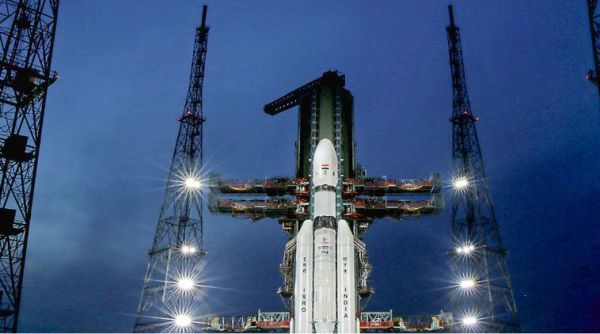
After launching into an orbit around the Earth at an altitude of 179 km on July 14, the spacecraft will gradually increase its orbit in a series of manoeuvres to escape the Earth’s gravity and slingshot towards the moon. After reaching close to the moon, the spacecraft will need to be captured by its gravity. Once that happens, another series of manoeuvres will reduce the orbit of the spacecraft to a 100×100 km circular one. Thereafter, the lander, which carries the rover inside it, will separate from the propulsion module and start its powered descent.
This whole process is likely to take around 42 days, with the landing slated for August 23 at the lunar dawn. Lunar days and nights last for 14 earth days. The lander and rover are built to last only one lunar day — they can’t survive the extreme drop in temperatures during lunar nights — and hence have to land right at dawn.
“There is an anomalous depletion in sodium and potassium at the site, whereas there is an enrichment in sulfur found in the soils at the highland landing site,” said the study published in the journal Nature Communications Earth and Environment.
As of now, water-ice on the Moon is understood to be present only in the polar regions, particularly under the craters where the Sun’s rays are unable to reach.
The successful hop experiment came as a surprise for everyone since ISRO had never talked about it previously, and it was never a part of original mission
The ISRO chairman disclosed that a joint moon-landing mission with Japan space agency JAXA, originally named LUPEX, or Lunar Polar Exploration, would be the Chandrayaan-5 mission. He did not mention the expected time frame for launch.
The discovery of the ancient crater with a diameter of 160 km continues to prove why Chandrayaan-3 was one of the most important moon missions of recent times.
Scientists are looking at whether the moon can serve as a base for deep space exploration and whether long-term habitation is possible on the Earth’s satellite.
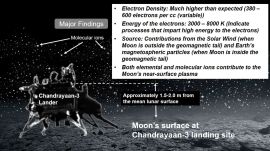
Findings from one of Chandrayaan 3’s scientific instruments support the hypothesis of a magma ocean on the Moon in its earliest phase. They also suggest a churn of lunar crust, probably caused by an asteroid hit.
Big-hitting Punjab Kings hunt down 210 to beat Chennai Super Kings by 5 wickets
Sports15 min ago
Punjab Kings knocked down a target of 210 with eight balls to spare to beat the Chennai Super Kings by five wickets in the 2026 Indian Premier League (IPL) at the Chepauk Stadium. It was CSK's sixth consecutive defeat at home and they have now lost their first two games of the season. Conversely, PBKS have started the 2026 season with two victories.





![👁 How can someone be the deputy leader [of the AAP] in the Upper House if they’re not willing to take on the BJP?](https://images.indianexpress.com/2026/01/Atishi.jpg?resize=150,83)