In the heart of Delhi, a stairway to the stars: The scientific secrets of Jantar Mantar
Long before the age of digital telescopes, Maharaja Jai Singh II envisioned a playground for astronomers in the center of Delhi. Jantar Mantar isn't just a collection of striking red geometric structures; it is a high-precision scientific instrument made of stone.


- 👁 travel1 / 7
Located in the heart of the capital, Delhi’s Jantar Mantar is far more than a historic landmark; it is a profound intersection of science, architecture, and royal ambition. Commissioned in the 18th century to map the heavens with unparalleled precision, this celestial observatory harbors several lesser-known details that reveal the true genius of its design. (Source: Photo by Aanya Mehta )
- 👁 travel2 / 7
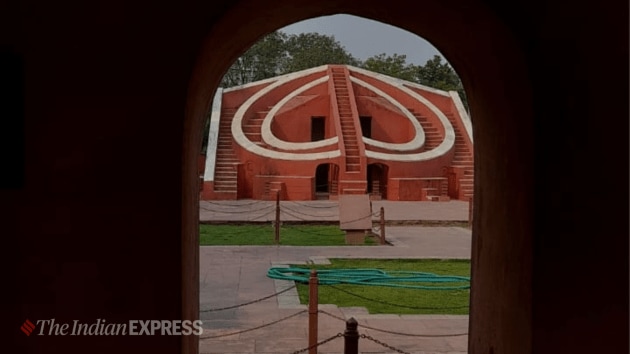
The Name Has a Scientific Meaning: The term Jantar Mantar comes from the Sanskrit words Yantra (instrument) and Mantra (calculation or formula), meaning “instruments for computation,” not magic or mysticism as the name might suggest. (Source: Photo by Aanya Mehta )

- 👁 travel3 / 7
Built to Correct Astronomical Errors: Maharaja Jai Singh II commissioned the observatory after finding inaccuracies in existing astronomical tables. He even consulted Persian, Islamic, and European sources to refine his calculations. (Source: Photo by Aanya Mehta )

- 👁 travel4 / 7
A Rare Blend of Global Knowledge: Jai Singh sent scholars to study observatories in places like Samarkand and Europe, making Jantar Mantar a product of cross cultural scientific exchange long before globalisation. (Source: Photo by Aanya Mehta )
- 👁 travel5 / 7
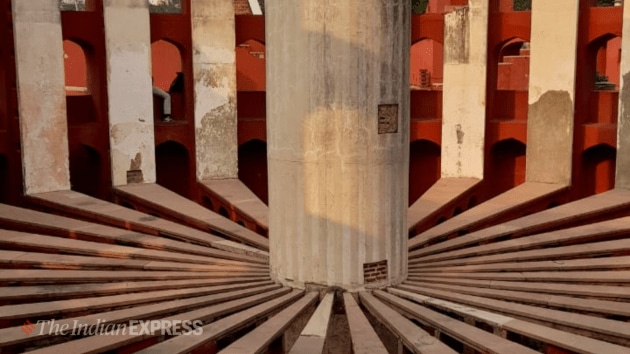
Designed for Extreme Precision: The instruments were built in masonry instead of metal because stone structures expand less with heat, allowing more stable and accurate observations in Delhi’s climate. (Source: Photo by Aanya Mehta )
- 👁 travel6 / 7
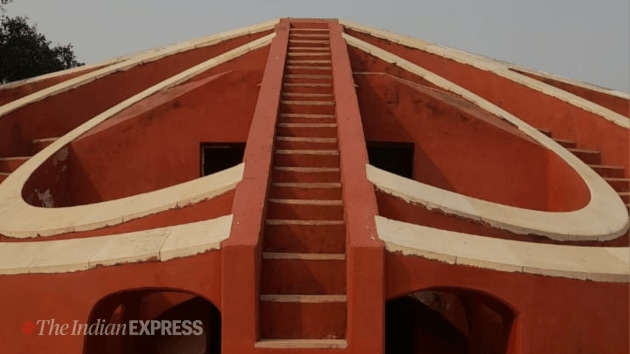
Each Instrument Has a Specific Purpose: The complex includes devices like the Samrat Yantra (sundial), Jai Prakash Yantra (to map the sky), and Ram Yantra (to measure altitude and direction of celestial bodies), forming a complete open air astronomical lab. (Source: Photo by Aanya Mehta )

- 👁 travel7 / 7
Hidden in Plain Sight: Despite being surrounded today by the busy streets of New Delhi, the site was originally built on the outskirts of the Mughal city, where clear skies and minimal obstruction allowed accurate celestial observations. (Source: Photo by Aanya Mehta )