
Monday, April 6, 2026
Top 10 Java 21 Certification Practice Questions for 1Z0-830 Exam
Hello guys, a lot of you emailed me to share sample questions for 1Z0–830 exam or Java 21 certification exam and free coupons for my Udemy course “1Z0–830 Java SE 21 Developer Professional Exam Practice Test” .
I am sorry I cannot share free coupon at the moment as I put a lot of effort into it and I appreciate if you could buy it but I am going to share sample questions with you so that you get ideas about what to expect in real Java 21 Certification exam with code 1Z0–830 and also share $9.9 coupon so that you can get the course for best price.
If you don’t know, Java 21 Certification Exam or 1Z0–830 is one of the toughest Java exam I have seen so far. The questions are long and lengthy, options are many and chances of missing things are very high.
That’s the reason they have increased the time from 90 minutes to 120 minutes but kept the number of questions same, I mean 50 questions.
So they have given you more time, almost two minutes 10 seconds per question but let me tell you its not enough for most questions.
That’s why it becomes increasingly important for you to solve as many sample questions as possible and give as many mock test as you can to improve your speed and accuracy.
After all, exam is not cheap and you have to spend close to $250 to get the voucher but most importantly you want to pass in first attempt as I have found that’s your best chance.
By the way, I have also shared more than 266+ questions on my Udemy course“1Z0–830 Java SE 21 Developer Professional Exam Practice Test” and you can use coupon code JAVA21FANS to get it for just $9.9.
10 1Z0–830 Sample Questions for Java 21 Certification Exam Practice
Without any further ado, here are the 10 sample questions for Java 21 certification exam, also known 1Z0–830 exam. I will also share solution and explanation at the end of the article for you very soon but before that I would like you to solve this question and paste your answer in comments.
- You are given the following code snippet:
String[] letters = {"x", "y", "z", "w", "v", "u"};
String output = "Sequence:";
for (String ch : letters) {
 output += "-" + ch;
}
Which of the following code fragments produces the same result as the above loop using Java Streams?
A.
String output = Arrays.stream(letters)
 .reduce("Sequence:", (s1, s2) -> s1 + "-" + s2);
B.
String output = "Sequence:";
output += Arrays.stream(letters).parallel()
 .reduce((s1, s2) -> s1 + "-" + s2).get();
C.
String output = Arrays.stream(letters).parallel()
 .reduce("Sequence:", (s1, s2) -> s1 + "-" + s2);
D.
String output = "Sequence:";
output += Arrays.stream(letters).parallel()
 .reduce("", (s1, s2) -> s1 + "-" + s2);
2. Given the code fragment:
String[] txt = {"AB", "CD"};
x:
for (String value : txt) {
 var values = value.toCharArray();
 for (int i = values.length - 1; i >= 0; i--) {
 if (i < 1) continue x;
 else if (values[i] == 'C') break;
 System.out.println(txt[i]);
 }
}
What is the result?
- A) A
- B) ABD
- C) AD
- D) AB
- E) CDCD
- F) ABAB
- G) No output is produced.
3. Which local variable initialization statement is correct?
A) var 24H = Duration.ofHours(24);
B) var backslashChar = '\\';
C) var doubleSlash = "\\\\";
D) var underscoreIndex = "A_Z".indexOf("_");
E) None of the above
4. Given following code, what would be the result?
int[] values = {-1,-2,0,2,1};
Deque<Integer> numbers = new ArrayDeque<>();
for (int i = 0; i < values.length; i++) {
 if (i%2 == 0) {
 numbers.offerFirst(Integer.valueOf(values[i]));
 }else{
 numbers.offerLast(Integer.valueOf(values[i]));
 }
}
System.out.println(numbers);
Options are:
A. [1, 0, -1, -2, 2]
B. [-1, 0, -1, -2, 2]
C. [-1, 0, 1, -2, 2]
D. [-1, -2, -0, 1, 2]
E. None of the Above
5. What is the output of this program?
public class Test {
 public static String test(Number value) {
 return switch(value) {
 case Double num when num > 0 -> "Positive";
 case Double num when num < 0 -> "Negative";
 case Double num when num == 0 -> "Zero";
 default -> "Invalid";
 };
 }
public static void main(String[] args) {
try {
Number num = Integer.valueOf(1);
System.out.println(test(num));
num = null;
System.out.println(test(num));
} catch(Exception e) {
System.out.println("Error");
}
}
}A.
Error
Error
B.
Invalid
Error
C.
Positive
Invalid
D.
Invalid
Invalid
E.
Positive
Error
F. None of the above
6. What is the output of this code?
DateTimeFormatter fmt = DateTimeFormatter.ofPattern("CM");
var x = LocalDate.of(2001, 2, 5);
var y = Period.ofMonths(3).plusDays(1);
var z = x.plus(y);
System.out.println(fmt.format(z));
A. 56
B. 83
C. 38
D. 65
E. None of the above
7. Given:
IntStream.concat(IntStream.range(0,3), IntStream.range(3,7))
 .parallel()
 .sorted()
 .filter(i -> i < 5 && i > 1)
 .mapToObj(i -> String.valueOf(i))
 .forEach(s -> Logger.getLogger("test").log(Level.INFO, String.valueOf(s)));
What is the result?
Options:
A. Values of 2 3 4 are logged in unpredictable order
B. Values of 6 5 1 0 are logged in this order
D. Values of 4 3 2 are logged in this order
E. Values of 2 3 4 are logged in this order
F. Values of 0 1 5 6 are logged in this order
G. None of the above
8. Given the code fragment:
List<Integer> nums = Collections.synchronizedList(new ArrayList<>());
Callable<String> c = () -> {
 for (int i = 0; i < 5; i++) {
 nums.add(i);
 }
 return null;
};
Collection<Callable<String>> tasks = List.of(c, c, c); // Three identical Callable instances
ExecutorService es = Executors.newFixedThreadPool(2);
try {
 List<Future<String>> results = es.invokeAll(tasks);
 es.shutdown();
 nums.stream().forEach(i -> System.out.print(i));
} catch (InterruptedException e) {
 System.out.println("error");
}
What is the result?
Options:
A. Some of the integers in the range 0 to 4 in the ascending order are printed.
B. Some of the integers in the range 0 to 4 in the descending order are printed.
C. All of the integers in the range 0 to 4 in the ascending order are printed. Each integer appears 3 times the result.
D. None of the above
9. Given
List<Integer> nums = Collections.synchronizedList(new ArrayList<>());

Callable<String> c = () -> {
 for (int i = 0; i < 5; i++) {
 nums.add(i);
 }
 return null;
};
Collection<Callable<String>> tasks = List.of(c, c, c);
ExecutorService es = Executors.newFixedThreadPool(2);
try {
 List<Future<String>> results = es.invokeAll(tasks);
 es.shutdown();
 nums.stream().forEach(i -> System.out.print(i));
} catch (InterruptedException e) {
 System.out.println("error");
}
What is the result?
Options:
A. Some of the integers in the range 0 to 4 in ascending order are printed.
B. Some of the integers in the range 0 to 4 in descending order are printed.
C. All of the integers in the range 0 to 4 in ascending order are printed. Each integer appears 3 times in the result.
D. All of the integers in the range 0 to 4 in stochastic (random) order are printed. Each integer appears 3 times in the result.
E. Some of the integers in the range 0 to 4 in stochastic (random) order are printed.
F. All of the integers in the range 0 to 4 in descending order are printed. Each integer appears 3 times in the result.
G. The word “error” is printed.
H. None of the above
10. Given
public record Food(String name, int calories) {}

public class Test {
 public static void main(String[] args) {
 Food[] foods = {new Food("Apple", 200),
 new Food("Banana", 400),
 new Food("Cake", 800),
 new Food("Donut", 700)};
 // Line n1
 }
}
Which code fragment, when inserted at Line n1, finds a Food object with the lowest number of calories from a stream of randomly selected Food objects?
Options:
A.
Food food = IntStream.generate(() -> ThreadLocalRandom.current().nextInt(foods.length-1))
 .limit(10)
 .mapToObj(i -> foods[i])
 .max((f1, f2) -> f1.calories() - f2.calories())
 .get();
B.
Food food = IntStream.generate(() -> ThreadLocalRandom.current().nextInt(foods.length-1))
 .mapToObj(i -> foods[i])
 .sorted((f1, f2) -> f1.calories() - f2.calories())
 .findFirst()
 .get();
C.
Food food = IntStream.generate(() -> ThreadLocalRandom.current().nextInt(foods.length))
 .mapToObj(i -> foods[i])
 .sorted((f1, f2) -> f1.calories() - f2.calories())
 .findFirst()
 .get();
D. Both of them
E. None of the above
Top Java 21 Certification 1Z0–830 Resources (Books, Courses, and Practice Tests)
As many of you also asked for Java 21 certification resources to crack the 1Z0–830 exam like books, online courses, and practice tests so here they are
Books
- OCP Java 17 & 21 Programmer Certification Fundamentals Part 1: 1Z0–829 1Z0–830 by Hanumanth Deshmukh
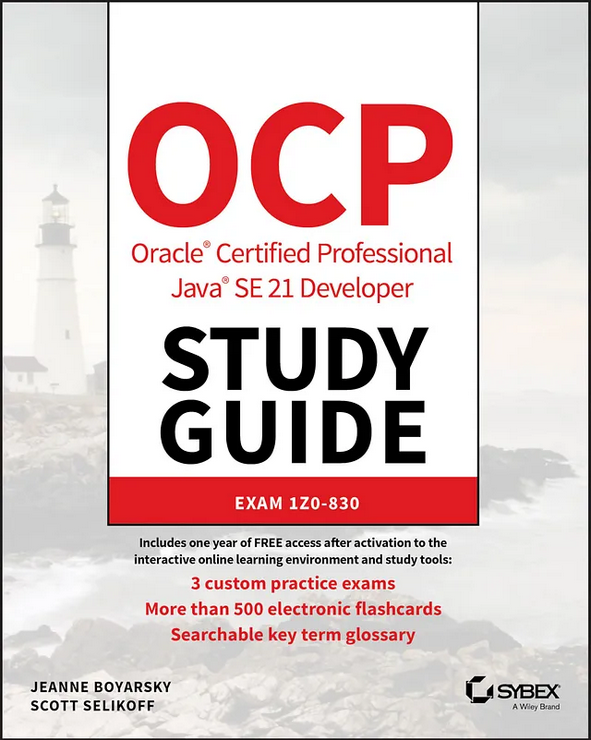
- OCP Java SE 21 Developer Study Guide (1Z0–830) by Scott Selikoff & Jeanne Boyarsky
- Java: The Complete Reference, Thirteenth Edition (Covers Java SE 21)
2. Courses
- Java SE 21 Developer | Oracle Certified Professional 1Z0–830 (video course)
- Java 21, Java 17, Java 11, Java 8 (adv.) and Spring Boot 3
- Java Masterclass 2025: 130+ Hours of Expert Lessons
- Oracle Java SE 21 Developer Professional: 1Z0–830
- Java Bootcamp: Learn Java with 100+ Java Projects

3. Practice Tests
Here are the practice tests courses you can take on Udemy. These contains multiple choice and multi-selection questions for you to practice in exam like environment.
- 1Z0–830 Java SE 21 Developer Professional Exam Practice Test
- Java 21 Professional Certification — — 6 full Tests
That’s all on these Java 21 Certification Sample question post guys. I hope you like these questions. Try to solve them today and I will update the post with answers tomorrow or day after tomorrow.
And, in case you need. have also shared more than 266+ questions on my Udemy course“1Z0–830 Java SE 21 Developer Professional Exam Practice Test” and you can use coupon code JAVA21FANS to get it for just $9.9.
Other Java 21 Exam related articles which I have shared earlier
- Is 1Z0–830 Java SE 21 Developer Professional OCP 21 the Toughest Java Exam Ever?
- 1Z0–829 (Java 17) or 1Z0–830 (Java 21)? Which Oracle Java Certification to Choose in 2025?
- Top 5 Books, Courses, and Practice Tests for Java 21 Certification Exam (1Z0–830)
- Does Oracle’s Java Certifications Really Worth it in 2025?
- Java 21 Exam Syllabus and Official Page
Thank for reading this article, if you like this article then please share with you friends and colleagues, if you got any questions then feel free to ask.
P.S. — If you are looking for a course to prepare for Java SE 17 certification then Oracle Java Certification — Java 17 Practice Testfrom Udemy is the right place to start it. It explains about new features of Java17 required for OCAJP 17 exam.


