|
VOOZH | about |
|
VOOZH | about |
Every business, from the corner mom-and-pop shop to the sprawling global corporation, thrives on meaningful relationships. Marketing publications speak about customer satisfaction, sales conversions, and brand loyalty, but at the heart is an unspoken trust between businesses and their customers. Cultivating, nurturing, and understanding these relationships is the key to success, but doing so isn’t always easy.
That’s where customer relationship management (CRM) software comes into play. It’s an integral tool that tracks customer interactions and information so that — whether through marketing automation or real, in-person customer service — a business can deliver personalized, knowledgeable service, messaging, and support to each customer. If you’re aiming to build and maintain those coveted customer relationships, it’s a must-have tool.
There are a myriad of CRM choices out there. So how do you decide?
Today, we’ll dive deep into the world of open source CRM software, discuss its benefits, explore the best ones out there, and, of course, shine a spotlight on our top pick: Jetpack CRM.
Open source software is, by definition, open to use by anyone for any purpose. It’s meant for contributors to play with, add to, and customize for themselves and for everyone else in the community. As a result, using open source software provides unparalleled freedom from corporate greed and unfair regulation. Learn more about open source.
Here are a few reasons open source CRM systems are so appealing:
Have you ever bought a shirt that’s either a bit too snug or slightly too loose? With open source CRM, that’s never a concern. You have the full freedom to tweak, modify, and reimagine the software to align perfectly with your business operations and goals.
Want a specific feature? Add it. Think something’s redundant? Chuck it. It’s all in your hands.
There’s a distinct sense of community in the open source world. When you choose an open source CRM, you’re joining a vibrant community of developers, enthusiasts, and users.
Have a question? Pose it. Stuck somewhere? There are countless forums, discussion boards, and community spaces brimming with experts ready to lend a hand or share some wisdom. It’s like having a 24/7 help desk, but one that’s fueled by passion and collaboration.
Budgets can be finicky and businesses are always looking to maximize value without breaking the bank. Open source CRMs often come with no licensing fees.
Yes, you read that right.
Instead of splurging on expensive proprietary solutions, you can invest that budget elsewhere, maybe in training your team or marketing. Plus, with the ability to choose only the features you need, you’re not paying for unnecessary bells and whistles. It’s value packed and wallet friendly!
So, open source CRMs bring customizability, community strength, and cost-effectiveness to the table. But what should you be considering when picking one out?
Choosing an open source CRM? That’s a good decision!
But before you celebrate, there’s the matter of picking a specific one. Just as every superhero has their unique powers, each CRM comes with special features. But some elements are essential.
Here’s what you should be on the lookout for:
This is the bread and butter of any CRM system. You need to know your customers to serve them better. A robust contact management system lets you keep detailed profiles, track interactions, and maintain histories. This isn’t just about names and email addresses — you need to be able to understand their preferences, behaviors, and patterns.
Sales are the power plant of any business. An efficient CRM should help streamline and automate your sales processes. Think of features that assist in lead scoring, pipeline management, and even forecasting. With the right tools in place, your sales team can free themselves from hours of admin tasks and spend more time on what they do best — selling.
What you can measure, you can manage. And in the vast universe of customer interactions and sales, there’s a lot to measure. Your chosen CRM should provide insightful analytics and clear reporting tools. Whether it’s tracking sales performance, monitoring customer behavior, or analyzing campaign outcomes, clarity is key.
You probably use a plethora of tools and platforms in your business operations. It’s crucial that your CRM doesn’t exist in isolation. Integration capabilities allow your CRM to play nice with other tools like enterprise resource planning systems, email marketing platforms, and ecommerce solutions. The goal is a seamless flow of information across your business ecosystem.
Your business won’t always be what it is today. It’ll grow, evolve, and transform. And when it does, you want a CRM that grows with it. Look for scalability options and customization. As your needs change, your CRM should adapt, not become a bottleneck.
Finally, remember that a tool is only as good as its usability. A complex, convoluted CRM will only serve to frustrate your team. Opt for an intuitive solution, easy to understand, and quick to implement. After all, you want to spend your time building relationships, not scratching your head over software.
Now that you’re equipped with knowledge of what to seek in a CRM, let’s explore some top contenders in the open source arena.
The beauty of the open-source landscape is its rich diversity. And when it comes to CRM software, the choices are bountiful. We’ve curated a list of the top eight that are truly a cut above the rest.
Jetpack CRM is a true gem in the CRM cosmos, and it’s designed specifically for WordPress users. Let’s shed some light on what makes it shine.
Jetpack CRM integrates seamlessly with various tools, including Mail Campaigns, Zapier, and the broader Jetpack suite. And, as a WordPress-centric tool, you’ll find that it effortlessly syncs with WooCommerce.
WordPress has always believed that you deserve tools crafted with love for the platform. Jetpack CRM embodies that ethos.
Venturing further into our exploration, we land on SuiteCRM. SuiteCRM emerged from the shadows of SugarCRM when the latter shifted its focus to a proprietary approach. Now, SuiteCRM stands tall with its own set of features and innovations.
SuiteCRM isn’t shy when it comes to playing with other tools. Integrate with popular platforms like Mailchimp, Microsoft Outlook, and even Google Calendar. Plus, with its API, the doors to myriad other integrations are wide open.
SuiteCRM has certainly carved a niche for itself, providing a feature-rich alternative to some heavy hitters in the CRM domain.
Next up is Odoo CRM, a part of the Odoo suite. While there are more features available, let’s zoom in on the CRM aspect.
As a part of the larger Odoo family, the CRM integrates effortlessly with other Odoo applications, be it ecommerce, marketing, or sales. Outside of the Odoo sphere, API functionalities facilitate connections with other platforms.
Odoo CRM thrives in its ecosystem, bringing to the table a holistic business solution, with CRM as one of its stars.
Looking further into the open source CRM landscape, we stumble upon Vtiger, a force to be reckoned with. Established as an offshoot of SugarCRM, Vtiger has taken on a life of its own and cultivated a loyal user base.
Vtiger plays nicely with the likes of PayPal, Outlook, Office 365, and many other tools. And if you have the capabilities, their API welcomes all kinds of custom integrations.
Bridging the gap between ecommerce and CRM, there’s OroCRM. This CRM shines brightly for ecommerce businesses using specific software.
As an ecommerce-focused tool, OroCRM smoothly integrates with various platforms. And, through its REST API, the integration possibilities are fairly vast.
With OroCRM, ecommerce businesses have a trusty sidekick, ensuring they’re always connected with their customers.
EspoCRM brings an agile and easily-customizable solution to the CRM table. With a flexible design and keen sense for the user experience, EspoCRM ensures businesses can adapt it to fit their unique needs.
EspoCRM supports integrations with Google Calendar, Mailchimp, and more. Plus, its robust API allows further expansion and integration with other tools you might be using.
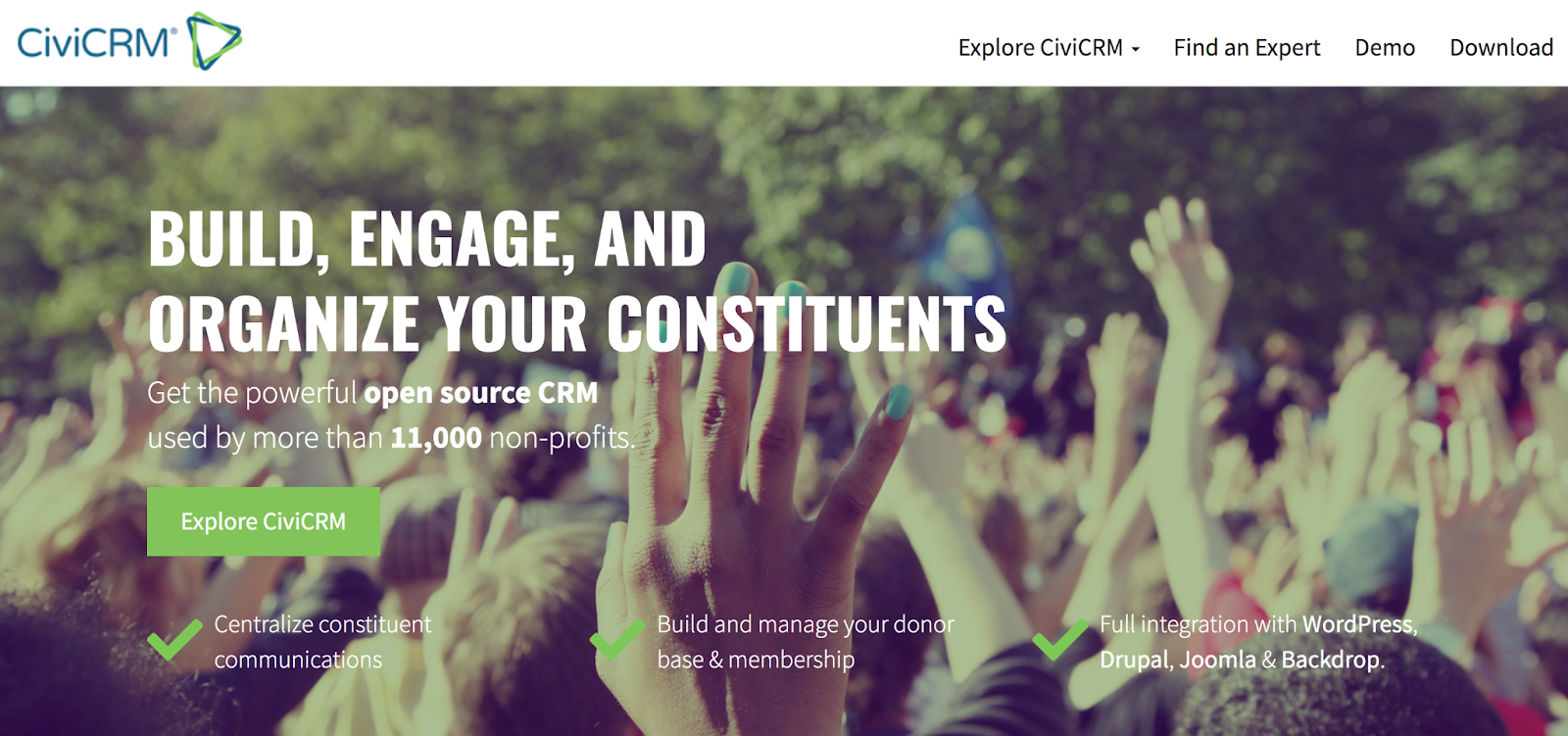
Primarily tailored for non-governmental and civic organizations, CiviCRM offers a bouquet of tools that make donor management, event organization, and outreach more efficient.
Tailored for civic organizations, CiviCRM integrates seamlessly with various helpful platforms.
An underdog in the CRM arena, Axelor CRM offers a broad suite of business tools.
Axelor shines with its API, letting businesses tie it to any other software. Plus, out-of-the-box integrations include Office 365, G Suite, and many more tools.
An open source CRM is essentially a customer relationship management tool where the source code is open for all to see, modify, and improve upon. It’s not just a piece of software; it’s a collaborative effort, driven by a community eager to create a transparent and adaptable solution. It’s about empowering organizations, regardless of size, to have a tool tailored to their needs.
Proprietary CRM software is like a sealed black box. You can use it, but you can’t peek inside or tweak its mechanics. On the flip side, open source CRM is like a transparent puzzle, where each piece (code) is visible and can be modified. While both have their pros and cons, open source offers flexibility and adaptability, often at a lower cost.
Absolutely! Open source CRMs are not only budget-friendly but also customizable. Startups and small businesses can mold them to fit their unique needs, ensuring they’re not paying for features they don’t need. Plus, they can grow and adapt the CRM as their business scales.
Yes, you can! While the exact steps might vary based on the CRM you’re migrating from and to, most CRMs, including Jetpack CRM, offer tools or plugins to assist in data migration. And if you ever hit a snag, the robust community support is always there to lend a hand.
While CRMs are designed to streamline operations, businesses can face challenges like data migration, staff training, and ensuring the software aligns with their sales process. The good news? With a user-friendly solution like Jetpack CRM, many of these challenges are reduced.
When you integrate Jetpack CRM with WordPress, you’re blending the best of both worlds. You get a powerful website platform seamlessly connected to an intuitive CRM system. It means effortless data syncing, ease of use, and the advantage of managing both your website and customer relationships from a single dashboard.
Plus, Jetpack’s suite of tools work harmoniously with Jetpack CRM, making it the Swiss army knife for businesses running on WordPress.
Mike is the Head of Product for Jetpack CRM at Automattic, where he helps shape the future of one of the most flexible CRM solutions for WordPress. Mike co-founded Zero BS CRM which was acquired by Automattic in 2019 and became Jetpack CRM.
Nurture Contacts. Grow your Business.
Jetpack CRM has all of the tools you need to grow your business. It’s also modular, so you can customize it to suit your needs.
Get startedHave a question?
Comments are closed for this article, but we're still here to help! Visit the support forum and we'll be happy to answer any questions.
View support forum