


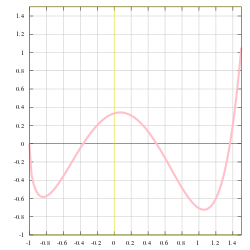
👁 {\displaystyle {\begin{aligned}&\scriptstyle \\&\textstyle f(x)={\frac {(4x^{3}-6x^{2}+1){\sqrt {x+1}}}{3-x}}\end{aligned}}}
Functio in arte mathematica est congruentia inter duas copias, quae ad quodque elementum primae copiae unum elementum secundae copiae destinat.[1] Prima copia dominium dicitur, altera codominium. Si 👁 {\displaystyle x}
quoddam elementum primae copiae designat, 👁 {\displaystyle x}
variabilis independens est. Si 👁 {\displaystyle f}
functio est, quae mathematice per 👁 {\displaystyle y=f(x)}
scribitur et significat "👁 {\displaystyle y}
esse elementum codominii ad elementum 👁 {\displaystyle x}
dominii destinatum", variabilis 👁 {\displaystyle y}
dependens appellatur.
Si plura elementa sunt, quae 👁 {\displaystyle y}
ad elementum 👁 {\displaystyle x}
destinari possint, congruentia non est
functio. Exempli gratia: sit 👁 {\displaystyle f(x)=\pm {\sqrt {x}}}
sintque dominium et codominium copiae
numerorum realium 👁 {\displaystyle \mathbb {R} }
. Haec congruentia non est functio, quod elemento 👁 {\displaystyle x}
(velut 4) duo elementa (i. e. 2, -2) attribuuntur. Sin autem codominium est copia numerorum realium non-negativorum vel functio est velut 👁 {\displaystyle f(x)=+{\sqrt {x}}}
, haec congruentia functio appellatur.
Functionem definire licet per formulam aut regulam aut tabulam, dum modo unum elementum codominii sit quod ad quodque elementum dominii destinetur. Functiones sunt species relationis: functio 👁 {\displaystyle f}
est copia parium ordinatarum (a, b) ut 👁 {\displaystyle f(a)=b}
.
Analysis est theoria functionum. Analysis numerorum realium est theoria functionum quarum dominium (et codominium) est 👁 {\displaystyle \mathbb {R} }
; analysis numerorum complexorum est analysis earum, quarum dominium est 👁 {\displaystyle \mathbb {C} }
. G. H. Hardy dicit, "Illa notio, quantitatem variabilis ex quadam alia dependere, fortasse notio potissima in tota arte mathematica est."[2]
Si dominium est copia quantitatum binarum, sicut 👁 {\displaystyle \mathbb {R} ^{2}}
, functio duas variabiles independentes habet. Exempli gratia, 👁 {\displaystyle f(x,y)=x^{2}+y^{2}}
. Quae functio 👁 {\displaystyle f}
par elementorum 👁 {\displaystyle (x,y)}
ad unum elementum codominii (quod est 👁 {\displaystyle \mathbb {R} }
) destinat, velut par 👁 {\displaystyle (2,3)}
ad 👁 {\displaystyle 2^{2}+3^{2}=4+9=13}
. Functiones autem tres, quattuor pluresve variabiles independentes habere possunt.
Altera notatio functionum est notatio lambda, quae variabiles independentes post lambda litteram enumerat. Scribitur: 👁 {\displaystyle f=\lambda (x).x^{2}}
quod eandem functionem atque 👁 {\displaystyle f(x)=x^{2}}
describit. Forma sicut 👁 {\displaystyle \lambda (x).x^{2}}
appellatur combinatoria.
Si ad quoddam elementum 👁 {\displaystyle y}
codominii aut nullum aut unum elementum 👁 {\displaystyle x}
dominii destinatur, functio appellatur functio iniectiva, aut functio unum elementum uni elemento attribuens. Si omne elementum 👁 {\displaystyle y}
codominii habet elementum 👁 {\displaystyle x}
(aut plura elementa 👁 {\displaystyle x_{1},x_{2},x_{3},}
...) dominii quod ad 👁 {\displaystyle y}
destinatur, functio appellatur functio superiectiva. Functio quae simul iniectiva et superiectiva est, functio biiectiva appellatur.
Quaedam functio biiectiva 👁 {\displaystyle f}
habet functionem inversam 👁 {\displaystyle f^{-1}}
, cuius dominium est codominium functionis 👁 {\displaystyle f}
cuiusque codominium dominium functionis 👁 {\displaystyle f}
. Si 👁 {\displaystyle f(x)=y}
, tum est 👁 {\displaystyle f^{-1}(y)=x}
. Exempli gratia: functio 👁 {\displaystyle f(x)=x/2}
habet functionem inversam 👁 {\displaystyle f^{-1}(x)=2x}
. Formulam functionis inversae describere saepenumero haud facile est.
Compositio functionum est nova functio per quam elementum dominii primae functionis cum elemento codominii secundae functionis congruit. Si 👁 {\displaystyle y=f(x),y=g(x)}
sunt functiones, et si dominium functionis 👁 {\displaystyle f}
est (aut continet) codominium functionis 👁 {\displaystyle g}
, scribi potest 👁 {\displaystyle f\circ g=f(g(x))}
. Exempli gratia, sint 👁 {\displaystyle f(x)=x^{2},g(x)=\sin(x)}
. Nunc 👁 {\displaystyle f\circ g=f(g(x))=(\sin(x))^{2}}
, et 👁 {\displaystyle g\circ f=g(f(x))=\sin(x^{2})}
. Non sunt eaedem functiones: si 👁 {\displaystyle x=\pi ,f(g(x))=(\sin(\pi ))^{2}=0}
, sed 👁 {\displaystyle g(f(x))=\sin(\pi ^{2})\approx -0.43}
.
Copia omnium functionum invertibilium quarum dominium et codominium eadem copia est caterva appellatur. Idem factor catervae est functio quae quodque elementum cum eodum elemento coniungit: 👁 {\displaystyle f(x)=x}
; operatio catervae est compositio.
Notae
[recensere | fontem recensere]Nexus interni
Bibliographia
[recensere | fontem recensere]- Anton,Howard(1980),Calculus with Analytical Geometry,Wiley,ISBN978-0-471-03248-9
- Bartle,Robert G.(1976),The Elements of Real Analysis(2nd ed.),Wiley,ISBN978-0-471-05464-1
- Behnke, H., F. Bachmann, K. Fladt, et W. Süss, eds. 1974. Fundamentals of Mathematics, vol 1: Foundations of Mathematics: The Real Number System and Algebra. Convertit S. H. Gould. Cantabrigiae Massachusettae: MIT Press.
- Hardy, G. H. 1952. A Course of Pure Mathematics. Editio 10a. Cantabrigiae: Cambridge University Press.
- Husch,Lawrence S.(2001),Visual Calculus,University of Tennessee
- Katz,Robert(1964),Axiomatic Analysis,D. C. Heath and Company.
- Ponte,João Pedro(1992),"The history of the concept of function and some educational implications",The Mathematics Educator3(2): 3–8
- Thomas,George B.;Finney,Ross L.(1995),Calculus and Analytic Geometry(9th ed.),Addison-Wesley,ISBN978-0-201-53174-9
- Youschkevitch,A. P.(1976),"The concept of function up to the middle of the 19th century",Archive for History of Exact Sciences16(1): 37–85.
- Monna,A. F.(1972),"The concept of function in the 19th and 20th centuries, in particular with regard to the discussions between Baire, Borel and Lebesgue",Archive for History of Exact Sciences9(1): 57–84.
- Kleiner,Israel(1989),"Evolution of the Function Concept: A Brief Survey",The College Mathematics Journal(Mathematical Association of America)20(4): 282–300.
- Ruthing,D.(1984),"Some definitions of the concept of function from Bernoulli, Joh. to Bourbaki, N.",Mathematical Intelligencer6(4): 72–77.
- Dubinsky,Ed;Harel,Guershon(1992),The Concept of Function: Aspects of Epistemology and Pedagogy,Mathematical Association of America,ISBN0883850818.
- Malik,M. A.(1980),"Historical and pedagogical aspects of the definition of function",International Journal of Mathematical Education in Science and Technology11(4): 489–492.
- Boole, George (1854), An Investigation into the Laws of Thought on which are founded the Laws of Thought and Probabilities", Walton and Marberly, London UK; Macmillian and Company, Cambridge UK. Republished as a googlebook.
- Eves,Howard.(1990),Foundations and Fundamental Concepts of Mathematics: Third Edition,Dover Publications, Inc. Mineola, NY,ISBN0-486-69609-X (pbk)
- Frege,Gottlob.(1879),Begriffsschrift: eine der arithmetischen nachgebildete Formelsprache des reinen Denkens,Halle
- Grattan-Guinness, Ivor and Bornet, Gérard(1997),George Boole: Selected Manuscripts on Logic and its Philosophy,Springer-Verlag, Berlin,ISBN3-7643-5456-9 (Berlin...)
- Halmos, Paul R. 1970. Naive Set Theory, Springer-Verlag, New York, ISBN 0-387-90092-6.
- Hardy,Godfrey Harold(1908),A Course of Pure Mathematics,Cambridge University Press(published 1993),ISBN978-0-521-09227-2
- Reichenbach, Hans. 1947. Elements of Symbolic Logic, Dover Publishing Inc., New York NY, ISBN 0-486-24004-5.
- Russell, Bertrand. 1903. The Principles of Mathematics: Vol. 1, Cambridge at the University Press, Cambridge, UK, republished as a googlebook.
- Russell, Bertrand. 1920. Introduction to Mathematical Philosophy (second edition), Dover Publishing Inc., New York NY, ISBN 0-486-27724-0 (pbk).
- Suppes, Patrick. 1960. Axiomatic Set Theory, Dover Publications, Inc, New York NY, ISBN 0-486-61630-4. cf his Chapter 1 Introduction.
- Tarski, Alfred. 1946/ Introduction to Logic and to the Methodolgy of Deductive Sciences, republished 1195 by Dover Publications, Inc., New York, NY ISBN 0-486-28462-X
- Venn, John. 1881. Symbolic Logic, Macmillian and Co., London UK. Republished as a googlebook.
- van Heijenoort, Jean (1967, 3rd printing 1976), From Frege to Godel: A Source Book in Mathematical Logic, 1879–1931, Harvard University Press, Cambridge, MA, ISBN 0-674-32449-8 (pbk)
- Gottlob Frege (1879) Begriffsschrift, a formula language, modeled upon that of arithmetic, for pure thought with commentary by van Heijenoort, pages 1–82
- Giuseppe Peano (1889) The principles of arithmetic, presented by a new method with commentary by van Heijenoort, pages 83–97
- Bertrand Russell (1902) Letter to Frege with commentary by van Heijenoort, pages 124–125. Wherein Russell announces his discovery of a "paradox" in Frege's work.
- Gottlob Frege (1902) Letter to Russell with commentary by van Heijenoort, pages 126–128.
- David Hilbert (1904) On the foundations of logic and arithmetic, with commentary by van Heijenoort, pages 129–138.
- Jules Richard (1905) The principles of mathematics and the problem of sets, with commentary by van Heijenoort, pages 142–144. The Richard paradox.
- Russell, Bertrand. 1908a. Mathematical logic as based on the theory of types, with commentary by Willard Quine, pages 150–182.
- Ernst Zermelo (1908) A new proof of the possibility of a well-ordering, with commentary by van Heijenoort, pages 183–198. Wherein Zermelo rails against Poincaré's (and therefore Russell's) notion of impredicative definition.
- Ernst Zermelo (1908a) Investigations in the foundations of set theory I, with commentary by van Heijenoort, pages 199–215. Wherein Zermelo attempts to solve Russell's paradox by structuring his axioms to restrict the universal domain B (from which objects and sets are pulled by definite properties) so that it itself cannot be a set, i.e., his axioms disallow a universal set.
- Norbert Wiener (1914) A simplification of the logic of relations, with commentary by van Heijenoort, pages 224–227
- Thoralf Skolem. 1922. Some remarks on axiomatized set theory, with commentary by van Heijenoort, pages 290–301. Wherein Skolem defines Zermelo's vague "definite property".
- Moses Schönfinkel. 1924. On the building blocks of mathematical logic, with commentary by Willard Quine, pages 355–366. The start of combinatory logic.
- John von Neumann. 1925. An axiomatization of set theory, with commentary by van Heijenoort , pages 393–413. Wherein von Neumann creates "classes" as distinct from "sets" (the "classes" are Zermelo's "definite properties"), and now there is a universal set, etc.
- Hilbert, David. 1927. The foundations of mathematics by van Heijenoort, with commentary, pages 464–479.
- Whitehead, Alfred North, et Bertrand Russell. 1913, 1962. Principia Mathematica to *56. Cantabrigiae: at the University Press, Londinii.