
Availability notice: Claude Fable 5 access suspended
Update (June 12, 2026): Claude Fable 5 is no longer available to any customer. The U.S. government issued an export control directive, citing national security authorities, ordering Anthropic to suspend access to Fable 5 and Mythos 5 for any foreign national whether inside or outside the United States. To ensure compliance, Anthropic has disabled access for all of its customers worldwide, so Fable 5 can no longer be selected in Claude, the API, or partner tools. Plan around Claude Opus 4.8 or another available model until access is restored, and check Anthropic's official documentation for the latest status before architecting around Fable 5.
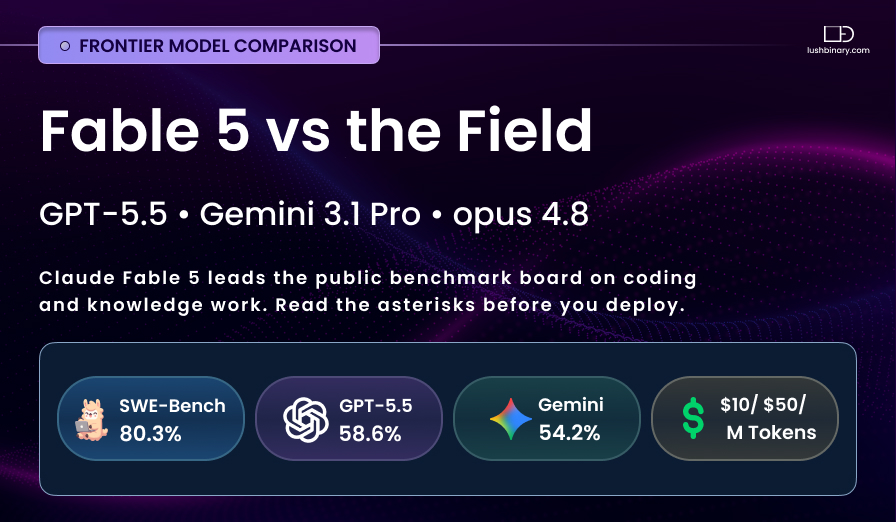
On June 9, 2026, Anthropic released Claude Fable 5, the most capable model it has ever made generally available, and published a benchmark table putting it head to head against GPT-5.5, Gemini 3.1 Pro, and its own Claude Opus 4.8. The headline is clear: Fable 5 leads the public board on the work businesses actually do. The fine print is just as important, because some of the most eye-catching numbers belong to a restricted model you cannot buy.
This comparison cuts through the launch noise. We line up the benchmarks that matter for real deployments, read the asterisks honestly, compare pricing on a per-task basis, and give you a task-by-task framework for choosing between Fable 5, GPT-5.5, Gemini 3.1 Pro, and Opus 4.8. No model wins every row, and the right answer for most teams is routing, not standardizing.
If you want the full background on Fable 5 itself, the safety split, and the rollout timeline, start with our Claude Fable 5 developer guide.
📌 What This Comparison Covers
1The Four Contenders at a Glance
Before the benchmarks, it helps to know what each model is positioned for and what it costs to run.
| Model | Vendor | Input / Output ($/M) | Positioned for |
|---|---|---|---|
| Claude Fable 5 | Anthropic | $10 / $50 | Hardest long-horizon coding and knowledge work |
| Claude Opus 4.8 | Anthropic | $5 / $25 | Best price-to-capability default; Fable 5's fallback |
| GPT-5.5 | OpenAI | $5 / $30 | Strong agentic coding via Codex CLI |
| Gemini 3.1 Pro | Google DeepMind | $2 / $12 | Google-ecosystem fit; spatial reasoning |
💡 On pricing parity
Anthropic published the $10/$50 rate for Fable 5 but did not put a like-for-like price for GPT-5.5 or Gemini 3.1 Pro in the launch table. The rates above are OpenAI's and Google's current standard list prices (short-context tier), gathered from their pricing pages as of June 2026. Both have separate long-context tiers above 200K tokens and caching/batch discounts that change the effective number, so always compare on your own input/output split. See the full breakdown in section 5.
2The Full Benchmark Matrix (Read the Asterisks)
Anthropic published a comparison across Claude Fable 5 / Mythos 5, Claude Opus 4.8, GPT-5.5, and Gemini 3.1 Pro. Two methodology points are load-bearing. First, the table shows the higher of the Fable 5 and Mythos 5 scores, which are within one to three points of each other on most rows. Second, starred (*) rows are where the two diverge more, because Fable 5's blocking safeguards for cybersecurity and biology pull its score down toward Opus 4.8. On those rows, the number you see is Mythos 5, the restricted model, not the Fable 5 you can deploy.
| Benchmark | Fable 5 | Opus 4.8 | GPT-5.5 | Gemini 3.1 Pro |
|---|---|---|---|---|
| SWE-Bench Pro (coding) | 80.3% | 69.2% | 58.6% | 54.2% |
| FrontierCode (Diamond, xhigh) | 29.3% | 13.4% | 5.7% | - |
| Terminal-Bench 2.1* | 88.0%* | 82.7% | 83.4% (Codex CLI) | 70.7% (Gemini CLI) |
| GDPval-AA (knowledge, ELO) | 1932 | 1890 | 1769 | 1314 |
| GDP.pdf vision (no tools) | 29.8% | 22.5% | 24.9% | 16.7% |
| Blueprint-Bench 2 (spatial) | 38.6% | 14.5% | 36.2% | 26.5% |
| AutomationBench (tool use) | 17.4% | 15.5% | 12.9% | 9.6% |
| OSWorld-Verified (computer use) | 85.0% | 83.4% | 78.7% | 76.2% |
| Legal Agent Benchmark | 13.3% | 10.4% | 2.1% | 0.0% |
| Humanity's Last Exam (tools)* | 64.5%* | 57.9% | 52.2% | 51.4% |
| ExploitBench (cyber)* | 78.0%* | 40.0% | 34.0% | - |
| HealthBench Professional* | 66.0%* | 56.9% | 51.8% | - |
Source: Anthropic Claude Fable 5 and Mythos 5 benchmark table, June 9, 2026. Starred (*) rows show Mythos 5, the restricted model; Fable 5 performs closer to Opus 4.8 on those because of blocking safeguards. A dash means no comparable published figure.
⚠️ Do not benchmark-shop on starred numbers
ExploitBench is the starkest case: 78.0% belongs to the restricted Mythos 5, while Anthropic separately reports Fable 5 made 0% progress on offensive cyber tasks in blocking mode. If you are evaluating Fable 5 for deployment, treat starred figures as the ceiling of the restricted tier, not what you will actually receive.
3Agentic Coding: Where the Gap Is Widest
Coding is where Fable 5 separates from the field most cleanly. On SWE-Bench Pro it scores 80.3%, an 11-point lead over Opus 4.8 (69.2%) and more than 20 points ahead of GPT-5.5 (58.6%) and Gemini 3.1 Pro (54.2%). On the harder FrontierCode Diamond set the relative gap is even larger: 29.3% versus 13.4% for Opus 4.8 and 5.7% for GPT-5.5.
The one row where Fable 5 does not lead outright is Terminal-Bench 2.1, where GPT-5.5 through its own Codex CLI harness posts 83.4%, fractionally ahead of Opus 4.8's 82.7%. Fable 5's 88.0% on that benchmark is starred, so read it as the restricted tier's ceiling. Even so, the practical takeaway holds: for raw, multi-file, long-horizon coding capability, Fable 5 is the strongest model you can deploy today.
💡 Harness matters as much as model
GPT-5.5's Terminal-Bench score uses the Codex CLI harness and Gemini's uses the Gemini CLI. The agent loop around a model (planning, tool calls, verification) often moves the score as much as the base model. When you compare, hold the harness constant or test each model in its native agent. See our loop engineering guide for why.
4Knowledge Work, Vision, and Tool Use
The pattern from coding repeats across the knowledge-work rows. On GDPval-AA, an ELO-style measure of professional knowledge tasks, Fable 5 posts 1932 against 1890 for Opus 4.8, 1769 for GPT-5.5, and 1314 for Gemini 3.1 Pro. On document vision without tools (GDP.pdf) it leads at 29.8%, with GPT-5.5 second at 24.9%. Tool use (AutomationBench) and legal tasks follow the same shape: a clear Fable 5 lead, Opus 4.8 close behind, and the other two trailing.
Two rows are worth singling out. On spatial reasoning (Blueprint-Bench 2), GPT-5.5 is genuinely competitive at 36.2% against Fable 5's 38.6%, far ahead of Opus 4.8's 14.5%, so if your workload is spatial or diagram-heavy, GPT-5.5 deserves a real evaluation. And on computer use (OSWorld-Verified), the four models cluster tightly between 76% and 85%, with Fable 5 only narrowly ahead.
The throughline: Fable 5's advantage is largest on hard, multi-step, autonomous work and smallest on tasks where all frontier models have converged. That distinction is exactly what should drive your routing strategy and your budget.
5Pricing: The Premium-Tier Decision
Fable 5 lists at $10 per million input tokens and $50 per million output tokens, exactly double Opus 4.8's $5/$25 and the most expensive rate card of the four. The other three are materially cheaper. Here is the full standard rate card, with cached-input rates and the long-context tier that kicks in above 200K prompt tokens for the OpenAI and Google models.
| Model | Input ($/M) | Cached input ($/M) | Output ($/M) | Long-context (>200K) |
|---|---|---|---|---|
| Fable 5 | $10 | $1 | $50 | Not published |
| Opus 4.8 | $5 | $0.50 | $25 | Single tier |
| GPT-5.5 | $5 | $0.50 | $30 | $10 / $1 / $45 |
| Gemini 3.1 Pro | $2 | $0.20 | $12 | $4 / $0.40 / $18 |
Standard short-context (≤200K prompt tokens) list prices as of June 2026. Long-context column is input / cached / output for prompts above 200K tokens. Fable 5 and Opus 4.8 from Anthropic; GPT-5.5 from OpenAI's pricing page; Gemini 3.1 Pro from Google AI Studio / Vertex AI. Cached-input rates reflect each vendor's 90% cache-read discount. OpenAI and Google also offer a 50% Batch API discount.
To make the rate card concrete, here is what a single agentic task that consumes 200,000 input tokens and produces 50,000 output tokens costs on each model at standard rates (no cache hits):
| Model | Input (200K) | Output (50K) | Total / task | vs Fable 5 |
|---|---|---|---|---|
| Fable 5 | $2.00 | $2.50 | $4.50 | 1.0x |
| GPT-5.5 | $1.00 | $1.50 | $2.50 | 0.56x |
| Opus 4.8 | $1.00 | $1.25 | $2.25 | 0.50x |
| Gemini 3.1 Pro | $0.40 | $0.60 | $1.00 | 0.22x |
The formula is cost = input/1,000,000 * P_in + output/1,000,000 * P_out. At Fable 5 rates that is 0.2 * 10 + 0.05 * 50 = $4.50; GPT-5.5 is 0.2 * 5 + 0.05 * 30 = $2.50; Opus 4.8 is 0.2 * 5 + 0.05 * 25 = $2.25; and Gemini 3.1 Pro is 0.2 * 2 + 0.05 * 12 = $1.00. On this representative split, Gemini 3.1 Pro is roughly 4.5x cheaper than Fable 5, and GPT-5.5 and Opus 4.8 both land near half the Fable 5 cost. At one million such tasks a month, that is about $4.5M on Fable 5 versus $1M on Gemini 3.1 Pro, before any caching.
Caching changes the picture for agents that reuse a large system prompt or codebase across many turns. All four vendors price cache reads at roughly one tenth of base input. With a cache hit, Fable 5's input on the example drops from $2.00 to $0.20, GPT-5.5 from $1.00 to $0.10, and Gemini 3.1 Pro from $0.40 to $0.04. Note that Anthropic charges a cache-write premium (1.25x for the 5-minute cache, 2x for the 1-hour cache) on the first call, while OpenAI's standard rows do not add a separate cache-write fee, so high-reuse workloads tilt the math further toward the cheaper models.
⚠️ Cost is not the whole story
Gemini 3.1 Pro being 4.5x cheaper per token does not make it 4.5x cheaper per finished task. A model that solves a hard coding task in one pass can beat a cheaper model that needs three retries, more output tokens, and human cleanup. Fable 5's SWE-Bench Pro lead (80.3% vs 54.2%) is exactly the kind of gap that can pay for the premium on long-horizon work. Always measure cost per successful task on your own workload, not the headline per-token rate, and re-verify the live rates on each vendor's pricing page before you commit, because they change often.
6Which Model Should You Use?
No single model wins everything, so route by task instead of standardizing on one. Here is a practical decision guide:
Reach for Claude Fable 5
Multi-day autonomous coding, large framework migrations, complex multi-stage knowledge work, and any task where self-verification and sustained autonomy justify twice the token cost.
Stay on Claude Opus 4.8
Routine, high-volume, or latency-sensitive work: classification, summarization, drafting, interactive chat, and most day-to-day agentic tasks. Half the price and the sensible default.
Consider GPT-5.5
Teams already invested in the Codex CLI harness, spatial or diagram-heavy reasoning, and cost-sensitive coding where its $5/$30 rate (roughly half Fable 5) buys competitive quality.
Consider Gemini 3.1 Pro
Google-ecosystem deployments (Vertex AI, Workspace) and cost-sensitive, high-volume workloads. At $2/$12 it is the cheapest of the four by far (about 4.5x cheaper per token than Fable 5), so it wins where the benchmark gap does not justify the premium.
The disciplined approach: run a representative sample of your real tasks on each candidate, measure quality and token spend, and route by task type. If your workload lives near cybersecurity or biology, test Fable 5 specifically, because its safeguards may hand those queries to Opus 4.8 and you could be paying the premium for a fallback answer.
7Why Lushbinary for Multi-Model Builds
Picking a model is the easy part. The hard part is the architecture around it: routing each request to the right model by difficulty, capping agentic spend, exploiting prompt caching, and handling fallbacks gracefully. Lushbinary has shipped production Claude, GPT, and Gemini integrations across healthcare, fintech, SaaS, and e-commerce.
- Model routing and evals - LLM gateways that send each task to the cheapest model that meets your quality bar, backed by an eval harness that proves it.
- Cost control - prompt-cache strategy, budgets, and hard caps so agentic workloads do not surprise you.
- Agent architecture - tool-calling, self-verification loops, and multi-step orchestration tuned to each model's strengths.
- AWS infrastructure - production deployment with VPC isolation, encryption, monitoring, and autoscaling.
🚀 Free Consultation
Not sure whether Fable 5, GPT-5.5, or Gemini 3.1 Pro fits your workload? We will benchmark them against your real tasks, design a routing strategy that keeps spend in check, and give you a clear recommendation with no obligation.
8Frequently Asked Questions
Is Claude Fable 5 better than GPT-5.5 and Gemini 3.1 Pro?
On Anthropic's published benchmark table, Claude Fable 5 leads both on the work most teams do. It scores 80.3% on SWE-Bench Pro against 58.6% for GPT-5.5 and 54.2% for Gemini 3.1 Pro, and tops knowledge work (GDPval-AA 1932 vs 1769 and 1314), tool use, legal, and spatial reasoning. GPT-5.5 stays competitive on agentic coding via its Codex CLI harness (Terminal-Bench 2.1 83.4%), and Gemini 3.1 Pro fits Google-ecosystem workloads. The catch is price: Fable 5 costs $10/$50 per million tokens.
How much does Claude Fable 5 cost compared to GPT-5.5 and Gemini 3.1 Pro?
Claude Fable 5 lists at $10 per million input tokens and $50 output, the priciest of the four. As of June 2026, GPT-5.5 is $5/$30 (standard, under 200K context), Gemini 3.1 Pro is $2/$12, and Claude Opus 4.8 is $5/$25. On a 200K-input, 50K-output task that works out to $4.50 on Fable 5, $2.50 on GPT-5.5, $2.25 on Opus 4.8, and $1.00 on Gemini 3.1 Pro, so Gemini is about 4.5x cheaper per token. All four offer roughly 90% cache-read discounts; OpenAI and Google add a 50% Batch API discount.
Why do Claude Fable 5's cybersecurity and biology benchmark numbers have an asterisk?
Anthropic's table shows the higher of the Fable 5 and Mythos 5 scores. On starred rows (cybersecurity, biology, and a few others) the displayed figure is Mythos 5, the restricted model. Fable 5's blocking safeguards route those queries to Opus 4.8, so a Fable 5 deployment performs closer to Opus 4.8 there. For example, ExploitBench shows 78.0% for the restricted model, but Fable 5 made 0% progress on offensive cyber tasks in blocking mode.
Which model is best for agentic coding in 2026?
For raw agentic coding capability, Claude Fable 5 leads with SWE-Bench Pro 80.3% and FrontierCode Diamond 29.3%. GPT-5.5 is strong through its Codex CLI harness and costs less. The disciplined approach is to route by task: Fable 5 on the hardest, longest-horizon coding work, and a cheaper model like Opus 4.8 or GPT-5.5 for routine changes.
What context window does Claude Fable 5 have?
Anthropic's launch announcement did not publish Claude Fable 5's context-window size or maximum output tokens. Do not architect around a specific context length until it is confirmed in the official model documentation. Claude Opus 4.8, which Fable 5 falls back to, carries a 1M-token context window.
📚 Sources
- Anthropic - Claude Fable 5 and Claude Mythos 5 (benchmark table)
- Anthropic - Claude Opus 4.8 (pricing and context baseline)
- CNBC - Anthropic releases Mythos-like AI model to the public
- The Verge - Anthropic releases its first Mythos-class model
- OpenAI - API pricing (GPT-5.5 $5/$30 standard, $10/$45 long context)
- Google - Vertex AI generative AI pricing (Gemini 3.1 Pro $2/$12, $4/$18 above 200K)
Content was rephrased for compliance with licensing restrictions. Benchmark figures and methodology notes sourced from the official Anthropic Claude Fable 5 and Mythos 5 announcement and reporting by CNBC and The Verge as of June 9, 2026. GPT-5.5 and Gemini 3.1 Pro per-token rates gathered from OpenAI's and Google's pricing pages as of June 2026 (standard short-context tier). All pricing may change - always verify on the vendor's official pricing page before modeling cost.
Choosing Between Frontier Models?
Lushbinary benchmarks Fable 5, GPT-5.5, and Gemini 3.1 Pro against your real workloads and builds the routing layer that sends each task to the right model. Let's talk.
Ready to Build Something Great?
Get a free 30-minute strategy call. We'll map out your project, timeline, and tech stack - no strings attached.
Prefer email? Reach us directly: