

Binomial Transform
The binomial transform takes the sequence 👁 a_0
, 👁 a_1
, 👁 a_2
, ... to the sequence 👁 b_0
, 👁 b_1
, 👁 b_2
, ... via the transformation


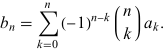
The inverse transform is
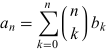
(Sloane and Plouffe 1995, pp. 13 and 22). The inverse binomial transform of 👁 b_n=1
for prime 👁 n
and 👁 b_n=0
for composite 👁 n
is 0, 1, 3, 6, 11, 20, 37, 70, ... (OEIS A052467).
The inverse binomial transform of 👁 b_n=1
for even 👁 n
and 👁 b_n=0
for odd 👁 n
is 0, 1, 2, 4, 8, 16, 32, 64, ... (OEIS A000079).
Similarly, the inverse binomial transform of 👁 b_n=1
for odd 👁 n
and 👁 b_n=0
for even 👁 n
is 1, 2, 4, 8, 16, 32, 64, ... (OEIS A000079).
The inverse binomial transform of the Bell numbers
1, 1, 2, 5, 15, 52, 203, ... (OEIS A000110)
is a shifted version of the same numbers: 1, 2, 5, 15, 52, 203, ... (Bernstein and
Sloane 1995, Sloane and Plouffe 1995, p. 22).


The central and raw moments of statistical distributions are also related by the binomial transform.
See also
Binomial, Central Moment, Euler Transform, Exponential Transform, Möbius Transform, Raw MomentExplore with Wolfram|Alpha

More things to try:
References
Bernstein, M. and Sloane, N. J. A. "Some Canonical Sequences of Integers." Linear Algebra Appl. 226/228, 57-72, 1995.Sloane, N. J. A. Sequences A000079/M1129, A000110/M1484, and A052467 in "The On-Line Encyclopedia of Integer Sequences."Sloane, N. J. A. and Plouffe, S. The Encyclopedia of Integer Sequences. San Diego, CA: Academic Press, 1995.Referenced on Wolfram|Alpha
Binomial TransformCite this as:
Weisstein, Eric W. "Binomial Transform." From MathWorld--A Wolfram Resource. https://mathworld.wolfram.com/BinomialTransform.html