

Cyclic Group

A cyclic group is a group that can be generated by a single element 👁 X
(the group generator). Cyclic groups are Abelian.

A cyclic group of finite group order 👁 n
is denoted 👁 C_n
, 👁 Z_n
,
👁 Z_n
, or 👁 C_n
; Shanks 1993, p. 75), and its generator 👁 X
satisfies


| 👁 X^n=I, |
(1)
|

where 👁 I
is the identity element.

The ring of integers 👁 Z
form an infinite cyclic group under addition, and the integers
0, 1, 2, ..., 👁 n-1
(👁 Z_n
) form a cyclic group of order 👁 n
under addition (mod 👁 n
). In both cases, 0 is the identity
element.


There exists a unique cyclic group of every order 👁 n>=2
, so cyclic groups of the same order are always isomorphic
(Scott 1987, p. 34; Shanks 1993, p. 74). Furthermore, subgroups of cyclic
groups are cyclic, and all groups of prime group order are cyclic. In fact, the only simple Abelian groups are the cyclic groups of order 👁 n=1
or 👁 n
a prime (Scott 1987, p. 35).


The 👁 n
th cyclic group is represented in the
Wolfram Language as [n].

Examples of cyclic groups include 👁 C_2
, 👁 C_3
,
👁 C_4
, ..., and the modulo
multiplication groups 👁 M_m
such that 👁 m=2
,
4, 👁 p^n
, or 👁 2p^n
, for 👁 p
an odd prime and 👁 n>=1
(Shanks 1993, p. 92).


Cyclic groups all have the same multiplication table structure. The table for 👁 C_(20)
is illustrated above.

By computing the characteristic factors, any Abelian group can be expressed as a group
direct product of cyclic subgroups, for example,
finite group C2×C4 or finite
group C2×C2×C2. It is common to combine the indices for the highest
prime factors of the direct product representation of a group since this provides
a shorter notation and no ambiguity arises. For example 👁 C_2×C_3
is commonly written 👁 C_6
.


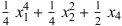
The cycle index of the cyclic group 👁 C_p
is given by

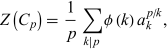
where 👁 k|p
means 👁 k
divides 👁 p
and 👁 phi(k)
is the totient function
(Harary 1994, p. 184). The first few are given by




See also
Abelian Group, Characteristic Factor, Cyclic Group C2, Cyclic Group C3, Cyclic Group C4, Cyclic Group C5, Cyclic Group C6, Cyclic Group C7, Cyclic Group C8, Cyclic Group C9, Cyclic Group C10, Cyclic Group C11, Cyclic Group C12, Metacyclic Group, Modulo Multiplication Group, Simple Group Explore this topic in the MathWorld classroomExplore with Wolfram|Alpha

More things to try:
References
Harary, F. In Graph Theory. Reading, MA: Addison-Wesley, pp. 181 and 184, 1994.Lomont, J. S. "Cyclic Groups." §3.10.A in Applications of Finite Groups. New York: Dover, p. 78, 1987.Scott, W. R. "Cyclic Groups." §2.4 in Group Theory. New York: Dover, pp. 34-35, 1987.Shanks, D. Solved and Unsolved Problems in Number Theory, 4th ed. New York: Chelsea, 1993.Referenced on Wolfram|Alpha
Cyclic GroupCite this as:
Weisstein, Eric W. "Cyclic Group." From MathWorld--A Wolfram Resource. https://mathworld.wolfram.com/CyclicGroup.html