

Dedekind Sum

Given relatively prime integers 👁 p
and 👁 q
(i.e., 👁 (p,q)=1
), the Dedekind sum is defined by


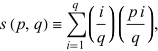
where
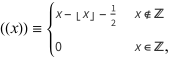
with 👁 |_x_|
the floor
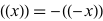
function. 👁 ((x))
is an odd function since 👁 ((x))=-((-x))
and is periodic with period 1. The Dedekind sum
is meaningful even if 👁 (p,q)!=1
,
so the relatively prime restriction is sometimes dropped (Apostol 1997, p. 72).
The symbol 👁 s(p,q)
is sometimes used instead of 👁 s(p,a)
(Beck 2000).




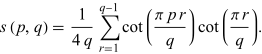
The Dedekind sum can also be expressed in the form
If 👁 0<h<k
, let 👁 r_0
, 👁 r_1
,
..., 👁 r_(n+1)
denote the remainders in the Euclidean algorithm
given by


for 👁 1<=r_(j+1)<r_j
and 👁 r_(n+1)=1
. Then



(Apostol 1997, pp. 72-73).
In general, there is no simple formula for closed-form evaluation of 👁 s(p,q)
, but some special cases are


(Apostol 1997, p. 62). Apostol (1997, p. 73) gives the additional special cases

![👁 12hks(h,k)=(k-2)[k-1/2(h^2+1)] for k=2 (mod h)](https://mathworld.wolfram.com/images/equations/DedekindSum/NumberedEquation6.svg)


for 👁 k=r (mod h)
and 👁 h=t (mod r)
, where 👁 r>=1
and 👁 t=+/-1
. Finally,



for 👁 k=5 (mod h)
and 👁 h=t (mod 5)
, where 👁 t=+/-1
or 👁 +/-2
.


Dedekind sums obey 2-term

(Dedekind 1953; Rademacher and Grosswald 1972; Pommersheim 1993; Apostol 1997, pp. 62-64) and 3-term

(Rademacher 1954), reciprocity laws, where 👁 a
, 👁 a^'
;
👁 b
, 👁 b^'
; and 👁 c
, 👁 c^'
are pairwise relatively prime, and


| 👁 aa^'=1 (mod b) |
(17)
|
| 👁 bb^'=1 (mod c) |
(18)
|
| 👁 cc^'=1 (mod a) |
(19)
|



(Pommersheim 1993).
👁 6qs(p,q)
is an integer (Rademacher and
Grosswald 1972, p. 28), and if 👁 theta=(3,q)
, then



and

In addition, 👁 s(p,q)
satisfies the congruence


which, if 👁 q
is odd, becomes


(Apostol 1997, pp. 65-66). If 👁 q=3
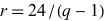
, 5, 7, or 13, let 👁 r=24/(q-1)
, let integers 👁 a
, 👁 b
,
👁 c
, 👁 d
be given with 👁 ad-bc=1
such that 👁 c=c_1q
and 👁 c_1>0
, and let




Then 👁 rdelta
is an even integer (Apostol 1997, pp. 66-69).

Let 👁 p
, 👁 q
, 👁 u
,
👁 v in N
with 👁 (p,q)=(u,v)=1
(i.e., are pairwise relatively
prime), then the Dedekind sums also satisfy




where 👁 t=pv+qu
,
and 👁 u^'
, 👁 v^'
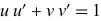
are any integers such that 👁 uu^'+vv^'=1
(Pommersheim 1993).


If 👁 p
is prime, then


(Dedekind 1953; Apostol 1997, p. 73). Moreover, it has been beautifully generalized by Knopp (1980).
See also
Dedekind Eta Function, Iseki's FormulaExplore with Wolfram|Alpha

More things to try:
References
Apostol, T. M. "Properties of Dedekind Sums," "The Reciprocity Law for Dedekind Sums," and "Congruence Properties of Dedekind Sums." §3.7-3.9 in Modular Functions and Dirichlet Series in Number Theory, 2nd ed. New York: Springer-Verlag, pp. 52 and 61-69, 1997.Apostol, T. M. Ch. 12 in Introduction to Analytic Number Theory. New York: Springer-Verlag, 1976.Beck, M. "Dedekind Cotangent Sums" 7 Dec 2001. http://arxiv.org/abs/math.NT/0112077.Dedekind, R. "Erlauterungen zu den Fragmenten, XXVIII." In The Collected Works of Bernhard Riemann. New York: Dover, pp. 466-478, 1953.Iseki, S. "The Transformation Formula for the Dedekind Modular Function and Related Functional Equations." Duke Math. J. 24, 653-662, 1957.Knopp, M. I. "Hecke Operators and an Identity for Dedekind Sums." J. Number Th. 12, 2-9, 1980.Pommersheim, J. "Toric Varieties, Lattice Points, and Dedekind Sums." Math. Ann. 295, 1-24, 1993.Rademacher, H. "Generalization of the Reciprocity Formula for Dedekind Sums." Duke Math. J. 21, 391-398, 1954.Rademacher, H. and Grosswald, E. Dedekind Sums. Washington, DC: Math. Assoc. Amer., 1972.Rademacher, H. and Whiteman, A. L. "Theorems on Dedekind Sums." Amer. J. Math. 63, 377-407, 1941.Referenced on Wolfram|Alpha
Dedekind SumCite this as:
Weisstein, Eric W. "Dedekind Sum." From MathWorld--A Wolfram Resource. https://mathworld.wolfram.com/DedekindSum.html