

Double Bubble
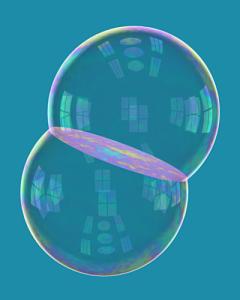
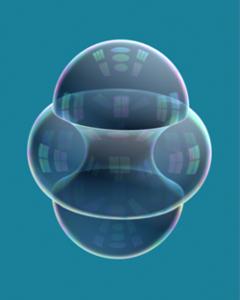
A double bubble is pair of bubbles which intersect and are separated by a membrane bounded by the intersection. The usual double bubble is illustrated in the left figure above. A more exotic configuration in which one bubble is torus-shaped and the other is shaped like a dumbbell is illustrated at right (illustrations courtesy of J. M. Sullivan).

In the plane, the analog of the double bubble consists of three circular arcs meeting in two points. It has been proved that the configuration of arcs meeting at equal
👁 120 degrees
angles)
has the minimum perimeter for enclosing two equal areas
(Alfaro et al. 1993, Morgan 1995).

It had been conjectured that two equal partial spheres sharing a boundary of a flat disk separate two volumes of air using a total surface
area that is less than any other boundary. This equal-volume case was proved
by Hass et al. (1995), who reduced the problem to a set of 👁 200260
integrals which they carried out on an ordinary PC. Frank
Morgan, Michael Hutchings, Manuel Ritoré, and Antonio Ros finally proved the
conjecture for arbitrary double bubbles in early 2000. In this case of two unequal
partial spheres, Morgan et al. showed that the separating boundary which minimizes
total surface area is a portion of a sphere which meets
the outer spherical surfaces at dihedral angles
of 👁 120 degrees
. Furthermore, the curvature
of the partition is simply the difference of the curvatures
of the two bubbles,


where 👁 R
is the radius of the interface and 👁 r_1
and 👁 r_2
are the radii of the bubbles (Isenberg 1992, pp. 88-95).
Furthermore, for three bubbles with radii 👁 r_1
, 👁 r_2
,
and 👁 r_3
, and interface radii 👁 R_1
, and 👁 R_2
,


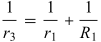
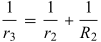
(Isenberg 1992, pp. 88-95).
Amazingly, a group of undergraduates has extended the theorem to four-dimensional double bubbles, as well as certain cases in five-space and higher dimensions. The corresponding triple bubble conjecture remains open (Cipra 2000).
See also
Apple Surface, Bubble, Circle-Circle Intersection, Double Sphere, Isovolume Problem, Sphere-Sphere IntersectionExplore with Wolfram|Alpha

More things to try:
References
Alfaro, M.; Brock, J.; Foisy, J.; Hodges, N.; and Zimba, J. "The Standard Double Bubble in 👁 R^2
Uniquely Minimized Perimeter." Pacific J. Math. 159, 47-59, 1993.Almgren, F. J. and Taylor, J. "The Geometry of Soap Films and Soap Bubbles." Sci. Amer. 235, 82-93, Jul. 1976.Campbell, P. J. (Ed.). Reviews. Math. Mag. 68, 321, 1995.Cipra, B. "Rounding Out Solutions to Three Conjectures." Science 287, 1910-1911, 2000.Haas, J.; Hutchings, M.; and Schlafy, R. "The Double Bubble Conjecture." Electron. Res. Announc. Amer. Math. Soc. 1, 98-102, 1995.Haas, J. "General Double Bubble Conjecture in 👁 R^3

Solved." Focus: The Newsletter of the Math. Assoc. Amer., No. 5, pp. 4-5, May/June 2000.Hutchings, M.; Morgan, F.; Ritoré, M.; and Ros, A. "Proof of the Double Bubble Conjecture." http://www.ugr.es/~ritore/bubble/bubble.pdf.Isenberg, C. The Science of Soap Films and Soap Bubbles. New York: Dover, 1992.Morgan, F. "The Double Bubble Conjecture." FOCUS 15, 6-7, 1995.Morgan, F. "Double Bubble Conjecture Proved." http://www.maa.org/features/mathchat/mathchat_3_18_00.html.Peterson, I. "Toil and Trouble over Double Bubbles." Sci. News 148, 101, Aug. 12, 1995.Ritoré, M. "Proof of the Double Bubble Conjecture Preprint." http://www.ugr.es/~ritore/bubble/bubble.htm.👁 Update a link

Sullivan, J. M. "Double Bubble Images." http://torus.math.uiuc.edu/jms/Images/double/
Referenced on Wolfram|Alpha
Double BubbleCite this as:
Weisstein, Eric W. "Double Bubble." From MathWorld--A Wolfram Resource. https://mathworld.wolfram.com/DoubleBubble.html