

Greedy Algorithm
An algorithm used to recursively construct a set of objects from the smallest possible constituent parts.
Given a set of 👁 k
integers (👁 a_1
, 👁 a_2
, ..., 👁 a_k
) with 👁 a_1<a_2<...<a_k
, a greedy algorithm can be used to
find a vector of coefficients (👁 c_1
, 👁 c_2
, ..., 👁 c_k
) such that





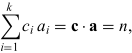
where 👁 c·a
is the dot product, for some given integer 👁 n
. This can be accomplished by letting
👁 c_i=0
for 👁 i=1
, ..., 👁 k-1
and setting


where 👁 |_x_|
is the floor function. Now define the difference between the representation and 👁 n
as


| 👁 Delta=n-c·a. |
(3)
|

If 👁 Delta=0
at any step, a representation has been found. Otherwise, decrement the nonzero 👁 c_i
term with least 👁 i
, set all 👁 c_j=0
for 👁 j<i
, and build up the remaining terms from


for 👁 j=i-1
,
..., 1 until 👁 Delta=0
or all possibilities have been exhausted.


For example, McNugget numbers are numbers which are representable using only 👁 (a_1,a_2,a_3)=(6,9,20)
. Taking 👁 n=62
and applying the algorithm iteratively gives the sequence
(0, 0, 3), (0, 2, 2), (2, 1, 2), (3, 0, 2), (1, 4, 1), at which point 👁 Delta=0
. 62 is therefore a McNugget
number with




If any integer 👁 n
can be represented with 👁 c_i=0
or 1 using a sequence (👁 a_1
, 👁 a_2
, ...), then this sequence is called a complete
sequence.


A greedy algorithm can also be used to break down an arbitrary fraction into an Egyptian fraction in a finite number of steps.
For a fraction 👁 a/b
, find the least integer 👁 x_1
such that 👁 1/x_1<=a/b
, i.e.,


| 👁 x_1=[b/a], |
(6)
|
![👁 x_1=[b/a],](https://mathworld.wolfram.com/images/equations/GreedyAlgorithm/NumberedEquation6.svg)
where 👁 [x]
is the ceiling function. Then find the least
integer 👁 x_2
such that 👁 1/x_2<=a/b-1/x_1
. Iterate until there is no remainder. The
algorithm gives two or fewer terms for 👁 1/n
and 👁 2/n
, three or fewer terms for 👁 3/n
, and four or fewer for 👁 4/n
.
![👁 [x]](https://mathworld.wolfram.com/images/equations/GreedyAlgorithm/Inline33.svg)




See also
Coin Problem, Complete Sequence, Egyptian Fraction, Frobenius Equation, Frobenius Number, Integer Relation, Knapsack Problem, Levine-O'Sullivan Greedy Algorithm, McNugget Number, Reverse Greedy Algorithm, Square Number, Subset Sum Problem, Sylvester's SequenceExplore with Wolfram|Alpha

More things to try:
References
👁 Image
Wagon, S. "Greedy Coins." http://library.wolfram.com/infocenter/MathSource/5187/.
Referenced on Wolfram|Alpha
Greedy AlgorithmCite this as:
Weisstein, Eric W. "Greedy Algorithm." From MathWorld--A Wolfram Resource. https://mathworld.wolfram.com/GreedyAlgorithm.html