

Integral

The term "integral" can refer to a number of different concepts in mathematics. The most common meaning is the the fundamenetal object of calculus corresponding to summing infinitesimal pieces to find the content of a continuous region. Other uses of "integral" include values that always take on integer values (e.g., integral embedding, integral graph), mathematical objects for which integers form basic examples (e.g., integral domain), and particular values of an equation (e.g., integral curve),
In calculus, an integral is a mathematical object that can be interpreted as an area or a generalization of area. Integrals, together with derivatives, are the fundamental objects of calculus. Other words for integral include antiderivative and primitive. The process of computing an integral is called integration (a more archaic term for integration is quadrature), and the approximate computation of an integral is termed numerical integration.
The Riemann integral is the simplest integral definition and the only one usually encountered in physics and elementary calculus. In fact, according to Jeffreys and Jeffreys (1988, p. 29), "it appears that cases where these methods [i.e., generalizations of the Riemann integral] are applicable and Riemann's [definition of the integral] is not are too rare in physics to repay the extra difficulty."
The Riemann integral of the function 👁 f(x)
over 👁 x
from 👁 a
to 👁 b
is written


| 👁 int_a^bf(x)dx. |
(1)
|

Note that if 👁 f(x)=1
,
the integral is written simply

| 👁 int_a^bdx |
(2)
|

as opposed to 👁 int_a^b1dx
.

Every definition of an integral is based on a particular measure. For instance, the Riemann integral is based on
Jordan measure, and the Lebesgue
integral is based on Lebesgue measure. Moreover,
depending on the context, any of a variety of other integral notations may be used.
For example, the Lebesgue integral of an integrable
function 👁 f
over a set 👁 X
which is measurable with respect to a measure 👁 mu
is often written


| 👁 int_Xf(x)dmu. |
(3)
|

In the event that the set 👁 X
in () is an interval 👁 X=[a,b]
,
the "subscript-superscript" notation from (2) is usually
adopted. Another generalization of the Riemann integral is the Stieltjes
integral, where the integrand function 👁 f
defined on a closed interval 👁 I=[a,b]
can be integrated against a real-valued bounded function
👁 alpha(x)
defined on 👁 I
, the result of which has the form

![👁 X=[a,b]](https://mathworld.wolfram.com/images/equations/Integral/Inline11.svg)

![👁 I=[a,b]](https://mathworld.wolfram.com/images/equations/Integral/Inline13.svg)


or equivalently
| 👁 intfdalpha. |
(5)
|

Yet another scenario in which the notation may change comes about in the study of differential geometry, throughout which
the integrand 👁 f(x)dx
is considered a more general differential
k-form 👁 omega=f(x)dx
and can be integrated on a set 👁 X
using either of the equivalent notations


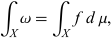
where 👁 mu
is the above-mentioned Lebesgue measure.
Worth noting is that the notation on the left-hand side of equation () is similar
to that in expression () above.

There are two classes of (Riemann) integrals: definite integrals such as (5), which have upper and lower limits, and indefinite integrals, such as
| 👁 intf(x)dx, |
(7)
|

which are written without limits. The first fundamental theorem of calculus allows definite integrals
to be computed in terms of indefinite integrals,
since if 👁 F(x)
is the indefinite integral for 👁 f(x)
, then


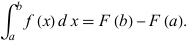
What's more, the first fundamental theorem of calculus can be rewritten more generally in terms of differential
forms (as in () above) to say that the integral
of a differential form 👁 omega
over the boundary 👁 partialOmega
of some orientable
manifold 👁 Omega
is equal to the exterior derivative 👁 domega
of 👁 omega
over the interior of 👁 Omega
, i.e.,


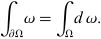
Written in this form, the first fundamental theorem of calculus is known as Stokes' Theorem.
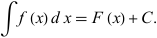
Since the derivative of a constant is zero, indefinite integrals are defined only up to an arbitrary constant of integration 👁 C
, i.e.,

| 👁 intf(x)dx=F(x)+C. |
(10)
|
Wolfram Research maintains a web site http://integrals.wolfram.com/ that can find the indefinite integral of many common (and not so common) functions.
Differentiating integrals leads to some useful and powerful identities. For instance, if 👁 f(x)
is continuous, then

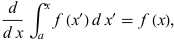
which is the first fundamental theorem of calculus. Other derivative-integral identities include
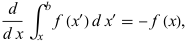

(Kaplan 1992, p. 275), its generalization

(Kaplan 1992, p. 258), and
![👁 d/(dx)int_a^xf(x,t)dt=1/(x-a)int_a^x[(x-a)partial/(partialx)f(x,t)+(t-a)partial/(partialt)f(x,t)+f(x,t)]dt,](https://mathworld.wolfram.com/images/equations/Integral/NumberedEquation15.svg)
as can be seen by applying (14) on the left side of (15) and using partial integration.
Other integral identities include


| 👁 int_VJd^3r | 👁 = | 👁 int_Vpartial/(partialx_k)(x_iJ_k)-int_Vrdel ·Jd^3r |
(18)
|
| 👁 Image | 👁 = | 👁 -int_Vrdel ·Jd^3r |
(19)
|


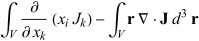


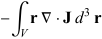
and the amusing integral identity

where 👁 F
is any function and

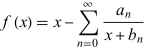
as long as 👁 a_n>=0
and 👁 b_n
is real (Glasser 1983).


Integrals with rational exponents can often be solved by making the substitution 👁 u=x^(1/n)
, where 👁 n
is the least common multiple
of the denominator of the exponents.


See also
A-Integrable, Abelian Integral, Calculus, Chebyshev-Gauss Quadrature, Chebyshev Quadrature, Darboux Integral, Definite Integral, Denjoy Integral, Derivative, Differential Geometry, Differential k-Form, Double Exponential Integration, Double Integral, Euler Integral, Form Integration, Fundamental Theorem of Gaussian Quadrature, Gauss-Jacobi Mechanical Quadrature, Gaussian Quadrature, Haar Integral, Hermite-Gauss Quadrature, Indefinite Integral, Integral Calculus, Integration, Jacobi-Gauss Quadrature, Laguerre-Gauss Quadrature, Lebesgue Integral, Lebesgue-Stieltjes Integral, Legendre-Gauss Quadrature, Leibniz Integral Rule, Lobatto Quadrature, Multiple Integral, Nested Function, Newton-Cotes Formulas, Numerical Integration, Perron Integral, Quadrature, Radau Quadrature, Recursive Monotone Stable Quadrature, Repeated Integral, Romberg Integration, Riemann Integral, Singular Integral, Stieltjes Integral, Stokes' Theorem, Triple Integral Explore this topic in the MathWorld classroomPortions of this entry contributed by Christopher Stover
Explore with Wolfram|Alpha

More things to try:
References
Beyer, W. H. "Integrals." CRC Standard Mathematical Tables, 28th ed. Boca Raton, FL: CRC Press, pp. 233-296, 1987.Boros, G. and Moll, V. Irresistible Integrals: Symbolics, Analysis and Experiments in the Evaluation of Integrals. Cambridge, England: Cambridge University Press, 2004.Bronstein, M. Symbolic Integration I: Transcendental Functions. New York: Springer-Verlag, 1996.Dubuque, W. G. "Re: Integrals done free on the Web." posting, Sept. 24, 1996.Glasser, M. L. "A Remarkable Property of Definite Integrals." Math. Comput. 40, 561-563, 1983.Gordon, R. A. The Integrals of Lebesgue, Denjoy, Perron, and Henstock. Providence, RI: Amer. Math. Soc., 1994.Gradshteyn, I. S. and Ryzhik, I. M. Tables of Integrals, Series, and Products, 6th ed. San Diego, CA: Academic Press, 2000.Jeffreys, H. and Jeffreys, B. S. Methods of Mathematical Physics, 3rd ed. Cambridge, England: Cambridge University Press, p. 29, 1988.Kaplan, W. Advanced Calculus, 4th ed. Reading, MA: Addison-Wesley, 1992.Piessens, R.; de Doncker, E.; Uberhuber, C. W.; and Kahaner, D. K. QUADPACK: A Subroutine Package for Automatic Integration. New York: Springer-Verlag, 1983.Ritt, J. F. Integration in Finite Terms: Liouville's Theory of Elementary Methods. New York: Columbia University Press, p. 37, 1948.Shanks, D. Solved and Unsolved Problems in Number Theory, 4th ed. New York: Chelsea, p. 145, 1993.Wolfram Research. "The Integrator." http://integrals.wolfram.com/.Referenced on Wolfram|Alpha
IntegralCite this as:
Stover, Christopher and Weisstein, Eric W. "Integral." From MathWorld--A Wolfram Resource. https://mathworld.wolfram.com/Integral.html