

Jacobi Polynomial

The Jacobi polynomials, also known as hypergeometric polynomials, occur in the study of rotation groups and in the solution to the equations of motion of the symmetric top. They are solutions to the Jacobi differential equation, and give some other special named polynomials as special cases. They are implemented in the Wolfram Language as [n, a, b, z].
For 👁 alpha=beta=0
,
👁 P_n^((0,0))(x)
reduces to a Legendre
polynomial. The Gegenbauer polynomial



and Chebyshev polynomial of the first kind can also be viewed as special cases of the Jacobi polynomials.
Plugging
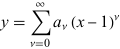
into the Jacobi differential equation gives the recurrence relation
![👁 [gamma-nu(nu+alpha+beta+1)]a_nu-2(nu+1)(nu+alpha+1)a_(nu+1)=0](https://mathworld.wolfram.com/images/equations/JacobiPolynomial/NumberedEquation3.svg)
for 👁 nu=0
,
1, ..., where


Solving the recurrence relation gives
![👁 P_n^((alpha,beta))(x)=((-1)^n)/(2^nn!)(1-x)^(-alpha)(1+x)^(-beta)(d^n)/(dx^n)[(1-x)^(alpha+n)(1+x)^(beta+n)]](https://mathworld.wolfram.com/images/equations/JacobiPolynomial/NumberedEquation5.svg)
for 👁 alpha,beta>-1
.
They form a complete orthogonal system in the interval 👁 [-1,1]
with respect to the weighting function

![👁 [-1,1]](https://mathworld.wolfram.com/images/equations/JacobiPolynomial/Inline5.svg)

and are normalized according to
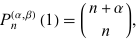
where 👁 (n; k)
is a binomial coefficient. Jacobi polynomials
can also be written


where 👁 Gamma(z)
is the gamma function and


Jacobi polynomials are orthogonal polynomials and satisfy
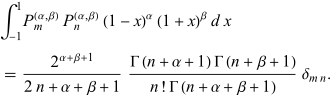
The coefficient of the term 👁 x^n
in 👁 P_n^((alpha,beta))(x)
is given by


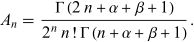
They satisfy the recurrence relation
![👁 2(n+1)(n+alpha+beta+1)(2n+alpha+beta)P_(n+1)^((alpha,beta))(x) =[(2n+alpha+beta+1)(alpha^2-beta^2)+(2n+alpha+beta)_3x]P_n^((alpha,beta))(x)-2(n+alpha)(n+beta)(2n+alpha+beta+2)P_(n-1)^((alpha,beta))(x),](https://mathworld.wolfram.com/images/equations/JacobiPolynomial/NumberedEquation12.svg)
where 👁 (m)_n
is a Pochhammer symbol


The derivative is given by
![👁 d/(dx)[P_n^((alpha,beta))(x)]=1/2(n+alpha+beta+1)P_(n-1)^((alpha+1,beta+1))(x).](https://mathworld.wolfram.com/images/equations/JacobiPolynomial/NumberedEquation14.svg)
The orthogonal polynomials with weighting function 👁 (b-x)^alpha(x-a)^beta
on the closed interval 👁 [a,b]
can be expressed in the form

![👁 [a,b]](https://mathworld.wolfram.com/images/equations/JacobiPolynomial/Inline12.svg)
![👁 [const]P_n^((alpha,beta))(2(x-a)/(b-a)-1)](https://mathworld.wolfram.com/images/equations/JacobiPolynomial/NumberedEquation15.svg)
(Szegö 1975, p. 58).
Special cases with 👁 alpha=beta
are












Further identities are







(Szegö 1975, p. 79).
The kernel polynomial is

(Szegö 1975, p. 71).
The polynomial discriminant is
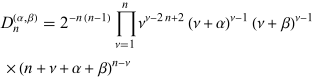
(Szegö 1975, p. 143).
In terms of the hypergeometric function,









where 👁 (alpha)_n
is the Pochhammer symbol (Abramowitz and Stegun
1972, p. 561; Koekoek and Swarttouw 1998).

Let 👁 N_1
be the number of zeros in 👁 x in (-1,1)
, 👁 N_2
the number of zeros in 👁 x in (-infty,-1)
, and 👁 N_3
the number of zeros in 👁 x in (1,infty)
. Define Klein's symbol


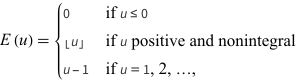
where 👁 |_x_|
is the floor function, and


![👁 E[1/2(|2n+alpha+beta+1|-|alpha|-|beta|+1)]](https://mathworld.wolfram.com/images/equations/JacobiPolynomial/Inline51.svg)


![👁 E[1/2(-|2n+alpha+beta+1|+|alpha|-|beta|+1)]](https://mathworld.wolfram.com/images/equations/JacobiPolynomial/Inline54.svg)


![👁 E[1/2(-|2n+alpha+beta+1|-|alpha|+|beta|+1)].](https://mathworld.wolfram.com/images/equations/JacobiPolynomial/Inline57.svg)
If the cases 👁 alpha=-1
,
👁 -2
,
..., 👁 -n
,
👁 beta=-1
,
👁 -2
,
..., 👁 -n
,
and 👁 n+alpha+beta=-1
,
👁 -2
,
..., 👁 -n
are excluded, then the number of zeros of 👁 P_n^((alpha,beta))
in the respective intervals are





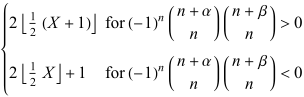


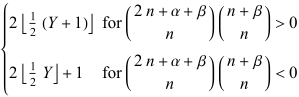


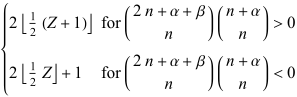
(Szegö 1975, pp. 144-146), where 👁 |_x_|
is again the floor function.

The first few polynomials are


![👁 1/2[2(alpha+1)+(alpha+beta+2)(x-1)]](https://mathworld.wolfram.com/images/equations/JacobiPolynomial/Inline83.svg)


![👁 1/8[4(alpha+1)(alpha+2)+4(alpha+beta+3)(alpha+2)(x-1)+(alpha+beta+3)(alpha+beta+4)(x-1)^2]](https://mathworld.wolfram.com/images/equations/JacobiPolynomial/Inline86.svg)
(Abramowitz and Stegun 1972, p. 793).
See Abramowitz and Stegun (1972, pp. 782-793) and Szegö (1975, Ch. 4) for additional identities.
See also
Chebyshev Polynomial of the First Kind, Gegenbauer Polynomial, Jacobi Function of the Second Kind, Rising Factorial, Zernike PolynomialRelated Wolfram sites
http://functions.wolfram.com/Polynomials/JacobiP/Explore with Wolfram|Alpha

References
Abramowitz, M. and Stegun, I. A. (Eds.). "Orthogonal Polynomials." Ch. 22 in Handbook of Mathematical Functions with Formulas, Graphs, and Mathematical Tables, 9th printing. New York: Dover, pp. 771-802, 1972.Andrews, G. E.; Askey, R.; and Roy, R. "Jacobi Polynomials and Gram Determinants" and "Generating Functions for Jacobi Polynomials." §6.3 and 6.4 in Special Functions. Cambridge, England: Cambridge University Press, pp. 293-306, 1999.Iyanaga, S. and Kawada, Y. (Eds.). "Jacobi Polynomials." Appendix A, Table 20.V in Encyclopedic Dictionary of Mathematics. Cambridge, MA: MIT Press, p. 1480, 1980.Koekoek, R. and Swarttouw, R. F. "Jacobi." §1.8 in The Askey-Scheme of Hypergeometric Orthogonal Polynomials and its 👁 q
-Analogue. Delft, Netherlands: Technische Universiteit Delft, Faculty of Technical Mathematics and Informatics Report 98-17, pp. 38-44, 1998.Roman, S. "The Theory of the Umbral Calculus I." J. Math. Anal. Appl. 87, 58-115, 1982.Szegö, G. "Jacobi Polynomials." Ch. 4 in Orthogonal Polynomials, 4th ed. Providence, RI: Amer. Math. Soc., 1975.
Referenced on Wolfram|Alpha
Jacobi PolynomialCite this as:
Weisstein, Eric W. "Jacobi Polynomial." From MathWorld--A Wolfram Resource. https://mathworld.wolfram.com/JacobiPolynomial.html