

Lambert W-Function

The Lambert 👁 W
-function,
also called the omega function, is the inverse function
of

| 👁 f(W)=We^W. |
(1)
|

The plot above shows the function along the real axis. The principal value of the Lambert 👁 W
-function is implemented in the Wolfram
Language as [z].
Different branches of the function are available in the Wolfram
Language as [k,
z], where 👁 k
is any integer and 👁 k=0
corresponds to the principal value. Although undocumented, [k,
z] autoevaluates to [k,
z] in the Wolfram Language.


Lambert (1758) considered the solution to

now known as Lambert's transcendental equation. Euler heard about Lambert's paper in 1764 when Lambert moved from Zurich
to Berlin. After some private disputes about the priorities of some related series
expansions in 1770/1771, Euler (1783) wrote a paper about Lambert's
transcendental equation in which he introduced a special case which reduces to
👁 wa^w=lx
,
which is nearly the definition of 👁 W(x)
, although Euler proposed defining a function more like
👁 -W(-x)
.
Euler considered series solutions in this paper and, in the first paragraph, explicitly
quotes Lambert as the one who first considered this equation.


Eisenstein (1844) considered the series of the infinite power tower

which can be expressed in closed form as
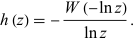
Pólya and Szegö (1925) were the first to use the symbol 👁 W
for the Lambert function.

Banwell and Jayakumar (2000) showed that a 👁 W
-function describes the relation between voltage, current,
and resistance in a diode, and Packel and Yuen (2004) applied the 👁 W
-function to a ballistic projectile in the presence of air
resistance. Other applications have been discovered in statistical mechanics, quantum
chemistry, combinatorics, enzyme kinetics, the physiology of vision, the engineering
of thin films, hydrology, and the analysis of algorithms (Hayes 2005).


The Lambert 👁 W
-function
is illustrated above in the complex plane.


The real (left) and imaginary (right) parts of the analytic continuation of 👁 W(z)
over the complex plane are illustrated
above (M. Trott, pers. comm.).

👁 W(x)
is real for 👁 x>=-1/e
.
It has the special values


| 👁 W(-1/2pi) | 👁 = | 👁 1/2ipi |
(5)
|
| 👁 W(-e^(-1)) | 👁 = | 👁 -1 |
(6)
|
| 👁 W(0) | 👁 = | 👁 0 |
(7)
|
| 👁 W(1) | 👁 = | 👁 0.567143.... |
(8)
|


👁 W(1)=0.567143...
(OEIS A030178) is called the omega
constant and can be considered a sort of "golden
ratio" of exponentials since

![👁 exp[-W(1)]=W(1),](https://mathworld.wolfram.com/images/equations/LambertW-Function/NumberedEquation5.svg)
giving
| 👁 ln[1/(W(1))]=W(1). |
(10)
|
![👁 ln[1/(W(1))]=W(1).](https://mathworld.wolfram.com/images/equations/LambertW-Function/NumberedEquation6.svg)
The Lambert 👁 W
-function
obeys the identity


(pers. comm. from R. Corless to O. Marichev, Sep. 29, 2015).


The function 👁 W(ze^z)/z
has a very complicated structure in the complex plane, but is simply equal to 1 for
👁 R[z]>=1
and a slightly extended region above and below the real axis.

![👁 R[z]>=1](https://mathworld.wolfram.com/images/equations/LambertW-Function/Inline30.svg)
The Lambert 👁 W
-function
has the series expansion

| 👁 W(x) | 👁 = | 👁 sum_(n=1)^(infty)((-1)^(n-1)n^(n-2))/((n-1)!)x^n |
(12)
|
| 👁 Image | 👁 = | 👁 x-x^2+3/2x^3-8/3x^4+(125)/(24)x^5-(54)/5x^6+(16807)/(720)x^7+.... |
(13)
|


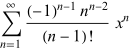



The Lagrange inversion theorem gives the equivalent series expansion
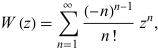
where 👁 n!
is a factorial. However, this series oscillates between
ever larger positive and negative
values for real 👁 z>~0.4
, and so cannot be used for practical numerical computation.


An asymptotic formula which yields reasonably accurate results for 👁 z>~3
is





![👁 L_1-L_2+(L_2)/(L_1)+(L_2(-2+L_2))/(2L_1^2)+(L_2(6-9L_2+2L_2^2))/(6L_1^3)+(L_2(-12+36L_2-22L_2^2+3L_2^3))/(12L_1^4)+(L_2(60-300L_2+350L_2^2-125L_2^3+12L_2^4))/(60L_1^5)+O[((L_2)/(L_1))^6],](https://mathworld.wolfram.com/images/equations/LambertW-Function/Inline46.svg)
where


(Corless et al. 1996), correcting a typographical error in de Bruijn (1981). Another expansion due to Gosper (pers. comm., July 22, 1996) is the double series
![👁 W(x)=a+sum_(n=0)^infty{sum_(k=0)^n(S_1(n,k))/([ln(x/a)-a]^(k-1)(n-k+1)!)}[1-(ln(x/a))/a]^n,](https://mathworld.wolfram.com/images/equations/LambertW-Function/NumberedEquation9.svg)
where 👁 S_1
is a nonnegative Stirling number
of the first kind and 👁 a
is a first approximation which can be used to select between
branches. The Lambert 👁 W
-function is two-valued for 👁 -1/e<=x<0
. For 👁 W(x)>=-1
, the function is denoted 👁 W_0(x)
or simply 👁 W(x)
, and this is called the principal
branch. For 👁 W(x)<=-1
,
the function is denoted 👁 W_(-1)(x)
. The derivative of
👁 W
is


![👁 1/([1+W(x)]exp[W(x)])](https://mathworld.wolfram.com/images/equations/LambertW-Function/Inline65.svg)


![👁 (W(x))/(x[1+W(x)])](https://mathworld.wolfram.com/images/equations/LambertW-Function/Inline68.svg)
for 👁 x!=0
.
For the principal branch when 👁 z>0
,


| 👁 ln[W(z)]=lnz-W(z). |
(22)
|
![👁 ln[W(z)]=lnz-W(z).](https://mathworld.wolfram.com/images/equations/LambertW-Function/NumberedEquation10.svg)
The 👁 n
th
derivatives of the Lambert 👁 W
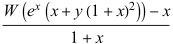
-function are given by


![👁 W^((n))(z)=(W^(n-1)(z))/(z^n[1+W(z)]^(2n-1))sum_(k=1)^na_(kn)W^k(z),](https://mathworld.wolfram.com/images/equations/LambertW-Function/NumberedEquation11.svg)
where 👁 a_(kn)
is the number triangle

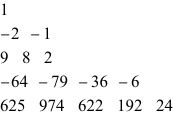
(OEIS A042977). This has exponential generating function





See also
Abel Polynomial, Digit-Shifting Constants, Lambert's Transcendental Equation, Omega Constant, Power TowerRelated Wolfram sites
http://functions.wolfram.com/ElementaryFunctions/ProductLog/Explore with Wolfram|Alpha

More things to try:
References
Banwell, T. C. and Jayakumar, A. "Exact Analytical Solution for Current Flow Through Diode with Series Resistance." Electronics Lett. 36, 291-292, 2000.Barry, D. J., Culligen-Hensley, P. J.; and Barry, S. J. "Real Values of the 👁 W
Function." ACM Trans. Math. Software 21, 161-171, 1995.Borwein, J. M. and Corless, R. M. "Emerging Tools for Experimental Mathematics." Amer. Math. Monthly 106, 899-909, 1999.Briggs, K. "👁 W

-ology, or, Some Exactly Solvable Growth Models." http://keithbriggs.info/W-ology.html.Briggs, K. "Graph Theory and Lambert's 👁 W

function." http://keithbriggs.info/graph_theory_and_W.html.Corless, R. M. "Material on the Lambert 👁 W

Function." (Ed. W. W. Küchlin). New York: ACM, pp. 197-204, 1997. http://www.apmaths.uwo.ca/~rcorless/frames/PAPERS/LambertW/.Corless, R. M.; Gonnet, G. H.; Hare, D. E. G.; Jeffrey, D. J.; and Knuth, D. E. "On the Lambert 👁 W

Function." Adv. Comput. Math. 5, 329-359, 1996.Corless, R. M.; Gonnet, G. H.; Hare, D. E. G.; and Jeffrey, D. J. "Lambert's 👁 W

Function in Maple." Maple Technical Newsletter 9, 12-22, Spring 1993.Corless, R. M. and Jeffrey, D. J. "The Wright 👁 omega

Function." In Artificial Intelligence, Automated Reasoning, and Symbolic Computation (Ed. J. Calmet, B. Benhamou, O. Caprotti, L. Henocque and V. Sorge). Berlin: Springer-Verlag, pp. 76-89, 2002.Corless, R. M.; Jeffrey, D. J.; and Knuth, D. E. "A Sequence of Series for the Lambert 👁 W

Function." In Proceedings of the 1997 International Symposium on Symbolic and Algebraic Computation, Maui, Hawaii. New York: ACM Press, pp. 197-204, 1997.de Bruijn, N. G. Asymptotic Methods in Analysis. New York: Dover, pp. 27-28, 1981.Eisenstein, G. "Entwicklung von 👁 alpha^(alpha^(alpha^...))

." J. reine angew. Math. 28, 49-52, 1844.Euler, L. "De serie Lambertina Plurimisque eius insignibus proprietatibus." Acta Acad. Scient. Petropol. 2, 29-51, 1783. Reprinted in Euler, L. Opera Omnia, Series Prima, Vol. 6: Commentationes Algebraicae. Leipzig, Germany: Teubner, pp. 350-369, 1921.Fritsch, F. N.; Shafer, R. E.; and Crowley, W. P. "Algorithm 443: Solution of the Transcendental Equation 👁 we^w=x

." Comm. ACM 16, 123-124, 1973.Gosper, R. W. Jr. "The Solutions of 👁 ye^(y^2)=x

and 👁 ye^y=x

." ACM SIGSAM Bull. 32, 8-10, 1998.Gosper, R. W. "Re: 2nd Order Eulerians." posting, July 22, 1996.Gray, J. J. and Tilling, L. "Johann Heinrich Lambert, Mathematician and Scientist 1728-1777." Historia Math. 5, 13-41, 1978.Hayes, B. "Why 👁 W

?" Amer. Sci. 93, 104-108, 2005.Jeffrey, D. J.; Hare, D. E. G.; and Corless, R. M. "Unwinding the Branches of the Lambert 👁 W

Function." Math. Scientist 21, 1-7, 1996.Jeffrey, D. J.; Hare, D. E. G.; and Corless, R. M. "Exact Rational Solutions of a Transcendental Equation." C. R. Math. Acad. Sci. Canada 20, 71-76, 1998.Jeffrey, D. J.; Corless, R. M.; Hare, D. E. G.; and Knuth, D. E. "Sur l'inversion de 👁 y^ae^y

au moyen des nombres de Stirling associes." Comptes Rendus Acad. Sci. Paris 320, 1449-1452, 1995.Kalman, D. "A Generalized Logarithm for Exponential-Linear Equations." College Math. J. 32, 2-14, 2001.Lambert, J. H. "Observations variae in Mathesin Puram." Acta Helvitica, physico-mathematico-anatomico-botanico-medica 3, 128-168, 1758.ORCCA. "The Lambert W Function." http://www.orcca.on.ca/LambertW.Packel, E. and Yuen, D. "Projectile Motion with Resistance and the Lambert 👁 W

Function." College Math. J. 35, 337-350, 2004.Pólya, G. and Szegö, G. Aufgaben und Lehrsätze der Analysis. Berlin, 1925. Reprinted as Problems and Theorems in Analysis I. Berlin: Springer-Verlag, 1998.Sloane, N. J. A. Sequences A030178 and A042977 in "The On-Line Encyclopedia of Integer Sequences.""Time for a New Elementary Function?" FOCUS: Newsletter Math. Assoc. Amer. 20, 2, Feb. 2000.Valluri, S. R.; Jeffrey, D. J.; and Corless, R. M. "Some Applications of the Lambert 👁 W

Function to Physics." Canad. J. Phys. 78, 823-831, 2000.Wright, E. M. "Solution of the Equation 👁 ze^z=a

." Bull. Amer. Math. Soc. 65, 89-93, 1959.
Referenced on Wolfram|Alpha
Lambert W-FunctionCite this as:
Weisstein, Eric W. "Lambert W-Function." From MathWorld--A Wolfram Resource. https://mathworld.wolfram.com/LambertW-Function.html