

Lovász Number

The Lovász number 👁 theta(G)
of a graph 👁 G
,
sometimes also called the theta function of 👁 G
, was introduced by Lovász (1979) with the explicit
goal of estimating the Shannon capacity of a
graph. Let 👁 G
be a graph and let 👁 A
be the family of real matrices 👁 A=(a_(ij))
such that 👁 a_(ij)=0
if 👁 i
and 👁 j
are adjacent in 👁 G
, where the other elements are unconstrained. Let the eigenvalues
of 👁 A
be denoted 👁 lambda_1(A)>=lambda_2(A)>=...>=lambda_n(A)
. Then



![👁 theta(G)=max_(A in A)[1-(lambda_1(A))/(lambda_n(A))]](https://mathworld.wolfram.com/images/equations/LovaszNumber/NumberedEquation1.svg)
(Lovász 1979, Knuth 1994, Brimkov et al. 2000).
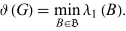
An equivalent definition considers 👁 B
the family of real matrices 👁 B=(b_(ij))
such that 👁 b_(ij)=0
if 👁 i=j
or 👁 i
and 👁 j
are adjacent in 👁 G
and other elements unconstrained. Then


Let 👁 theta(G)
be the Lovász number of a graph of 👁 G
. Then



where 👁 omega(G)
is the clique number and 👁 chi(G)
is the chromatic number
of 👁 G
. This is the sandwich
theorem. It can be rewritten by changing the role of graph complements, giving



which can be written using 👁 omega(G^_)=alpha(G)
with 👁 alpha
the independence number and 👁 theta(G)=chi(G^_)
the clique
covering number as



For a perfect graph,
Despite much work on the problem of determining 👁 theta(G)
, finding explicit values for interesting special cases
of graphs remains an open problem (Brimkov et al. 2000). However, explicit
formulas are known for 👁 theta(G)
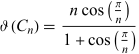
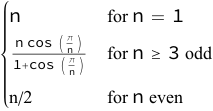
for several families of simple graphs. For example, for the cycle
graph 👁 C_n
with 👁 n>=3
and odd,


(Lovász 1979, Brimkov et al. 2000).
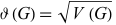
Self-complementary vertex-transitive graphs-including the Paley graphs--have 👁 theta(G)=sqrt(V(G))
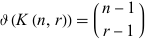
and a Kneser
graph 👁 K(n,r)
has

(Lovász 1979).
Fung (2011) gives the Lovász numbers of the Keller graphs 👁 G_1
,
👁 G_2
, ..., as 4, 6, 28/3, 👁 2^4
, 👁 2^5
, ....


The following table gives some special cases.




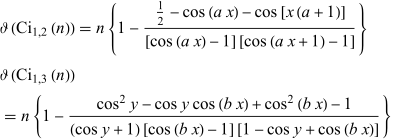
Brimkov et al. (2000) determined the additional closed forms for quartic circulant graphs, namely
![👁 theta(Ci_(1,2)(n))=n{1-(1/2-cos(ax)-cos[x(a+1)])/([cos(ax)-1][cos(ax+1)-1])} theta(Ci_(1,3)(n)) =n{1-(cos^2y-cosycos(bx)+cos^2(bx)-1)/((cosy+1)[cos(bx)-1][1-cosy+cos(bx)])}](https://mathworld.wolfram.com/images/equations/LovaszNumber/NumberedEquation9.svg)
for odd 👁 n
,
where


![👁 [(n-3)/6],](https://mathworld.wolfram.com/images/equations/LovaszNumber/Inline66.svg)
👁 |_z_|
is the floor
function, and 👁 [z]
is the ceiling function. These are special cases
of the formula

![👁 [z]](https://mathworld.wolfram.com/images/equations/LovaszNumber/Inline68.svg)

where



The Lovász number satisfies
![👁 theta(G□AdjustmentBox[x, BoxMargins -> {{-0.65, 0.13913}, {-0.5, 0.5}}, BoxBaselineShift -> -0.1]H)<=theta(G)theta(H),](https://mathworld.wolfram.com/images/equations/LovaszNumber/NumberedEquation11.svg)
where 👁 G□AdjustmentBox[x, BoxMargins -> {{-0.65, 0.13913}, {-0.5, 0.5}}, BoxBaselineShift -> -0.1]H
denotes the graph strong product (Lovász
1979). In addition, if 👁 G
is vertex-transitive, then
![👁 G□AdjustmentBox[x, BoxMargins -> {{-0.65, 0.13913}, {-0.5, 0.5}}, BoxBaselineShift -> -0.1]H](https://mathworld.wolfram.com/images/equations/LovaszNumber/Inline75.svg)


where 👁 G^_
denotes the graph complement of 👁 G
.


The Haemers number sometimes gives a better bound on the Shannon capacity than does the Lovász number.
See also
Clique Number, Coloring, Haemers Number, Sandwich Theorem, Shannon CapacityExplore with Wolfram|Alpha

More things to try:
References
Brimkov, V. E.; Codenotti, B.; Crespi, V.; and Leoncini, M. "On the Lovász Number of Certain Circulant Graphs." In Algorithms and Complexity. Papers from the 4th Italian Conference (CIAC 2000) Held in Rome, March 1-3, 2000 (Ed. G. Bongiovanni, G. Gambosi, and R. Petreschi). Berlin: Springer-Verlag, pp. 291-305, 2000.Fung, M. "The Lovász Number of the Keller Graphs." Master thesis. Universiteit Leiden: Mathematisch Instituut, 2011.Knuth, D. E. "The Sandwich Theorem." Electronic J. Combinatorics 1, No. 1, A1, 1-48, 1994. http://www.combinatorics.org/Volume_1/Abstracts/v1i1a1.html.Lovász, L. "On the Shannon Capacity of a Graph." IEEE Trans. Inform. Th. IT-25, 1-7, 1979.Schrijver, A. "A Comparison of the Delsarte and Lovász Bounds." IEEE Trans. Inform. Th. 25, 425-429, 1979.Shannon, C. E. "The Zero-Error Capacity of a Noisy Channel." IRE Trans. Inform. Th. 2, 8-19, 1956.Skarakis, C. "The Sandwich Theorem." §4.2.3 in "Convex Optimization: Theory and Practice." MSc dissertation. York, UK: Department of Mathematics, University of York, pp. 43-46, Aug. 22, 2008. http://keithbriggs.info/documents/Skarakis_MSc.pdf.Referenced on Wolfram|Alpha
Lovász NumberCite this as:
Weisstein, Eric W. "Lovász Number." From MathWorld--A Wolfram Resource. https://mathworld.wolfram.com/LovaszNumber.html