

Numerical Differentiation
Numerical differentiation is the process of finding the numerical value of a derivative of a given function at a given point. In general, numerical differentiation is more difficult than numerical integration. This is because while numerical integration requires only good continuity properties of the function being integrated, numerical differentiation requires more complicated properties such as Lipschitz classes. Numerical differentiation is implemented as [f, x, x0, scale] in the Wolfram Language package .
There are many applications where derivatives need to be computed numerically. The simplest approach simply uses the definition of the derivative
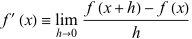
for some small numerical value of 👁 h<<1
.

See also
Derivative, Differentiation, Euler-Maclaurin Integration Formulas, Maclaurin-Cauchy Theorem, Numerical IntegrationExplore with Wolfram|Alpha

More things to try:
References
Press, W. H.; Flannery, B. P.; Teukolsky, S. A.; and Vetterling, W. T. "Numerical Derivatives." §5.7 in Numerical Recipes in FORTRAN: The Art of Scientific Computing, 2nd ed. Cambridge, England: Cambridge University Press, pp. 180-184, 1992.Weisstein, E. W. "Books about Numerical Methods." http://www.ericweisstein.com/encyclopedias/books/NumericalMethods.html.Referenced on Wolfram|Alpha
Numerical DifferentiationCite this as:
Weisstein, Eric W. "Numerical Differentiation." From MathWorld--A Wolfram Resource. https://mathworld.wolfram.com/NumericalDifferentiation.html