

Pentagonal Antiprism


The pentagonal antiprism is the antiprism having a regular pentagon for the top and bottom bases. Since the bases are rotated with respect to each other, it has a ribbon of 10 triangular faces connecting those pentagons, giving a total of 12 faces, making it a (non-regular) dodecahedron.
The equilateral pentagonal antiprism is also the uniform polyhedron with Maeder index 77 (Maeder 1997) and Har'El index 2 (Har'El 1993) as well as a canonical polyhedron.

The pentagonal antiprism is the convex hull of the pentagrammic crossed antiprism.
The unit pentagonal antiprism has volume
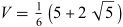
and Dehn invariant


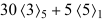


![👁 5[3cot^(-1)(2/(sqrt(5)))+tan^(-1)2],](https://mathworld.wolfram.com/images/equations/PentagonalAntiprism/Inline6.svg)
where the first expression uses the basis of Conway et al. (1999). It can be dissected into the metabidiminished icosahedron (E. Weisstein, Sep. 6, 2023).

Its dual polyhedron is the pentagonal trapezohedron, with which it is illustrated above.
See also
Diminished Polyhedron, Regular IcosahedronExplore with Wolfram|Alpha

More things to try:
References
Conway, J. H.; Radin, C.; and Sadun, L. "On Angles Whose Squared Trigonometric Functions Are Rational." Discr. Computat. Geom. 22, 321-332, 1999.Har'El, Z. "Uniform Solution for Uniform Polyhedra." Geometriae Dedicata 47, 57-110, 1993.Johnson, N. W. "Convex Polyhedra with Regular Faces." Canad. J. Math. 18, 169-200, 1966.Maeder, R. E. "77: Pentagonal Antiprism." 1997. https://www.mathconsult.ch/static/unipoly/7.html.Referenced on Wolfram|Alpha
Pentagonal AntiprismCite this as:
Weisstein, Eric W. "Pentagonal Antiprism." From MathWorld--A Wolfram Resource. https://mathworld.wolfram.com/PentagonalAntiprism.html