

Plethysm
A group theoretic operation which is useful in the study of complex atomic spectra. A plethysm takes a set of functions of a given symmetry type 👁 {mu}
and forms from them symmetrized products of a given degree
👁 r
and other symmetry type 👁 {nu}
. A plethysm


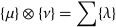
satisfies the rules




where 👁 Gamma_(munulambda)
is the coefficient
of 👁 {lambda}
in 👁 {mu}{nu}
,



where 👁 {nu^~}
is the partition of 👁 r
conjugate to 👁 {nu}
, and



where 👁 g_(munulambda)
is the coefficient of 👁 {lambda}
in the inner product 👁 {mu} degrees{nu}
(Wybourne 1970).


Explore with Wolfram|Alpha

More things to try:
References
Littlewood, D. E. "Polynomial Concomitants and Invariant Matrices." J. London Math. Soc. 11, 49-55, 1936.Wybourne, B. G. "The Plethysm of 👁 S
-Functions" and "Plethysm and Restricted Groups." Chs. 6-7 in Symmetry Principles and Atomic Spectroscopy. New York: Wiley, pp. 49-68, 1970.
Referenced on Wolfram|Alpha
PlethysmCite this as:
Weisstein, Eric W. "Plethysm." From MathWorld--A Wolfram Resource. https://mathworld.wolfram.com/Plethysm.html