

Pyramid


A pyramid is a polyhedron with one face (known as the "base") a polygon and all the other faces
triangles meeting at a common polygon
vertex (known as the "apex"). A right pyramid is a pyramid for which
the line joining the centroid of the base and the apex is perpendicular to the base.
A regular pyramid is a right pyramid whose base
is a regular polygon. An 👁 n
-gonal regular pyramid (denoted 👁 Y_n
) having equilateral
triangles as sides is possible only for 👁 n=3
, 4, 5. These correspond to the regular
tetrahedron, square pyramid, and pentagonal
pyramid, respectively.


Canonical 👁 n
-pyramids are illustrated above for 👁 n=3
to 7.


The illustration above shows canonical 👁 n
-pyramids together with their duals. As can be seen, such pyramids
are self-dual, corresponding to the fact
that a pyramid's skeleton (a wheel
graph) is a self-dual graph. Canonical 👁 n
-pyramids with unit midradius
and midcenter at the origin have regular polygon base circumradius


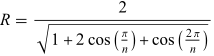
and base and apex at heights


giving an overall height
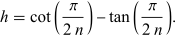
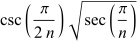
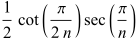
The corresponding edges lengths, generalized diameter, circumradius, surface area, and volume are
| 👁 d_n | 👁 = | 👁 csc(pi/(2n))sqrt(sec(pi/n)) |
(5)
|
| 👁 R_n | 👁 = | 👁 1/2cot(pi/(2n))sec(pi/n) |
(6)
|
| 👁 S_n | 👁 = | 👁 2n[tan(pi/n)+sqrt(2sec(pi/n)-1)] |
(7)
|
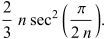
| 👁 V_n | 👁 = | 👁 2/3nsec^2(pi/(2n)). |
(8)
|






![👁 2n[tan(pi/n)+sqrt(2sec(pi/n)-1)]](https://mathworld.wolfram.com/images/equations/Pyramid/Inline22.svg)



Nets for the canonical 👁 n
-dipyramids
for 👁 n=3
, 4, ..., 10 are illustrated above.
The faces of the canonical 👁 n
-pyramid
are isosceles triangles with angles


![👁 cos^(-1)[4cos(pi/n)-cos((2pi)/n)-2]](https://mathworld.wolfram.com/images/equations/Pyramid/Inline31.svg)


![👁 cos^(-1)[1-cos(pi/n)].](https://mathworld.wolfram.com/images/equations/Pyramid/Inline34.svg)
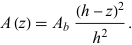
An arbitrary pyramid has a single cross-sectional shape whose lengths scale linearly with height. Therefore, the area of a cross
section scales quadratically with height, decreasing from 👁 A_b
at the base (👁 z=0
) to 0 at the apex (assumed to lie at a height 👁 z=h
). The area at a height 👁 z
above the base is therefore given by


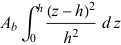
As a result, the volume of a pyramid, regardless of base shape or position of the apex relative to the base, is given by




Note that this formula also holds for the cone, elliptic cone, etc.
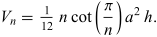
The volume of a pyramid whose base is a regular 👁 n
-sided polygon with side 👁 a
is therefore


Expressing in terms of the circumradius of the base gives
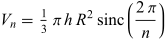
(Lo Bello 1988, Gearhart and Schulz 1990).
The geometric centroid is the same as for the cone, given by
| 👁 z^_=1/4h. |
(17)
|

The lateral surface area of a pyramid is
| 👁 S=1/2ps, |
(18)
|

where 👁 s
is the slant
height and 👁 p
is the base perimeter.


Joining two pyramids together at their bases gives a dipyramid, also called a bipyramid.
See also
Augmentation, Dipyramid, Elevatum, Elongated Pyramid, Gyroelongated Pyramid, Hexagonal Pyramid, Invaginatum, Pentagonal Pyramid, Pyramidal Frustum, Square Pyramid, Tetrahedron, Triangular Pyramid, Truncated Square Pyramid Explore this topic in the MathWorld classroomExplore with Wolfram|Alpha

More things to try:
References
Beyer, W. H. (Ed.). CRC Standard Mathematical Tables, 28th ed. Boca Raton, FL: CRC Press, p. 128, 1987.Gearhart, W. B. and Schulz, H. S. "The Function 👁 sinx/x
." College Math. J. 21, 90-99, 1990.Harris, J. W. and Stocker, H. "Pyramid." §4.3 in Handbook of Mathematics and Computational Science. New York: Springer-Verlag, pp. 98-99, 1998.Hart, G. "Pyramids, Dipyramids, and Trapezohedra." http://www.georgehart.com/virtual-polyhedra/pyramids-info.html.Kern, W. F. and Bland, J. R. "Pyramid" and "Regular Pyramid." §20-21 in Solid Mensuration with Proofs, 2nd ed. New York: Wiley, pp. 50-53, 1948.Lo Bello, A. J. "Volumes and Centroids of Some Famous Domes." Math. Mag. 61, 164-170, 1988.
Referenced on Wolfram|Alpha
PyramidCite this as:
Weisstein, Eric W. "Pyramid." From MathWorld--A Wolfram Resource. https://mathworld.wolfram.com/Pyramid.html