

Rabbit Sequence

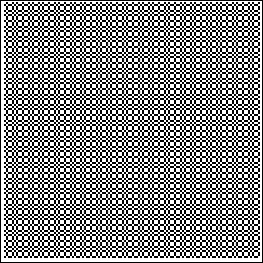
A sequence which arises in the hypothetical reproduction of a population of rabbits. Let the substitution
system map 👁 0->1
correspond to young rabbits growing old, and 👁 1->10
correspond to old rabbits producing young rabbits.
Starting with 0 and iterating using string
rewriting gives the terms 1, 10, 101, 10110, 10110101, 1011010110110, .... A
recurrence plot of the limiting value of this
sequence is illustrated above.


Converted to decimal, this sequence gives 1, 2, 5, 22, 181, ... (OEIS A005203), with the 👁 n
th term given by the recurrence
relation


with 👁 a(0)=0
,
👁 a(1)=1
, and 👁 F_n
the 👁 n
th Fibonacci number.


The limiting sequence written as a binary fraction 👁 0.1011010110110..._2
(OEIS A005614),
where 👁 (a_n...a_1a_0)_2
denotes a binary number (i.e., a number written in base
2, so 👁 a_i=0
or 1), is called the rabbit constant.



See also
Fibonacci Number, Rabbit Constant, Thue-Morse SequenceExplore with Wolfram|Alpha

More things to try:
References
Davison, J. L. "A Series and Its Associated Continued Fraction." Proc. Amer. Math. Soc. 63, 29-32, 1977.Gould, H. W.; Kim, J. B.; and Hoggatt, V. E. Jr. "Sequences Associated with t-ary Coding of Fibonacci's Rabbits." Fib. Quart. 15, 311-318, 1977.Schroeder, M. Fractals, Chaos, Power Laws: Minutes from an Infinite Paradise. New York: W. H. Freeman, p. 55, 1991.Sloane, N. J. A. Sequences A005203/M1539 and A005614 in "The On-Line Encyclopedia of Integer Sequences."Referenced on Wolfram|Alpha
Rabbit SequenceCite this as:
Weisstein, Eric W. "Rabbit Sequence." From MathWorld--A Wolfram Resource. https://mathworld.wolfram.com/RabbitSequence.html