

Regular Heptagon


The regular heptagon is the seven-sided regular polygon illustrated above, which has Schläfli symbol 👁 {7}
. According to Bankoff and Garfunkel
(1973), "since the earliest days of recorded mathematics, the regular heptagon
has been virtually relegated to limbo." Nevertheless, Thébault (1913)
discovered many beautiful properties of the heptagon, some of which are discussed
by Bankoff and Garfunkel (1973).


Although the regular heptagon is not a constructible polygon using the classical rules of Greek geometric
construction, it is constructible using a Neusis
construction (Johnson 1975; left figure above). To implement the construction,
place a mark 👁 X
on a ruler 👁 AZ
,
and then build a square of side length 👁 AX
. Then construct the perpendicular bisector at 👁 M
to 👁 BC
, and draw an arc centered at 👁 C
of radius 👁 CE
. Now place the marked ruler so that it passes through 👁 B
, 👁 X
lies on the arc, and 👁 A
falls on the perpendicular bisector. Then 👁 2theta=∠BAC=pi/7
, and two such triangles give the vertex
angle 👁 2pi/7
of a regular heptagon. Conway and Guy (1996) give a Neusis
construction for the heptagon. In addition, the regular heptagon can be constructed
using seven identical toothpicks to form 1:3:3 triangles (Finlay 1959, Johnson 1975,
Wells 1991; right figure above). Bankoff and Garfunkel (1973) discuss the heptagon,
including a purported discovery of the Neusis
construction by Archimedes (Heath 1931). Madachy (1979) illustrates how to construct
a heptagon by folding and knotting a strip of paper, and the regular heptagon can
also be constructed using a conchoid of Nicomedes.




Although the regular heptagon is not constructible using classical techniques, Dixon (1991) gives constructions for several angles very
close to 👁 360 degrees/7
.
While the angle subtended by a side is 👁 360 degrees/7 approx 51.428571 degrees
, Dixon gives constructions
containing angles of 👁 2sin^(-1)(sqrt(3)/4) approx 51.317813 degrees
,
👁 tan^(-1)(5/4) approx 51.340192 degrees
,
and 👁 30 degrees+sin^(-1)((sqrt(3)-1)/2) approx 51.470701 degrees
.






In the regular heptagon with unit circumradius and center 👁 O
,
construct the midpoint 👁 M_(AB)
of 👁 AB
and the mid-arc point 👁 X_(CB)
of the arc 👁 CB
, and let 👁 M_(OX)
be the midpoint of 👁 OX_(CB)
. Then 👁 M_(OX)=M_(AB)=1/sqrt(2)
(Bankoff and Garfunkel 1973).




In the regular heptagon, construct the points 👁 X_(CB)
, 👁 M_(AB)
, and 👁 M_(OX)
as above. Also construct the midpoint 👁 M_(OF)
and construct 👁 J
along the extension of 👁 M_(AB)B
such that 👁 M_(AB)J=M_(AB)X_(CB)
. Note that the apothem 👁 OM_(AB)
of the heptagon has length 👁 r=cos(pi/7)
. Then





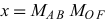
1. The length 👁 x=M_(AB)M_(OF)
is equal to 👁 sqrt(2)r=sqrt(2)cos(pi/7)
,
and also to the largest root of


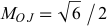
2. 👁 M_(OJ)=sqrt(6)/2
,
and
3. 👁 M_(AB)M_(OX)
is tangent to the circumcircle of 👁 DeltaM_(OF)OM_(AB)

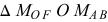
(Bankoff and Garfunkel 1973).

Construct a heptagonal triangle 👁 DeltaABC
in a regular heptagon with center 👁 O
, and let 👁 BN
and 👁 AM
bisect 👁 ∠ABC
and 👁 ∠BAC
, respectively, with 👁 M
and 👁 N
both lying on the circumcircle. Also define the midpoints
👁 M_(MO)
, 👁 M_(NO)
, 👁 M_(MC)
, and 👁 M_(NC)
. Then


| 👁 MN | 👁 = | 👁 1/2M_(MO)M_(NO)=1/2M_(MC)M_(NC) |
(2)
|
| 👁 Image | 👁 = | 👁 sqrt(2)M_(NO)M_(MC) |
(3)
|
| 👁 M_(MO)M_(MC) | 👁 = | 👁 M_(NO)M_(NC)=1/2 |
(4)
|
| 👁 M_(MO)M_(NC) | 👁 = | 👁 1/2sqrt(2) |
(5)
|





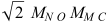


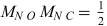


(Bankoff and Garfunkel 1973).
See also
Conchoid of Nicomedes, Edmonds' Map, Heptagon Theorem, Heptagonal Triangle, Neusis Construction, Klein Quartic, Polygon, Regular Polygon, Trigonometry Angles--Pi/7Explore with Wolfram|Alpha

More things to try:
References
Aaboe, A. Episodes from the Early History of Mathematics. Washington, DC: Math. Assoc. Amer., 1964.Bankoff, L. and Demir, H. "Solution to Problem E 1154." Amer. Math. Monthly 62, 584-585, 1955.Bankoff, L. and Garfunkel, J. "The Heptagonal Triangle." Math. Mag. 46, 7-19, 1973.Bold, B. Famous Problems of Geometry and How to Solve Them. New York: Dover, pp. 59-60, 1982.Conway, J. H. and Guy, R. K. The Book of Numbers. New York: Springer-Verlag, pp. 194-200, 1996.Courant, R. and Robbins, H. "The Regular Heptagon." §3.3.4 in What Is Mathematics?: An Elementary Approach to Ideas and Methods, 2nd ed. Oxford, England: Oxford University Press, pp. 138-139, 1996.Dixon, R. Mathographics. New York: Dover, pp. 35-40, 1991.Finlay, A. H. "Zig-Zag Paths." Math. Gaz. 43, 199, 1959.Heath, T. L. A Manual of Greek Mathematics. Oxford, England: Clarendon Press, pp. 340-342, 1931.Johnson, C. "A Construction for a Regular Heptagon." Math. Gaz. 59, 17-21, 1975.Madachy, J. S. Madachy's Mathematical Recreations. New York: Dover, pp. 59-61, 1979.Wells, D. The Penguin Dictionary of Curious and Interesting Geometry. London: Penguin, p. 210, 1991.SeeAlso
Referenced on Wolfram|Alpha
Regular HeptagonCite this as:
Weisstein, Eric W. "Regular Heptagon." From MathWorld--A Wolfram Resource. https://mathworld.wolfram.com/RegularHeptagon.html