

Skewes Number
The Skewes number (or first Skewes number) is the number 👁 Sk_1
above which 👁 pi(n)<li(n)
must fail (assuming that the Riemann
hypothesis is true), where 👁 pi(n)
is the prime counting
function and 👁 li(n)
is the logarithmic integral.


Isaac Asimov featured the Skewes number in his science fact article "Skewered!" (1974).
In 1912, Littlewood proved that 👁 Sk_1
exists (Hardy 1999, p. 17), and the upper bound


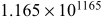
was subsequently found by Skewes (1933). The Skewes number has since been reduced to 👁 1.165×10^(1165)
by Lehman in 1966
(Conway and Guy 1996; Derbyshire 2004, p. 237), 👁 e^(e^(27/4)) approx 8.185×10^(370)
by te Riele (1987),
and less than 👁 1.39822×10^(316)
(Bays and Hudson 2000; Granville 2002; Borwein and Bailey 2003, p. 65; Havil
2003, p. 200; Derbyshire 2004, p. 237). The results of Bays and Hudson
left open the possibility that the inequality could fail around 👁 10^(176)
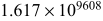
, and thus established a large range of violation around
👁 1.617×10^(9608)
(Derbyshire 2004,
p. 237). More recent work by Demichel establishes that the first crossover occurs
around 👁 1.397162914×10^(316)
,
where the probability that another crossover occurs before this value is infinitesimal
and can in fact be dramatically reduced in the suspect regions where there is such
a risk and these results are almost certainly the best currently possible (P. Demichel,
pers. comm., Aug. 22, 2005).




Rigorously, Rosser and Schoenfeld (1962) proved that there are no crossovers below 👁 10^8
, and this lower bound was subsequently
improved to 👁 8×10^(10)
by Brent (1975) and to 👁 10^(14)
by Kotnik (2008).


In 1914, Littlewood proved that the inequality must, in fact, fail infinitely often.
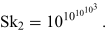
The second Skewes number 👁 Sk_2
(Skewes 1955) is the number above which 👁 pi(n)<li(n)
must fail assuming that the Riemann
hypothesis is false. It is much larger than the Skewes number 👁 Sk_1
,


See also
Graham's Number, Logarithmic Integral, Prime Counting Function, Riemann HypothesisExplore with Wolfram|Alpha

More things to try:
References
Asimov, I. "Skewered!" Of Matters Great and Small. New York: Ace Books, 1976.Asimov, I. "Science: Skewered!" Mag. Fantasy Sci. Fiction. Nov. 1974.Ball, W. W. R. and Coxeter, H. S. M. Mathematical Recreations and Essays, 13th ed. New York: Dover, p. 63, 1987.Bays, C. and Hudson, R. H. "A New Bound for the Smallest 👁 x
with 👁 pi(x)>li(x)

." Math. Comput. 69, 1285-1296, 2000.Boas, R. P. "The Skewes Number." In Mathematical Plums (Ed. R. Honsberger). Washington, DC: Math. Assoc. Amer., 1979.Borwein, J. and Bailey, D. Mathematics by Experiment: Plausible Reasoning in the 21st Century. Wellesley, MA: A K Peters, p. 65, 2003.Brent, R. P. "Irregularities in the Distribution of Primes and Twin Primes." Math. Comput. 29, 43-56, 1975.Conway, J. H. and Guy, R. K. The Book of Numbers. New York: Springer-Verlag, p. 61, 1996.Crandall, R. and Pomerance, C. Ex. 1.35 in Prime Numbers: A Computational Perspective. New York: Springer-Verlag, 2001.Demichel, P. "The Prime Counting Function and Related Subjects." http://demichel.net/patrick/li_crossover_pi.pdf.Derbyshire, J. Prime Obsession: Bernhard Riemann and the Greatest Unsolved Problem in Mathematics. New York: Penguin, p. 236, 2004.Granville, A. "Prime Possibilities and Quantum Chaos." 2002. http://www.msri.org/ext/Emissary/EmissarySpring02.pdf.Hardy, G. H. Ramanujan: Twelve Lectures on Subjects Suggested by His Life and Work, 3rd ed. New York: Chelsea, pp. 17 and 21, 1999.Havil, J. Gamma: Exploring Euler's Constant. Princeton, NJ: Princeton University Press, pp. 200 and 209, 2003.Kotnik, T. "The Prime-counting Function and its Analytic Approximations." Adv. Comput. Math. 29, 55-70, 2008.Lehman, R. S. "On the Difference 👁 pi(x)-li(x)

." Acta Arith. 11, 397-410, 1966.Littlewood, J. E. Littlewood's Miscellany. Cambridge, England: Cambridge University Press, pp. 110-112, 1986.Rosser, J. B. and Schoenfeld, L. "Approximate Formulas for some Functions of Prime Numbers." Ill. J. Math. 6, 64-94, 1962.Skewes, S. "On the Difference 👁 pi(x)-li(x)

." J. London Math. Soc. 8, 277-283, 1933.Skewes, S. "On the Difference 👁 pi(x)-li(x)

. II." Proc. London Math. Soc. 5, 48-70, 1955.te Riele, H. J. J. "On the Sign of the Difference 👁 pi(x)-li(x)

." Math. Comput. 48, 323-328, 1987.Wagon, S. Mathematica in Action. New York: W. H. Freeman, p. 30, 1991.
Referenced on Wolfram|Alpha
Skewes NumberCite this as:
Weisstein, Eric W. "Skewes Number." From MathWorld--A Wolfram Resource. https://mathworld.wolfram.com/SkewesNumber.html