

Snub Cube


The snub cube, also called the cubus simus (Kepler 1619, Weissbach and Martini 2002) or snub cuboctahedron, is an Archimedean solid having 38 faces (32 triangular and 6 square), 60 edges, and 24 vertices. It is a chiral solid, and hence has two enantiomorphous forms known as laevo (left-handed) and dextro (right-handed). A laevo snub dodecahedron is illustrated above together with a wireframe version and a net that can be used for its construction.
It is also the uniform polyhedron with Maeder index 12 (Maeder 1997), Wenninger index 17 (Wenninger 1989), Coxeter index 24 (Coxeter
et al. 1954), and Har'El index 17 (Har'El 1993). It has Schläfli
symbol 👁 s{3; 4}
and Wythoff symbol 👁 |234
.


Some symmetric projections of the snub cube are illustrated above.
It is implemented in the Wolfram Language as []. Precomputed properties are available as [, prop].
The tribonacci constant 👁 t
is intimately related to the metric properties of the snub
cube.

It can be constructed by snubification of a unit cube with outward offset


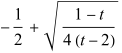



and twist angle
| 👁 theta | 👁 = | 👁 cos^(-1)[(8x^6-4x^4-2x^2-1)_2] |
(3)
|
| 👁 Image | 👁 = | 👁 cos^(-1)(sqrt(1/2t)) |
(4)
|
| 👁 Image | 👁 = | 👁 tan^(-1)((t-1)/(t+1)) |
(5)
|
| 👁 Image | 👁 = | 👁 0.287413.... |
(6)
|


![👁 cos^(-1)[(8x^6-4x^4-2x^2-1)_2]](https://mathworld.wolfram.com/images/equations/SnubCube/Inline12.svg)


Here, the notation 👁 (P(x))_n
indicates a polynomial root and 👁 t
is the tribonacci constant.


An attractive dual of the two enantiomers superposed on one another is illustrated above.

Its dual polyhedron is the pentagonal icositetrahedron, with which it is illustrated above.

Its skeleton is the snub cubical graph, several illustrations of which are illustrated above.
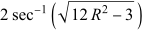
The midradius 👁 rho
of the dual and solid and circumradius 👁 R
for a snub cube of unit edge length
are given by












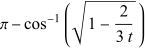
The distances from the center to the centroids of the triangular and square faces are given by the unique positive roots to the equations












The surface area of the snub cube of side length 1 is
| 👁 S=6+8sqrt(3) |
(22)
|





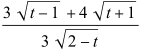


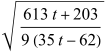





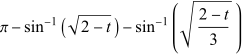
The dihedral angles are





![👁 pi-cos^(-1)[1/3(2t-1)]](https://mathworld.wolfram.com/images/equations/SnubCube/Inline92.svg)


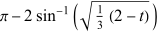


















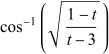
The angle subtended by an edge from the center is








See also
Archimedean Solid, Equilateral Zonohedron, Icositetrahedron, Pentagonal Icositetrahedron, Snub Cube-Pentagonal Icositetrahedron Compound, Snub Cubical Graph, Snub Dodecahedron, Tribonacci ConstantExplore with Wolfram|Alpha

More things to try:
References
Ball, W. W. R. and Coxeter, H. S. M. Mathematical Recreations and Essays, 13th ed. New York: Dover, p. 139, 1987.Coxeter, H. S. M.; Longuet-Higgins, M. S.; and Miller, J. C. P. "Uniform Polyhedra." Phil. Trans. Roy. Soc. London Ser. A 246, 401-450, 1954.Cundy, H. and Rollett, A. "Snub Cube. 👁 3^4.4
." §3.7.7 in Mathematical Models, 3rd ed. Stradbroke, England: Tarquin Pub., p. 107, 1989.Geometry Technologies. "Snub Cube." http://www.scienceu.com/geometry/facts/solids/snub_cube.html.Hardin, R. H. and Sloane, N. J. A. "McLaren's Improved Snub Cube and Other New Spherical Designs in Three Dimensions." Disc. Comput. Geom. 15, 429-441, 1996.Har'El, Z. "Uniform Solution for Uniform Polyhedra." Geometriae Dedicata 47, 57-110, 1993.Kasahara, K. "From Regular to Semiregular Polyhedrons." Origami Omnibus: Paper-Folding for Everyone. Tokyo: Japan Publications, pp. 220-221, 1988.Kepler, J. Harmonices Mundi. 1619. Reprinted Opera Omnia, Lib. II. Frankfurt, Germany.Longuet-Higgins, M. S. "Snub Polyhedra and Organic Growth." Proc. Roy. Soc. A 465, 477-491, 2009.Maeder, R. E. "12: Snub Cube." 1997. https://www.mathconsult.ch/static/unipoly/12.html.Robinson, R. M. "Arrangements of 24 Points on a Sphere." Math. Ann. 144, 17-48, 1961.Weissbach, B. and Martini, H. "On the Chiral Archimedean Solids." Contrib. Algebra and Geometry 43, 121-133, 2002.Wenninger, M. J. "The Snub Cube." Model 17 in Polyhedron Models. Cambridge, England: Cambridge University Press, p. 31, 1989.
Referenced on Wolfram|Alpha
Snub CubeCite this as:
Weisstein, Eric W. "Snub Cube." From MathWorld--A Wolfram Resource. https://mathworld.wolfram.com/SnubCube.html