

Square Root Algorithms

A sequence of approximations 👁 a/b
to 👁 sqrt(n)
can be derived by factoring


| 👁 a^2-nb^2=+/-1 |
(1)
|

(where 👁 -1
is possible only if 👁 -1
is a quadratic residue
of 👁 n
).
Then




and
| 👁 (1+sqrt(n))^1 | 👁 = | 👁 1+sqrt(n) |
(4)
|
| 👁 (1+sqrt(n))^2 | 👁 = | 👁 (1+n)+2sqrt(n) |
(5)
|
| 👁 (1+sqrt(n))(a+bsqrt(n)) | 👁 = | 👁 (a+bn)+sqrt(n)(a+b). |
(6)
|


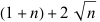



Therefore, 👁 a
and 👁 b
are given by the recurrence relations


with 👁 a_1=b_1=1
.
The error obtained using this method is

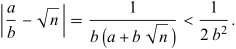
The first few approximants to 👁 sqrt(n)
are therefore given by


This algorithm is sometimes known as the Bhaskara-Brouncker algorithm, and the approximants are precisely those obtained by taking successive
convergents to the continued
fraction of 👁 sqrt(n)
.
The fact that if 👁 a/b
is an approximation to 👁 sqrt(2)
, then 👁 (a+2b)/(a+b)
is a better one (the 👁 n=2
case) was known to Theon of Smyrna in the second century
AD (Wells 1986, p. 35).




Another general technique for deriving this sequence, known as Newton's iteration, is obtained by letting 👁 x=sqrt(n)
. Then 👁 x=n/x
, so the sequence


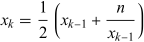
converges quadratically to the root. The first few approximants to 👁 sqrt(n)
are therefore given by


Wolfram's iteration provides a method for finding square roots of integers using the binary representation.
See also
Newton's Iteration, Pythagoras's Constant, Square Root, Wolfram's IterationExplore with Wolfram|Alpha

More things to try:
References
Flannery, S. and Flannery, D. In Code: A Mathematical Journey. London: Profile Books, p. 132, 2000.Wells, D. The Penguin Dictionary of Curious and Interesting Numbers. Middlesex, England: Penguin Books, pp. 34-35, 1986.Wolfram, S. A New Kind of Science. Champaign, IL: Wolfram Media, p. 1168, 2002.Referenced on Wolfram|Alpha
Square Root AlgorithmsCite this as:
Weisstein, Eric W. "Square Root Algorithms." From MathWorld--A Wolfram Resource. https://mathworld.wolfram.com/SquareRootAlgorithms.html