

Tanc Function


By analogy with the sinc function, define the tanc function by
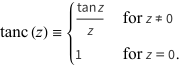
Since 👁 tanz/z
is not a cardinal function, the "analogy"
with the sinc function is one of functional structure,
not mathematical properties. It is quite possible that a better term than 👁 tanc(z)
, as introduced here, could be coined, although there
appears to be no name previously assigned to this function.


The derivative is given by
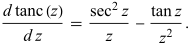
The indefinite integral can apparently not be done in closed form in terms of conventionally defined functions.

This function commonly arises in problems in physics, where it is desired to determine values of 👁 x
for which 👁 tanx=x
,
i.e., 👁 tanc(x)=1
.
This is a transcendental equation whose first few solutions are given in the following
table and illustrated above.


| 👁 n | OEIS | root |
| 0 | 0 | |
| 1 | A115365 | 4.4934094579090641753... |
| 2 | 7.7252518369377071642... | |
| 3 | 10.904121659428899827... | |
| 4 | 14.066193912831473480... | |
| 5 | 17.220755271930768739... |

The first of these solutions can be given in closed form as
| 👁 r_1=j_(3/2,1), |
(3)
|

where 👁 j_(n,k)
is the 👁 k
th
positive root of the Bessel function
of the first kind 👁 J_n(x)
.


The positive solutions can be written explicitly in series form as

(OEIS A079330 and A088989), where the series in 👁 q^(-1)
can be found by series reversion of the series
for 👁 x+cotx
and


| 👁 q=1/2(2k+1)pi |
(5)
|
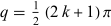
for 👁 k
a positive integer (D. W. Cantrell,
pers. comm., Jan. 3, 2003). In practice, the first three terms of the series
often suffice for obtaining approximate solutions.


Because of the vertical asymptotes of 👁 tanx
as odd multiples of 👁 pi/2
, this function is much less well-behaved than the sinc
function, even as 👁 x->infty
.
The plot above shows 👁 tanc(n)
for integers 👁 n
.
The values of 👁 n
giving incrementally smallest values of 👁 tanc(n)
are 👁 n=2
, 11, 1317811389848379909481978463177998812826691414678853402757616,
...(OEIS A079331), corresponding to values
of 👁 -1.09252
, 👁 -20.541
, 👁 -54.5197
, 👁 -74.7721
, .... Similarly, the values of 👁 n
giving incrementally largest values of 👁 tanc(n)
are 👁 n=1
, 122925461, 534483448, 3083975227, 214112296674652, ...
(OEIS A079332), corresponding to 1.55741, 2.65934,
3.58205, 4.3311, 18.0078, 18.0566, 556.306, ... (D. W. Cantrell, pers.
comm., Jan. 3, 2002). The following table (P. Carmody, pers. comm., Nov. 21,
2003) extends these results up through the 194,000 term of the continued fraction.
All these extrema correspond to numerators of the continued fraction expansion of
👁 pi/2
. In addition, since they must be
near an odd multiple of 👁 pi/2
in order for 👁 tanx
to be large, the corresponding denominators must be odd. There is also a very strong
correlation between 👁 tanc(n)
and the value of the subsequent term in the continued fraction expansion (i.e., a
high value there implies the prior convergent was a good approximation to 👁 pi/2
).


| smallest | convergent | largest |
| 1 | 1.55741 | |
| 👁 -1.09252 | 2 | |
| 👁 -20.541 | 4 | |
| 15 | 2.659341 | |
| 17 | 3.582052 | |
| 19 | 4.331096 | |
| 29 | 18.007800 | |
| 👁 -54.519653 | 118 | |
| 👁 -74.772130 | 136 | |
| 233 | 18.056613 | |
| 315 | 556.306227 | |
| 👁 -92.573200 | 1134 | |
| 👁 -103.160192 | 1568 | |
| 👁 -121.345309 | 1718 | |
| 👁 -155.444947 | 2154 | |
| 👁 -246.744810 | 2468 | |
| 👁 -415.804875 | 3230 | |
| 3727 | 2750.202396 | |
| 3763 | 10539.847388 | |
| 👁 -529.446126 | 5187 | |
| 👁 -829.712489 | 8872 | |
| 👁 -958.007133 | 9768 | |
| 👁 -2534.645599 | 11282 | |
| 👁 -5430.634611 | 12284 | |
| 15503 | 24263.751532 | |
| 👁 -12702.238257 | 24604 | |
| 👁 -43181.130288 | 153396 | |
| 156559 | 228085.415076 |






The sequences of maxima and minima are almost certainly unbounded, but it is not known how to prove this fact.
See also
du Bois-Reymond Constants, Sinc Function, Sinhc Function, TangentExplore with Wolfram|Alpha

More things to try:
References
Sloane, N. J. A. Sequences A079330, A088989, and A115365 in "The On-Line Encyclopedia of Integer Sequences."Referenced on Wolfram|Alpha
Tanc FunctionCite this as:
Weisstein, Eric W. "Tanc Function." From MathWorld--A Wolfram Resource. https://mathworld.wolfram.com/TancFunction.html