

Uniform Sum Distribution


The distribution for the sum 👁 X_1+X_2+...+X_n
of 👁 n
uniform variates on the interval 👁 [0,1]
can be found directly as


![👁 [0,1]](https://mathworld.wolfram.com/images/equations/UniformSumDistribution/Inline3.svg)

where 👁 delta(x)
is a delta function.

A more elegant approach uses the characteristic function to obtain
 =1/(2(n-1)!)sum_(k=0)^n(-1)^k(n; k)(u-k)^(n-1)sgn(u-k),](https://mathworld.wolfram.com/images/equations/UniformSumDistribution/NumberedEquation2.svg)
where the Fourier parameters are taken as 👁 (1,1)
. The first few values of 👁 P_n(u)
are then given by


![👁 1/2[sgn(1-u)+sgnu]](https://mathworld.wolfram.com/images/equations/UniformSumDistribution/Inline9.svg)


![👁 1/2[(-2+u)sgn(-2+u)-2(-1+u)sgn(-1+u)+usgnu]](https://mathworld.wolfram.com/images/equations/UniformSumDistribution/Inline12.svg)


![👁 1/4[-(-3+u)^2sgn(-3+u)+3(-2+u)^2sgn(-2+u)-3(-1+u)^2sgn(-1+u)+u^2sgnu]](https://mathworld.wolfram.com/images/equations/UniformSumDistribution/Inline15.svg)
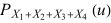

![👁 1/(12)[(-4+u)^3sgn(-4+u)-4(-3+u)^3sgn(-3+u)+6(-2+u)^3sgn(-2+u)-4(-1+u)^3sgn(-1+u)+u^3sgnu],](https://mathworld.wolfram.com/images/equations/UniformSumDistribution/Inline18.svg)
illustrated above.
Interestingly, the expected number of picks 👁 n
of a number 👁 x_k
from a uniform distribution on 👁 [0,1]
so that the sum 👁 sum_(k=1)^(n)x_k
exceeds 1 is e
(Derbyshire 2004, pp. 366-367). This can be demonstrated by noting that the
probability of the sum of 👁 n
variates being greater than 1 while the sum of 👁 n-1
variates being less than 1 is


![👁 [0,1]](https://mathworld.wolfram.com/images/equations/UniformSumDistribution/Inline21.svg)


| 👁 P_n^((1)) | 👁 = | 👁 int_1^nP_(X_1+...+X_n)(u)du-int_1^(n-1)P_(X_1+...+X_(n-1))(u)du |
(7)
|
| 👁 Image | 👁 = | 👁 (1-1/(n!))-[1-1/((n-1)!)] |
(8)
|
| 👁 Image | 👁 = | 👁 1/(n(n-2)!). |
(9)
|





![👁 (1-1/(n!))-[1-1/((n-1)!)]](https://mathworld.wolfram.com/images/equations/UniformSumDistribution/Inline30.svg)


The values for 👁 n=1
,
2, ... are 0, 1/2, 1/3, 1/8, 1/30, 1/144, 1/840, 1/5760, 1/45360, ... (OEIS A001048).
The expected number of picks needed to first exceed 1 is then simply


It is more complicated to compute the expected number of picks that is needed for their sum to first exceed 2. In this case,
| 👁 P_n^((2)) | 👁 = | 👁 int_2^nP_(X_1+...+X_n)(u)du-int_2^(n-1)P_(X_1+...+X_(n-1))(u)du |
(11)
|
| 👁 Image | 👁 = | 👁 ((n-2)(2^(n-1)-n))/(n!). |
(12)
|





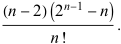
The first few terms are therefore 0, 0, 1/6, 1/3, 11/40, 13/90, 19/336, 1/56, 247/51840, 251/226800, ... (OEIS A090137 and A090138). The expected number of picks needed to first exceed 2 is then simply
| 👁 <n_2> | 👁 = | 👁 sum_(n=1)^(infty)nP_n^((2)) |
(13)
|
| 👁 Image | 👁 = | 👁 sum_(n=1)^(infty)(n(n-2)(2^(n-1)-n))/(n!) |
(14)
|
| 👁 Image | 👁 = | 👁 e^2-e. |
(15)
|


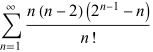


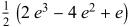
The following table summarizes the expected number of picks 👁 <n_s>
for the sum to first exceed an integer 👁 s
(OEIS A089087). A closed
form is given by



(Uspensky 1937, p. 278).
| 👁 s | 👁 <n_s> | OEIS | approximate |
| 1 | 👁 e | A001113 | 2.71828182... |
| 2 | 👁 e^2-e | A090142 | 4.67077427... |
| 3 | 👁 1/2(2e^3-4e^2+e) | A090143 | 6.66656563... |
| 4 | 👁 1/6(6e^4-18e^3+12e^2-e) | A089139 | 8.66660449... |
| 5 | 👁 1/(24)(24e^5-96e^4+108e^3-32e^2+e) | A090611 | 10.66666206... |




See also
Uniform Difference Distribution, Uniform Distribution, Uniform Product Distribution, Uniform Ratio DistributionExplore with Wolfram|Alpha

More things to try:
References
Derbyshire, J. Prime Obsession: Bernhard Riemann and the Greatest Unsolved Problem in Mathematics. New York: Penguin, 2004.Sloane, N. J. A. Sequences A001048/M0890, A001113/M1727, A089087, A089139, A090137, A090138, A090142, A090143, and A090611 in "The On-Line Encyclopedia of Integer Sequences."Uspensky, J. V. Introduction to Mathematical Probability. New York: McGraw-Hill, 1937.Referenced on Wolfram|Alpha
Uniform Sum DistributionCite this as:
Weisstein, Eric W. "Uniform Sum Distribution." From MathWorld--A Wolfram Resource. https://mathworld.wolfram.com/UniformSumDistribution.html