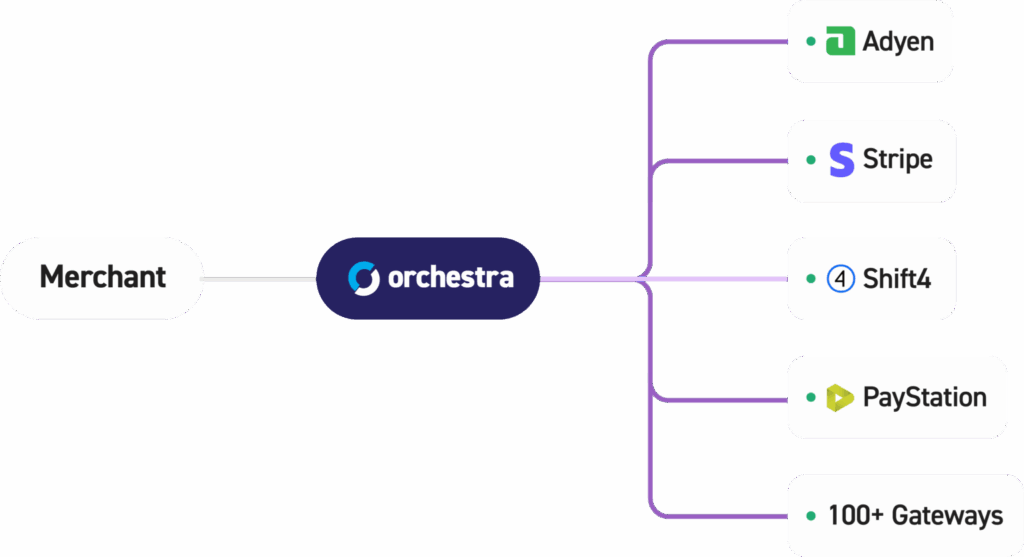
A payment orchestration platform that unifies your global stack. Route payments across Payment Service Providers, handle fallback, and launch faster, all with just one API.
No two products are built the same, but their payment headaches often are. Orchestra takes on the recurring complexity so your team doesn’t have to keep solving the same problems.
Before Orchestra
Complex Multi-PSP Management
Separate integrations for each PSP (Stripe, Adyen, Worldpay…)
Custom fallback logic when providers go down
Re-architecting for each new market
Weeks of development time per integration
With Orchestra
Single Integration, Global Scale
Single Integration
Single SDK/API connects to dozens of PSPs
Built-in fallback logic
Add new PSPs without additional integration work
99.9%
API uptime
<200ms
Latency globally
All
Countries / currencies supported
Level 1
PCI-DSS certified worldwide
One API to Rule All Payments
Integration flexibility – your stack, your rules. A single, unified endpoint abstracts away gateway differences.
Payment orchestration benefits enterprises through lower processing costs, higher approval rates, and faster market expansion. This guide covers the concrete triggers that signal it’s time to switch, what changes operationally, and how migration works without disrupting live payments.
A future-proof payment stack absorbs provider changes, regulatory shifts, and new payment methods without code rewrites. Here’s how a single API architecture eliminates payment technical debt and scales with your business.
A single payment provider costs you in failed transactions, vendor lock-in, and lost markets. Here’s the financial case for a multi-PSP strategy, the operational problems it creates, and how payment orchestration solves them.