

dilneiss/laravel-password-exposed-validation-rule
Laravel validation rule that checks if a password has been exposed in a data breach
Maintainers
Package info
github.com/dilneiss/laravel-password-exposed-validation-rule
pkg:composer/dilneiss/laravel-password-exposed-validation-rule
Requires
- php: ^7.1||^8.0||8.1||8.2
- divineomega/password_exposed: ^3.2.0
- illuminate/contracts: ^5.1||^6.0||^7.0||^8.0||^9.0||^10.0||^11.0
Requires (Dev)
- php-coveralls/php-coveralls: ^2.0
- phpunit/phpunit: ^7.0||^8.0||^9.0
Suggests
None
Provides
None
Conflicts
None
Replaces
None
LGPL-3.0-only cec9087bed85cd223417edff3791927258fb5aae
- Jordan Hall <jordan.woop@hall05.co.uk>
This package is auto-updated.
Last update: 2026-06-29 02:14:18 UTC
README
This package provides a Laravel validation rule that checks if a password has been exposed in a data breach. It uses the haveibeenpwned.com passwords API via the divineomega/password_exposed library.

👁 Travis CI
👁 Coverage Status
👁 StyleCI
👁 Image
Installation
To install, just run the following Composer command.
composer require divineomega/laravel-password-exposed-validation-rule
Please note that this package requires Laravel 5.1 or above.
Usage
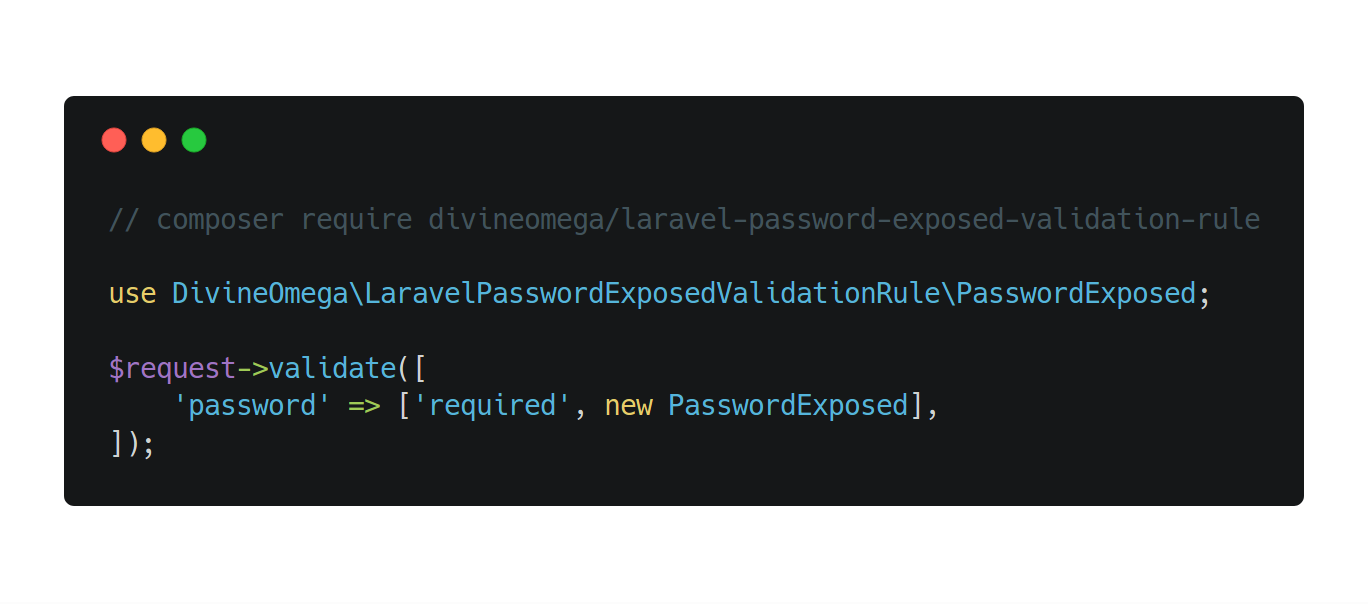
The following code snippet shows an example of how to use the password exposed validation rule.
use DivineOmega\LaravelPasswordExposedValidationRule\PasswordExposed;

$request->validate([
 'password' => ['required', new PasswordExposed()],
]);
If you wish, you can also set a custom validation message, as shown below.
use DivineOmega\LaravelPasswordExposedValidationRule\PasswordExposed;

$request->validate([
 'password' => ['required', (new PasswordExposed())->setMessage('This password is not secure.')],
]);