

divineomega/password_exposed
This PHP package provides a `password_exposed` helper function, that uses the haveibeenpwned.com API to check if a password has been exposed in a data breach.
Maintainers
Fund package maintenance!
Requires
- php: ^7.1||^8.0
- jord-jd/do-file-cache-psr-6: ^3.0
- jord-jd/psr-18-guzzle-adapter: ^3.0
- nyholm/psr7: ^1.0
- paragonie/certainty: ^2.4
- php-http/discovery: ^1.6
- psr/cache: ^1.0 || ^2.0 || ^3.0
- psr/http-client: ^1.0
- psr/http-factory-implementation: ^1.0
- psr/http-message: ^1.0 || ^2.0
- psr/http-message-implementation: ^1.0
Requires (Dev)
- fakerphp/faker: ^1.23
- kriswallsmith/buzz: ^1.0
- phpunit/phpunit: ^9.6
- symfony/cache: ^4.2.12
- vimeo/psalm: ^4
Suggests
None
Provides
None
Conflicts
None
Replaces
- divineomega/password_exposed: v5.0.2
LGPL-3.0-only f9d0e8879432f1e7cf80617b51c16c66071411c7
- Jordan Hall <jordan.woop@hall05.co.uk>
- Contributors
This package is auto-updated.
Last update: 2026-04-01 23:26:39 UTC
README
This PHP package provides a password_exposed helper function, that uses the haveibeenpwned.com API to check if a password has been exposed in a data breach.

👁 Unit tests
👁 PHP syntax
👁 Image


CI is run via GitHub Actions (unit tests, Psalm, and PHP syntax checks).
Installation
The password_exposed package can be easily installed using Composer. Just run the following command from the root of your project.
composer require "jord-jd/password_exposed"
If you have never used the Composer dependency manager before, head to the Composer website for more information on how to get started.
Usage
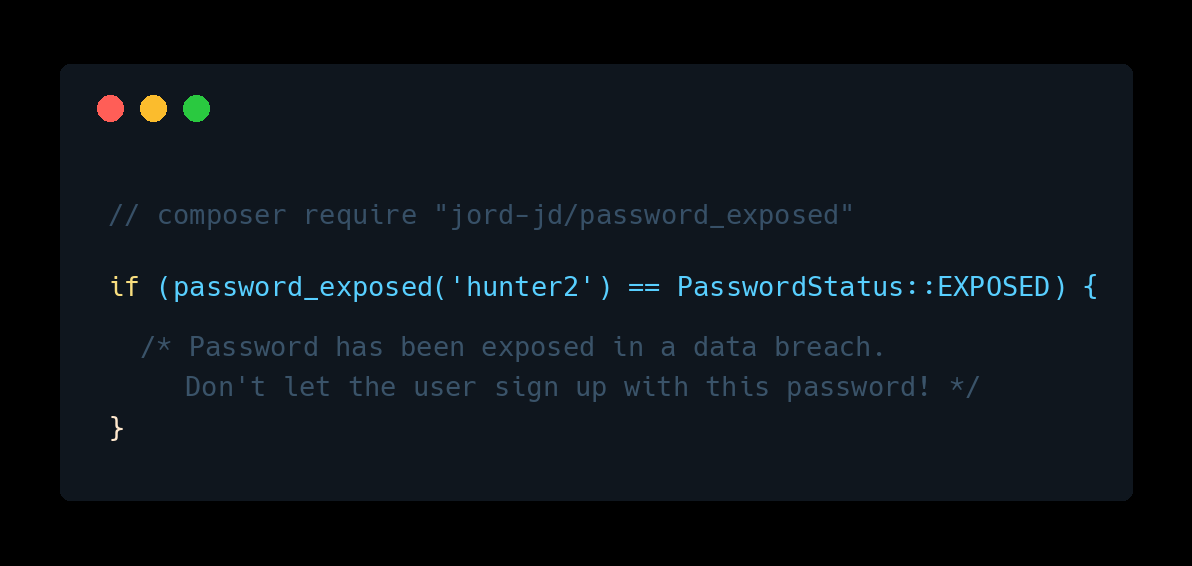
To check if a password has been exposed in a data breach, just pass it to the password_exposed method.
Here is a basic usage example:
switch(password_exposed('hunter2')) {

 case PasswordStatus::EXPOSED:
 // Password has been exposed in a data breach.
 break;

 case PasswordStatus::NOT_EXPOSED:
 // Password has not been exposed in a known data breach.
 break;

 case PasswordStatus::UNKNOWN:
 // Unable to check password due to an API error.
 break;
}
If you prefer to avoid using helper functions, the following syntax is also available.
$passwordStatus = (new PasswordExposedChecker())->passwordExposed($password);
SHA1 Hash
You can also supply the SHA1 hash instead of the plain text password, by using the following method.
$passwordStatus = (new PasswordExposedChecker())->passwordExposedByHash($hash);
or...
$passwordStatus = password_exposed_by_hash($hash);