VOOZH about

URL: https://pubmed.ncbi.nlm.nih.gov/29414327/

⇱ MERS-CoV infection in humans is associated with a pro-inflammatory Th1 and Th17 cytokine profile - PubMed


Clipboard, Search History, and several other advanced features are temporarily unavailable.
Skip to main page content
👁 Dot gov

The .gov means it’s official.
Federal government websites often end in .gov or .mil. Before sharing sensitive information, make sure you’re on a federal government site.

👁 Https

The site is secure.
The https:// ensures that you are connecting to the official website and that any information you provide is encrypted and transmitted securely.

Access keys NCBI Homepage MyNCBI Homepage Main Content Main Navigation

Add to Collections

Add to My Bibliography

Your saved search

Create a file for external citation management software

Your RSS Feed

Abstract

The Middle East respiratory syndrome coronavirus (MERS-CoV) has been recognized as a highly pathogenic virus to humans that infects the respiratory tract and is associated with high morbidity and mortality. Studies in animal models suggest that MERS-CoV infection induces a strong inflammatory response, which may be related to the severity of disease. Data showing the cytokine profiles in humans during the acute phase of MERS-CoV infection are limited. In this study, we have analyzed the profile of cytokine responses in plasma samples from patients with confirmed MERS-CoV infections (n = 7) compared to healthy controls (n = 13). The cytokine profiles, including T helper (Th) 1, Th2 and Th17 responses, were analyzed using cytometric bead array (CBA). A prominent pro-inflammatory Th1 and Th17 response was clearly seen in patients with MERS-CoV infection, with markedly increased concentrations of IFN-γ, TNF-α, IL-15 and IL-17 compared to controls. IL-12 expression levels showed no difference between patients with MERS-CoV infection and the healthy controls despite the significantly increased levels of IFN-α2 and IFN-γ (P < .01). No changes were observed in the levels of IL-2, IL-4, IL-5, IL-13, and TGF-α (P > .05). Our results demonstrate a marked pro-inflammatory cytokine response during the acute phase of MERS-CoV infection in humans.

Keywords: Cytokines; Humans; Interferons; MERS-CoV.


Conflict of interest statement

Authors have nothing to declare.

Figures

👁 Fig. 1
Fig. 1
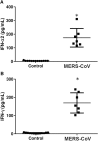
Changes in the plasma levels of interferons in patients with MERS-CoV infection. Significant increases in the plasma levels of (A) IFN-α2 and (B) IFN-γ. Data are expressed as Mean ± SEM. * indicates significant difference.
👁 Fig. 3
Fig. 3
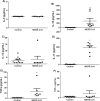
Levels of selected cytokines in patients with MERS-CoV infection. Plasma levels of (A) IL-5, (B) IL-10, (C) IL-13, (D) IL-17, (E) TNF-α, and (F) TGF-α in patients with MERS-CoV infection. Significant elevations were observed for IL-10, IL-17 and TNF-α while no changes were observed in the levels of IL-5, IL-13 and TGF-α. Data are expressed as Mean ± SEM. * indicates significant difference.
👁 Fig. 2
Fig. 2
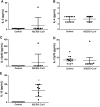
Changes in the levels of four α-helix bundle-containing cytokines in patients with MERS-CoV infection. Levels of (A) IL-2, (B) IL-4, (C) IL-12p40, (D) IL-12p70 and (E) IL-15 were measured in plasma samples. Strong elevation only in the levels of IL-15 in all patients (P < .01) was detected. Data are expressed as Mean ± SEM. * indicates significant difference.

References

    1. Mackay I.M., Arden K.E. MERS coronavirus: diagnostics, epidemiology and transmission. Virol. J. 2015;12:222. - PMC - PubMed
    1. Thomas C. MERS-CoV: where are we now? Ann. Acad. Med. Singapore. 2015;44:155–156. - PubMed
    1. Almaghrabi R.S., Omrani A.S. Middle East respiratory syndrome coronavirus (MERS-CoV) infection. Brit. J. Hospital Med. 2017;78:23–26. - PubMed
    1. Liu W.J., Zhao M., Liu K., Xu K., Wong G., Tan W. T-cell immunity of SARS-CoV: implications for vaccine development against MERS-CoV. Antiviral Res. 2017;137:82–92. - PMC - PubMed
    1. Lu G., Hu Y., Wang Q., Qi J., Gao F., Li Y. Molecular basis of binding between novel human coronavirus MERS-CoV and its receptor CD26. Nature. 2013;500:227–231. - PMC - PubMed
Cite

NCBI Literature Resources

MeSH PMC Bookshelf Disclaimer

The PubMed wordmark and PubMed logo are registered trademarks of the U.S. Department of Health and Human Services (HHS). Unauthorized use of these marks is strictly prohibited.