


Abstract
Study objective: Machine-learning algorithms allow improved prediction of sepsis syndromes in the emergency department (ED), using data from electronic medical records. Transfer learning, a new subfield of machine learning, allows generalizability of an algorithm across clinical sites. We aim to validate the Artificial Intelligence Sepsis Expert for the prediction of delayed septic shock in a cohort of patients treated in the ED and demonstrate the feasibility of transfer learning to improve external validity at a second site.
Methods: This was an observational cohort study using data from greater than 180,000 patients from 2 academic medical centers between 2014 and 2019, using multiple definitions of sepsis. The Artificial Intelligence Sepsis Expert algorithm was trained with 40 input variables at the development site to predict delayed septic shock (occurring greater than 4 hours after ED triage) at various prediction windows. We then validated the algorithm at a second site, using transfer learning to demonstrate generalizability of the algorithm.
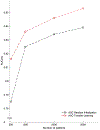
Results: We identified 9,354 patients with severe sepsis, of whom 723 developed septic shock at least 4 hours after triage. The Artificial Intelligence Sepsis Expert algorithm demonstrated excellent area under the receiver operating characteristic curve (>0.8) at 8 and 12 hours for the prediction of delayed septic shock. Transfer learning significantly improved the test characteristics of the Artificial Intelligence Sepsis Expert algorithm and yielded comparable performance at the validation site.
Conclusion: The Artificial Intelligence Sepsis Expert algorithm accurately predicted the development of delayed septic shock. The use of transfer learning allowed significantly improved external validity and generalizability at a second site. Future prospective studies are indicated to evaluate the clinical utility of this model.
Copyright © 2020 American College of Emergency Physicians. Published by Elsevier Inc. All rights reserved.
Figures





Update of
-
Predicting progression to septic shock in the emergency department using an externally generalizable machine learning algorithm.Wardi G, Carlile M, Holder A, Shashikumar S, Hayden SR, Nemati S. Wardi G, et al. medRxiv [Preprint]. 2020 Nov 4:2020.11.02.20224931. doi: 10.1101/2020.11.02.20224931. medRxiv. 2020. Update in: Ann Emerg Med. 2021 Apr;77(4):395-406. doi: 10.1016/j.annemergmed.2020.11.007. PMID: 33173889 Free PMC article. Updated. Preprint.
References
-
- Villar J, Clement JP, Stotts J, et al. Many emergency department patients with severe sepsis and septic shock do not meet diagnostic criteria within 3 hours of arrival. Ann Emerg Med. 2014;64:48–54. - PubMed
-
- Capp R, Horton CL, Takhar SS, et al. Predictors of patients who present to the emergency department with sepsis and progress to septic shock between 4 and 48 hours of emergency department arrival. Crit Care Med. 2015;43:983–988. - PubMed
-
- Sakr Y, Vincent JL, Schuerholz T, et al. Early- versus late-onset shock in European intensive care units. Shock. 2007;28:636–643. - PubMed
Publication types
MeSH terms
Grants and funding
LinkOut - more resources
Full Text Sources
Other Literature Sources
