
Edward Everett | |
|---|---|
| 👁 Image | |
| Member of the U.S.HouseofRepresentatives from Massachusetts's 4th district | |
| In office March 4, 1825–March 3, 1835 | |
| Preceded by | Timothy Fuller |
| Succeeded by | Samuel Hoar |
| 15th Governor of Massachusetts | |
| In office January 13, 1836–January 18, 1840 | |
| Lieutenant | George Hull |
| Preceded by | Samuel Turell Armstrong (acting) |
| Succeeded by | Marcus Morton |
| 20th United States Secretary of State | |
| In office November 6, 1852–March 3, 1853 | |
| President | Millard Fillmore |
| Preceded by | Daniel Webster |
| Succeeded by | William L. Marcy |
| United States Senator from Massachusetts | |
| In office March 4, 1853–June 1, 1854 | |
| Preceded by | John Davis |
| Succeeded by | Julius Rockwell |
| Personal details | |
| Born | (1794-04-11)April 11, 1794 Boston, Massachusetts |
| Died | January 15, 1865(1865-01-15) (aged70) Boston, Massachusetts |
| Political party | Whig |
| Spouse(s) | Charlotte Gray Brooks |
| Children | Anne Gorham Everett Charlotte Brooks Everett Grace Webster Everett Edward Brooks Everett Henry Sidney Everett William Everett |
| Alma mater | Harvard University |
| Occupation | Politician, educator |

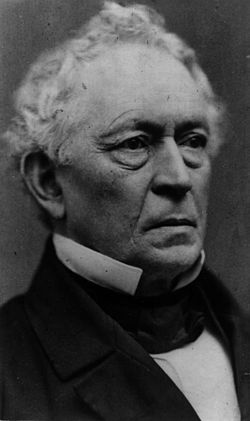
Edward Everett (April 11, 1794– January 15, 1865) was an American politician, religious leader and educator from Massachusetts. He was a Whig. He served as U.S. Representative, and U.S. Senator, the 15th Governor of Massachusetts, Minister to Great Britain, and United States Secretary of State. He also taught at Harvard University and was as president of Harvard. He was the Vice-Presidential candidate of the Constitutional Union Party in 1860. He gave a long speech at Gettysburg right before Abraham Lincoln.
When Abraham Lincoln became president, the Civil War broke out. Everett had been calmer about slavery, but he was a strong Unionist. He worked hard to raise support for the Union through speaking in public. In November 1863, when the military cemetery at Gettysburg, Pennsylvania was dedicated, Everett was the main speaker. His two-hour speech was before the much shorter, but now more famous Gettysburg Address by President Lincoln. Everett was moved by the short speech and wrote to Lincoln, "I should be glad if I could flatter myself that I came as near to the central idea of the occasion, in two hours, as you did in two minutes."[1]
References
[change | change source]- ↑ Simon, et al., eds. The Lincoln Forum: Abraham Lincoln, Gettysburg, and the Civil War. Mason City: Savas Publishing Company, 1999. ISBN978-1-882810-37-6, p. 41
Other websites
[change | change source]


- Edward Everett at the Database of Classical Scholars
- Full text of Everett's Gettysburg Oration
- Biography
- Works by Edward Everett at Project Gutenberg
- Works by or about Edward Everett at Internet Archive
- United States Congress. "Edward Everett (id: E000264)". Biographical Directory of the United States Congress.
- Official Commonwealth of Massachusetts Governor Biography at Archive.org
- Edward Everett Papers at Harvard University Archives
- Oil portrait of Edward Everett[permanent dead link] by Bass Otis, at University of Michigan Museum of Art


This short article about apersonfrom the United States can be made longer. You can help Wikipedia by adding to it.