
| Estonian | |
|---|---|
| eesti keel | |
| Nativeto | Estonia |
| Ethnicity | Estonians |
Native speakers | 1.1 million(2012)[1] |
| Latin (Estonian alphabet) Estonian Braille | |
| Official status | |
Official languagein | 👁 Image Estonia 👁 Image European Union |
| Regulatedby | Institute of the Estonian Language / Eesti Keele Instituut, Emakeele Selts (semi-official) |
| Language codes | |
| ISO 639-1 | et |
| ISO 639-2 | est |
| ISO 639-3 | est – inclusive codeIndividual codes: ekk–Standard Estonianvro–Võro |
| Glottolog | esto1258 |
| Linguasphere | 41-AAA-d |
| 👁 Image Distribution of estonian language | |
| This article contains IPA phonetic symbols. Without proper rendering support, you may see question marks, boxes, or other symbols instead of Unicode characters. For an introductory guide on IPA symbols, see Help:IPA. | |


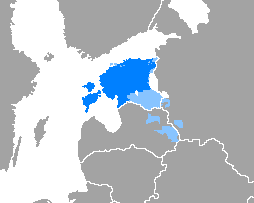
The Estonian language (Estonian: eesti keel) is a Uralic language. It is mainly spoken in Estonia. The Estonian language is similar to Finnish and is one of the few national languages of Europe not to be an Indo-European language.
The Estonian alphabet uses the Latin alphabet. It has many vowels, including Ö, Ä, Õ and Ü.
It has been influenced by and adopted many words from German and Swedish. The Estonian language also has different dialects.
Sample words
[change | change source]| Üks | One |
| Kaks | Two |
| Kolm | Three |
| Jah | Yes |
| Ei | No |
| Mina/Ma | I |
| Sina/Sa | You (in singular) |
| Tema/Ta | He/She |
| Meie/Me | We |
| Teie/Te | You (in plural) |
| Nemad/Nad | They |
| Olen/Mina olen | I am |
| Eesti | Estonia |
| Maja | House |
| Kodu | Home |
| Tee | Way |
References
[change | change source]- ↑ Estonian at Ethnologue (18th ed., 2015)
Standard Estonian at Ethnologue (18th ed., 2015)
Võro at Ethnologue (18th ed., 2015)

Estonian edition of Wikipedia, the free encyclopedia


