
This article needs more sources for verifiability. Please help improve this article by adding reliable sources. Unsourced material may be challenged or removed. Find sources:"Menstruation"–news · newspapers · books · scholar · JSTOR (Learn how and when to remove this message) |

Menstruation,[1] or menses, happens in human adult females (and other primates) when the egg is unfertilized and causes the lining of the vagina to shed (a period). During a period, blood comes out of the vagina of the female. It causes blood because the egg was released (it comes down) into the vagina and now it has to clean itself. menstruation takes two to seven days depending on the person.[source?]
Menstruation occurs every month there is no pregnancy. Some people might have irregular periods, and sometimes miss a month or have two periods close together. The menstrual cycle is between the first day of the period (first day of menstrual bleeding) to the day before the next period.[2][3] A period is irregular when it is less than 25 days or more than 35 days between periods.[2] A more common word for menstruation is a "period" or menstrual cycle (menses).
Summary
[change | change source]Inside the thick part of the uterus are blood vessels and nutrients that a baby will need to grow. Every month after puberty in a human female, the brain sends signals to the ovaries that tell them to release an ovum (egg). The ovum then travels through the fallopian tube (with the expectation of becoming fertilized by a sperm cell[where?]) into the uterus.
If an ovum is fertilized, it sticks to the wall of the uterus and starts to grow. If the ovum is not fertilized, it does not stick. The uterus then gets rid of the ovum and the extra tissue by releasing it from the body with blood. Tissue mixed with blood comes out of the uterus through the vagina. This is called menstruation or having a period. The bleeding normally lasts about 3-5 days, though some people may bleed longer or have a bit of bleeding between periods.[4]The cycle then repeats until menopause or during pregnancy.[verification needed]
For most people, the time between their periods is about one month. For about 2 years after menstruation starts, the time between periods is not always the same.[5] Some menstruators may skip a month, or have 2 periods close to each other. It is also possible and normal to have cramps (mildly painful, squeezing feelings) or to feel bloated (swollen up) in the abdomen at periods.[4] Serious pain (dysmenorrhea) is not normal even during a period. There are medicines made to treat problems, for example heavy bleeding, in women who bleed heavily (menorrhagia) during a period.
People who have periods often use tampons or sanitary pads to soak up the blood and tissue. A sanitary pad is a piece of material that absorbs (takes in) liquids which is worn between the vulva and underpants. A tampon is a stick of absorbent material that is placed in the vagina. Pads and tampons can be disposable or reusable.The use of a menstrual cup (or disc) is also possible. A menstrual cup is a silicone cup that is inserted inside the vagina to collect blood and other tissues. A menstrual disc follows the same idea but is made of more flexible material and is round and flatter than a cup, it is also inserted higher in the vagina.
Cycle
[change | change source]
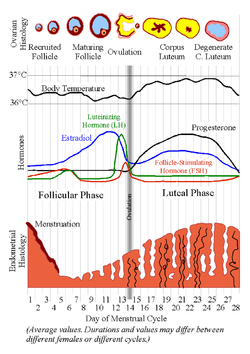
Menstruation
[change | change source]Most people menstruate for 3–5 days every month. However, anywhere from 2–7 days is normal. The amount of blood lost is normally about 50ml. Menstruators usually use a pad or a tampon to keep the blood from staining their undergarments, but there are many other forms of sanitary protection.
Menopause
[change | change source]Menopause is menstruation stopping at the age of around 45-70 (age 55 on average)[verification needed], which is caused by hormones. Symptoms include irritability, heat, vaginal burning and/or discomfort, and vaginal dryness. A slang word for it is called "the change". Most people must take a few months to adjust to the dryness. After they stop their period they can no longer produce babies.
Physical appearance
[change | change source]

The fluid that comes out looks like blood, but it is more than just blood. It also has endometrial tissue. This is the tissue that lines the inside of the uterus (womb).
Menses happens in the first days of the menstrual cycle. This is the changes that happen in a woman's body every month. These changes are started by changes in hormone levels in the blood. These changes also cause a person to ovulate and make an ovum (also called "egg"). Menstruation usually starts around the age of 11, even as early as 9 years old, and ends when the menstruator is too old to have children. However, some females can still have children from the age of 50-70.
Effect
[change | change source]Some people have lower abdominal pain when they menstruate. This is called dysmenorrhea, or cramps. Extreme and continuous (always happening) cramps are not normal and should be checked upon with a medical practitioner. The hormones that are produced before and during a period can also make a woman feel moody, or just strange. This is called premenstrual syndrome (PMS), or premenstrual tension (PMT). A person can feel bloated or swollen and have long cramps.
Some menstruators have extremely bad reactions to menstruation and may even feel suicidal. This is called premenstrual dysphoric disorder, or PMDD. Other physical effects include headaches, tender breasts, lower back pain, fatigue, acne, diarrhoea or constipation, trouble sleeping for example.[6]
Materials
[change | change source]Most menstruators use something to absorb or catch their menses. There are a number of different methods available. The most common methods of absorbing the flow are:
- sanitary towels (sometimes called "pads"), and padded underwear to prevent incontinence
- disposable tampon (daily)
Some people[verification needed] use:
- a sea sponge
- towels and other reusable absorbing items
Which is extremely dangerous. Sponges, towels, or reusing tampons, which may happen in places of poverty, can cause disease as well as toxic shock syndrome.
In addition to products to contain the menstrual flow, pharmaceutical companies provide, commonly non-steroidal anti-inflammatory drugs (NSAIDs), to relieve menstrual cramps.
Alternate medicine
[change | change source]Chinese medicine
[change | change source]Some herbs, such as dong quai, raspberry leaf and crampbark, are also claimed[verification needed] to relieve menstrual pain, however there is no documented scientific evidence.
Related pages
[change | change source]References
[change | change source]- ↑ "MeSH Browser". meshb.nlm.nih.gov. Retrieved 2026-04-01.
- 1 2 "Irregular periods". nhs.uk. 2017-10-24. Retrieved 2026-03-28.
- ↑ "MeSH Browser". meshb.nlm.nih.gov. Retrieved 2026-04-01.
- 1 2 "Frequently Asked Questions about Lagrangian Descriptors". 2016-09-27. doi:10.5194/acp-2016-633-sc2.
{{cite journal}}: Cite journal requires|journal=(help) - ↑ D. Apter (1980). "Serum Steroids and Pituitary Hormones in Female Puberty: A Partly Longitudinal Study". Clinical Endocrinology (Oxford). 12 (2): 107–120. doi:10.1111/j.1365-2265.1980.tb02125.x. PMID6249519. S2CID19913395.
- ↑ "Symptoms of Menstruation – Your Period". www.yourperiod.ca. Retrieved 2026-03-28.


| Endocrine system |
| Adrenalgland - Corpusluteum - Hypothalamus - Ovaries - Pancreas - Parathyroidgland - Pinealgland - Pituitarygland - Testes - Thyroidgland - Hormone |


- Articles needing additional references
- All articles needing additional references
- All articles with unsourced statements
- Articles with unsourced statements from March 2026
- Vague or ambiguous geographic scope
- All pages needing factual verification
- Wikipedia articles needing factual verification
- CS1 errors: missing periodical
- Commons category link from Wikidata
- Commons category link is locally defined
- Pages with broken anchors