
|
| |||
| Names | |||
|---|---|---|---|
| IUPAC name
Aminomethylamide | |||
| Other names
Carbamide | |||
| Identifiers | |||
| |||
3D model (JSmol) |
|||
| ChemSpider | |||
| ECHA InfoCard | 100.000.286 | ||
| E number | E927b (glazing agents, ...) | ||
CompTox Dashboard (EPA) |
|||
| |||
| Properties | |||
| (NH2)2CO | |||
| Molar mass | 60.07 g/mol | ||
| Appearance | white odourless solid | ||
| Density | 1.33·10³ kg/m³,[1] solid | ||
| Melting point | 132.7°C (406 K) decomposes | ||
| Boiling point | n.a. | ||
| 108 g/100 ml (20°C) 167 g/100 ml (40°C) 251 g/100 ml (60°C) 400 g/100 ml (80°C) 733 g/100 ml (100°C) | |||
| Acidity (pKa) | 0.18 | ||
| Basicity (pKb) | 13.82 | ||
| Structure | |||
| 4.56 p/D | |||
| Hazards | |||
| NFPA 704 (firediamond) | |||
Except where otherwise noted, data are given for materials in their standard state (at 25°C [77°F], 100kPa). | |||
| Infoboxreferences | |||


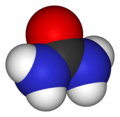


Urea is an organic compound. It was first found in urine in 1773 by the French chemist Jean Rouelle. It is also called Carbamide, and its chemical names are Carbonyl Diamide (used in inorganic chemistry) and Diaminomethanal (used in organic chemistry).
In humans, it is a normal component of blood and many body tissues. It is produced in the liver, where ammonia, a very toxic substance, is changed into urea, which has a very low toxicity, so low in fact, that it is many times less toxic than table salt. Most of the urea produced in this way is not needed by the body, and is removed from the blood in the kidneys and taken out of the body in urine.
References
[change | change source]Other websites
[change | change source]- MSDS sheet on urea Archived 2011-05-15 at the Wayback Machine
- Use of urea in hand dyeing
- use of urea as an automotive reagent to reduce harmful emissions (AdBlue Archived 2020-08-06 at the Wayback Machine)
- The dispensing and handling of Urea AdBlue (AdBlue Archived 2016-06-30 at the Wayback Machine)
👁 Image
This short article about chemistry can be made longer. You can help Wikipedia by adding to it.


This short article about chemistry can be made longer. You can help Wikipedia by adding to it.
Retrieved from "https://simple.wikipedia.org/w/index.php?title=Urea&oldid=10639937"
Hidden categories:
- Chemicals without a PubChem CID
- Articles without InChI source
- Articles without EBI source
- Articles without KEGG source
- Articles without UNII source
- Chembox CAS registry number not linked
- ECHA InfoCard ID from Wikidata
- E number from Wikidata
- Pages using collapsible list with both background and text-align in titlestyle
- Pages with old Chembox Hazards parameters
- Pages using Chembox with unknown parameters
- Articles containing unverified chemical infoboxes
- Chembox image size set
- Webarchive template wayback links
- Chemistry stubs