|
VOOZH | about |
|
VOOZH | about |
On paper, Cost of Goods Sold (COGS) seems straightforward. But in practice, it’s one of the most miscalculated metrics in SaaS finance. And buyers know it.
Should customer success COGS? What about hosting fees, integrations, or implementation teams?
Misclassify, and you distort your unit economics and gross profit. This can be a red flag for investors and strategic buyers evaluating your business. Potential buyers use the Cost of Goods Sold formula as an important factor in assessing a SaaS company’s scalability and financial stability.
Here’s what you need to know about COGS in software companies.
In layman’s terms, COGS is the sum of all the costs a company incurs to deliver its product or service to its customers. In many industries, COGS is a variable cost that grows as it sells additional units. In a business selling a physical product, for example, the amount spent on raw materials increases as more units are sold.
However, a factor unique to software companies is that COGS does not necessarily increase proportionally with sales growth. Because of the subscription-based business model of most SaaS companies, they don’t have to produce anything new each time a subscription is sold. Therefore, there could be little to no increase in COGS each time the company gains a new customer.
It’s important to distinguish between COGS and operating expenses (OPEX) like overhead, marketing, and other general administration costs. COGS should include only those expenses directly attributable to the production and delivery of the goods or services sold.
👁 SEG_Blog_COGSExplained-1 (1)
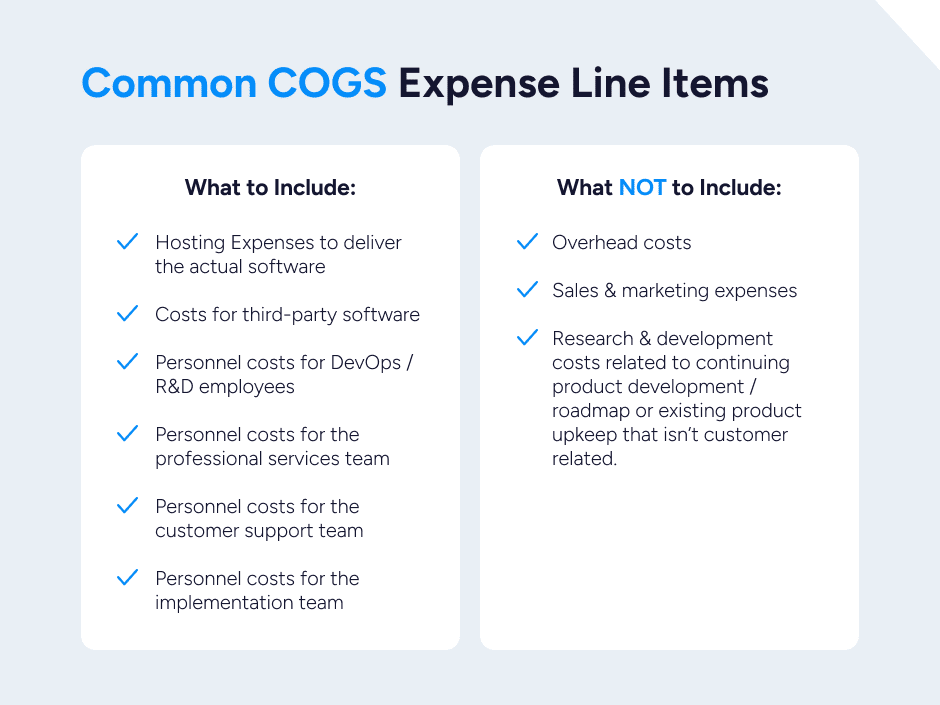
Software companies calculate COGS differently than traditional brick-and-mortar businesses. In SaaS, the focus is on expenses directly tied to delivering the product to customers. Common COGS line items include:
SaaS companies sometimes vary in what they include, but the guiding principle should be consistency and defensibility. Only costs directly attributable to production and delivery should be classified as COGS.
Equally as important is knowing what SaaS companies should leave out. COGS should never include expenses that don’t directly support product delivery, such as:
COGS should only reflect what it takes to deliver your product to customers today. Everything else including keeping the lights on and building tomorrow’s roadmap should stay in OpEx.
👁 How COGS Impacts SaaS Company Valuations
Private equity investors and strategic buyers heavily scrutinize COGS when evaluating potential acquisitions.
SaaS companies with optimized COGS command higher valuation multiples because of the impact of COGS on metrics. Here’s where a lower COGS impacts valuations:
Because gross margin is directly tied to COGS, the way a company manages delivery costs has a material impact on SaaS valuations.
Let’s consider a bootstrapped software company we’ll call “Company A.” Company A is a provider of project management software and has grown steadily to $6 million in annual recurring revenue (ARR) driven by strategic product development and customer-focused innovation.
Company A’s COGS is low due to its efficient use of cloud infrastructure and streamlined implementation and support processes. By investing early in scalable technology and automation, Company A has maintained a healthy gross margin of 75%.
This efficiency shows strategic buyers and investors that the business can scale profitably: growing revenue without costs rising in lockstep. It also reflects disciplined cost management and sound business strategy, qualities associated with durable, high-value SaaS companies.
Lower COGS also tends to correlate with higher valuation multiples. Company A’s healthy gross margins position it to command a stronger EV/ARR multiple than peers carrying heavier delivery costs.
For context, in the second quarter of 2025, gross margin was a key valuation driver, with >80% margin companies trading at a 105% premium to the SEG SaaS Index median. In the second quarter, 63% of public SaaS companies posted gross margins above 70%, and 23% cleared the 80% threshold. Companies above that market traded at a median EV/TTM revenue of 7.2x, compared with just 3.5x for those below 60%.
For Company A, this cost discipline has strengthened its appeal to potential buyers and demonstrates how managing COGS translates into higher valuations and greater market credibility.
We recently hosted Ben Murray, founder of The SaaS CFO, for a webinar where he shared common mistakes (including with COGS), metrics you should track, and how SaaS companies can tell a better financial story. Watch the conversation now on-demand.
Accurately forecasting COGS is critical for SaaS leaders who want to demonstrate efficiency, scalability, and financial discipline to strategic buyers and private equity investors. Missteps in classification or cost management can distort gross margin and undermine valuation.
SEG works with SaaS leaders to uncover the drivers behind their COGS, cut unnecessary expenses, and increase margins and valuation. Thinking about a strategic exit or growth investment? Let’s talk.
How Your Go Get Analysis Determines Your Company Valuation You’ve spent five years growing your SaaS business to $15 million in ARR with 40% year-over-year growth, strong gross margins, and…
Read article👁 btn-arrowWhen a buyer evaluates your SaaS business, the first thing they zoom in on is Annual Recurring Revenue (ARR). Predictable ARR is what turns a software company into a compounding…
Read article👁 btn-arrow