| 59 Persei | |
| 👁 Image | |
| Observationsdata Epok:J2000.0 | |
|---|---|
| Stjärnbild | Perseus |
| Rektascension | 04t42m54,33987s[1] |
| Deklination | +43°21′54,4795″[2] |
| Skenbar magnitud (👁 {\displaystyle V} ) | +5,30 (V)[3], +5,298 ± 0,010 (V)[2] |
| Stjärntyp | |
| Spektraltyp | A1 Vn[4] |
| B–V | 0,028 ± 0,005[5] |
| Variabeltyp | Misstänkt |
| Astrometri | |
| Radialhastighet (👁 {\displaystyle R_{v}} ) | +13,20 ± 3,1[3] km/s |
| Egenrörelse (µ) | RA:30,826 ± 0,267[1]mas/år Dek.:-50,576 ± 0,211[1]mas/år |
| Parallax (👁 {\displaystyle \pi } ) | 12,7294 ± 0,1774[1] |
| Avstånd | 256 ± 4 lå(79 ± 1pc) |
| Absolut magnitud (👁 {\displaystyle M_{V}} ) | 0,99[3] |
| Detaljer | |
| Massa | 2,58[6]M☉ |
| Radie | 2,5[7]R☉ |
| Luminositet | 41,1+11,7-9,2[8]L☉ |
| Temperatur | 10 734 ± 365[6]K |
| Vinkelhastighet | 212[8] km/s |
| Ålder | 198[6] miljonerår |
| Andra beteckningar | |
| GEN# +1.00029722, PLX 1041, UBV 4506, AG+43 484, GSC 02905-01947, PLX 1041.00, UBV M 10275, BD+43 1043, HD 29722, PPM 47288, uvby98 100029722, BSD 24-105, HIC 21928, ROT 669, WEB 4211, CEL 456, HIP 21928, SAO 39699, Gaia DR2 204676121033664384, FK5 2349, HR 1494, SKY# 7319, GC 5719, 2MASS J04425431+4321543, TD1 3449, GCRV 2760, N30 995, TYC 2905-1947-1 [2][9] | |

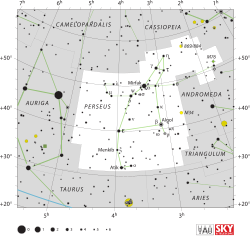
59 Persei, som är stjärnans Flamsteed-beteckning, är en misstänkt astrometrisk dubbelstjärna[10] belägen i den mellersta delen av stjärnbilden, Perseus Den har en skenbar magnitud på ca 5,30[3] och är svagt synlig för blotta ögat där ljusföroreningar ej förekommer. Baserat på parallax enligt Gaia Data Release 2 på ca 12,7[1] mas, beräknas den befinna sig på ett avstånd på ca 256 ljusår (ca 79 parsek) från solen. Den rör sig bort från solen med en heliocentrisk radialhastighet av ca 13 km/s.[3]
Egenskaper
[redigera | redigera wikitext]59 Persei A är en vit stjärna i huvudserien av spektralklass A1 Vn,[4] som genererar energi genom termonukleär fusion av väte i dess kärna och där suffixnoten 'n' anger "diffusa" linjer i dess spektrum på grund av stjärnans snabba rotation.[8] Den har en massa som är ca 2,6[7] solmassor, en radie som är ca 2,5[7] solradier och utsänder ca 41[8] gånger mera energi än solen från dess fotosfär vid en effektiv temperatur på ca 10700 K.[6]
Referenser
[redigera | redigera wikitext]- Den här artikeln är helt eller delvis baserad på material från engelskspråkiga Wikipedia, 59 Persei, 20 augusti 2020.
Noter
[redigera | redigera wikitext]- 1 2 3 4 5 Brown, A. G. A.; et al. (Gaia collaboration) (August 2018). "Gaia Data Release 2: Summary of the contents and survey properties". Astronomy & Astrophysics. 616. A1. arXiv:1804.09365. Bibcode:2018A&A...616A...1G. doi:10.1051/0004-6361/201833051. Gaia DR2 record for this source at VizieR.
- 1 2 3 ”Basic data: * 59 Per – High proper-motion Star”(på engelska). Centre de Données astronomiques de Strasbourg. http://simbad.u-strasbg.fr/simbad/sim-basic?Ident=59+Per&submit=SIMBAD+search.Läst 3 mars 2019.
- 1 2 3 4 5 Brown, A. G. A.; et al. (Gaia collaboration) (August 2018). "Gaia Data Release 2: Summary of the contents and survey properties". Astronomy & Astrophysics. 616. A1. arXiv:1804.09365. Bibcode:2018A&A...616A...1G. doi:10.1051/0004-6361/201833051. Gaia DR2 record for this source at VizieR.
- 1 2 Cowley, A.; et al. (April 1969), "A study of the bright A stars. I. A catalogue of spectral classifications", Astronomical Journal, 74: 375–406, Bibcode:1969AJ.....74..375C, doi:10.1086/110819
- ↑ van Leeuwen(2007).”Hipparcos, the New Reduction”(på engelska). http://vizier.u-strasbg.fr/viz-bin/VizieR-5?-out.add=.&-source=I/311/hip2&HIP=21928.Läst 3 mars 2019.
- 1 2 3 4 David, Trevor J.; Hillenbrand, Lynne A. (2015), "The Ages of Early-Type Stars: Strömgren Photometric Methods Calibrated, Validated, Tested, and Applied to Hosts and Prospective Hosts of Directly Imaged Exoplanets", The Astrophysical Journal, 804 (2): 146, arXiv:1501.03154, Bibcode:2015ApJ...804..146D, doi:10.1088/0004-637X/804/2/146.
- 1 2 3 Pasinetti Fracassini, L. E.; et al. (February 2001), "Catalogue of Apparent Diameters and Absolute Radii of Stars (CADARS)", Astronomy and Astrophysics (Third ed.), 367 (2): 521–524, arXiv:astro-ph/0012289, Bibcode:2001A&A...367..521P, doi:10.1051/0004-6361:20000451.
- 1 2 3 4 Zorec, J.; Royer, F. (January 2012), "Rotational velocities of A-type stars. IV. Evolution of rotational velocities", Astronomy & Astrophysics, 537: A120, arXiv:1201.2052, Bibcode:2012A&A...537A.120Z, doi:10.1051/0004-6361/201117691.
- ↑ "59 Per". SIMBAD. Centre de données astronomiques de Strasbourg. Hämtad 2019-03-30.
- ↑ Eggleton, P. P.; Tokovinin, A. A. (2008), "A catalogue of multiplicity among bright stellar systems", Monthly Notices of the Royal Astronomical Society, 389 (2): 869, arXiv:0806.2878, Bibcode:2008MNRAS.389..869E, doi:10.1111/j.1365-2966.2008.13596.x.