|
VOOZH | about |
|
VOOZH | about |
| This article or section may require additional citations. You can discuss this issue on the talk page or edit this page to improve it. |
| This article or section may require a cleanup. The editor who added this tag believes this page should be cleaned up for the following reason: Needs validity of information checked and references for most info. You can discuss this issue on the talk page or edit this page to improve it. |
| EarthBound 64 MOTHER3 豚王の最期 Mother 3: Fall of the Pig King | |
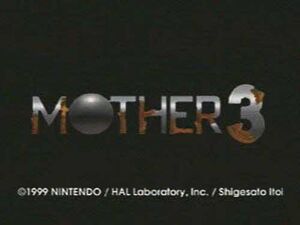
| 👁 Image Title screen | |
| System | Nintendo 64 |
| Genre | RPG |
| Rating | N/A |
| Publisher | Nintendo |
| Developer | Ape Inc. / HAL Laboratory, Inc. |
| Release dates | |
EarthBound 64[1] was an unreleased version of Mother 3 planned for release on the Nintendo 64. The game began development for the Nintendo 64DD with a projected release in 1999, but was switched to a normal Nintendo 64 Game Pak in the summer of 1998 when the Nintendo 64DD's future began to be doubted; however, due to the game's development potentially taking away resources from Nintendo's upcoming console, the Nintendo GameCube, the game was ultimately cancelled in late 2000 before being brought back into development for the Game Boy Advance in 2002, where the game ultimately saw release in 2006, exclusively in Japan. At one point, the team considered bringing the game to the Nintendo GameCube. [2]
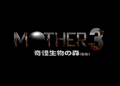
During development, the game was stated to have 12 playable characters across 12 chapters. This was later reduced to 9 chapters after the switch from disk to cartridge. [3] The subtitle used in the Japanese game was changed several times during development, with the first being "Forest of the Chimera" (森のキマイラ), the second being "Forest of Strange Creatures" (奇怪生物の森), and the final being "Fall of the Pig King".[4]
| This article or section of the page is incomplete. The editor who added this tag believes this is the reason: Please add more story differences. Unless it is not needed, remove this template. Otherwise, here are some sources: https://tcrf.net/Prerelease:Mother_3/Differences#Story and https://tcrf.net/Prerelease:Mother_3/Differences#Cutscenes.2FEvents Please help by contributing to it. |
Though the storyline of the game is, for the most part, the same as the Game Boy Advance release, several things were changed from the planned Nintendo 64 game. For one, the game was spread over the course of 10 years, unlike the final game, which is spread over the course of only three years. The overall tone of the story was intended to be darker than the final product was.
The story was intended to consider one place changing over time, and day by day see how the area changes; consistently changing "town gossip" was an idea in place as a plot device. Each enemy was supposed to have its own perspective, no matter how minor.
Unfortunately, the story was deemed too complex to be told on the Nintendo 64's hardware, given its limitations. The size and scope of the game's story had to be dramatically reduced in order to accommodate the Nintendo 64's hardware, before expanding to take advantage of the 64DD's hardware capabilities; it was shrunk to fit within the scope of a standard Nintendo 64 cartridge.
The following list is for known major story changes or omissions from the N64 version to the final GBA release, ordered using the cut-down chapter structure.
Sometime after November 1999 (the last mention of this structure)[14] and before May 2000, the chapter structure for EarthBound 64 was reduced from twelve to "seven, (technically nine)" chapters. It is all but confirmed that this revised chapter structure was what was utilised for the GBA version, as seven of that version's chapters are full gameplay segments (chapters 1-5, 7, 8), and two are small segments lacking much gameplay (chapter 0, 6). Below is a list of notes regarding the game's story, from when the game was still be 12 chapters.
The following characters were showcased or mentioned in some capacity, in promotional material for the game. Characters that are speculated to have been in the game but do not have written confirmation, bar a few exceptions, will not be mentioned on this list.
Full Party members
Guest Party members
Characters of unknown status
The following characters do not have confirmation regarding their status as either fully playable, or just guest party members.
Non-playable characters
Other
Cut characters
The following characters were mentioned at least once, and were not included in the GBA version in any capacity.
| This article or section of the page is incomplete. The editor who added this tag believes this is the reason: Please add EarthBound 64's gameplay, along with the differences between the N64 and GBA version's gameplay mechanics. Here are some sources: https://tcrf.net/Prerelease:Mother_3/Differences#Gameplay, https://tcrf.net/Prerelease:Mother_3/Differences#Battle_System, and https://tcrf.net/Prerelease:Mother_3/1999#Space_World_.2799 Please help by contributing to it. |
| This article or section of the page is incomplete. The editor who added this tag believes this is the reason: Unless this is needed, remove this template. Otherwise, please provide an enemy gallery of the enemies from EarthBound 64. Here is a source: https://mother4ever.net/mother-64-enemies/ Please help by contributing to it. |
EarthBound 64 was planned not long after EarthBound itself was nearing release, with an in-game reference to the development team planning Mother 3 in Japan, localized as them planning EarthBound 2 in the English release. The initial planning stages were for a Super NES release, and development began using EarthBound as a base. According to Starmen.Net co-founder Reid Young, the game was to use pre-rendered graphics akin to Donkey Kong Country [19], but this fact is unsubstantiated. Itoi stated in a 1992 interview, however, that "it was decided" that they were creating Mother 2's successor on the Super NES CD add-on. [20] But when the add-on was cancelled, development instead begun on the Super Famicom shortly after the Japanese release of Mother 2. However, the Super NES was quickly on its way to being replaced by the Nintendo 64, so development shifted to the Nintendo 64 in late 1995 after the Super NES version was partway complete. Inspired by the Nintendo 64's planned launch title, Super Mario 64, the development team decided that EarthBound 64 would be a 3D game, rather than it being a 2D sprite-based game like the first two titles in the series. When the project moved to the Nintendo 64DD later that year, it allowed the team the freedom to implement the planned scope of the game in accommodation with the vast potential for the 64DD hardware, [21] with the planned cartridge size being 64 megabytes (or 512 megabits). [22] But when the 64DD add-on kept getting delayed, and its future as a commercial success began to be uncertain, the game was changed to a cartridge release in late 1998, with a planned use of the same size cartridge which contained The Legend of Zelda: Ocarina of Time and utilization of the Rumble Pak add-on for the Nintendo 64 controller.[23]
The team for EarthBound 64 consisted of several notable figures who had contributed to the Pokémon series. Benimaru Itoh (who had also previously illustrated and written the Ness's Adventure Chronicles manga) was selected as art director. Toshinao Aoki was selected as enemy designer.[24] Tomoaki Imakuni was one of the 3D modellers.[25] Shogo Sakai was brought on as the composer for the game, as Hirokazu Tanaka and Keiichi Suzuki were busy with other projects. Sakai was brought on to compose in November 1996, as he had given a demo tape to the game's team, who loved his music and brought him on immediately to compose.[26] In addition, a sound programmer was brought on to work with Sakai, that being Takuto Kitsuta. Kitsuta was also a secondary composer for the game, as Sakai stated in a December 1997 interview "I left all the techno or mechanical music to (Mr. Kitsuta). [27]
Early on, the team was overambitious with the product, and the team envisioned and implemented ideas, characters, and elements that were too massive for the Nintendo 64's hardware to contain. Halfway through development, the team had to drastically downscale their original vision, as the team could not achieve their large-scale ideas on the Nintendo 64DD (and later on Nintendo 64) and its limitations. Due to the difficulty of development, with the 3D aspect of the game being far more complex than the 2D sprite-based past games, the team, including Shigesato Itoi, were discouraged from making a fourth game in the Mother series. Other aspects of development were shortchanged as well, with Iwata stated in an interview regarding the development of Mother 3 for the Nintendo 64; "any normal project has a trial period where you make a sample product and get the green light based on the response. But MOTHER 3 was special in that we skipped the trial period and went straight to game production. Without that trial period, all we had was our experience and achievements from making MOTHER 2, without the benefit of starting off with a team of people who worked on MOTHER 2". These shortcuts were primarily due to financial concerns. Development also was impacted by the financial situation at HAL Laboratories, and their lack of ability to afford to train talent. [28] To relieve this problem, the team that worked on Pokémon Stadium was brought on to help with 3D elements. [29]
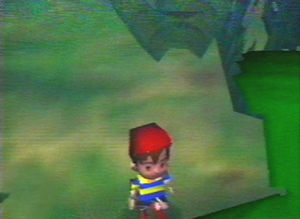
Initially, the development team was unskilled at 3D graphics, as they had only programmed 2D sprite-based games in the past; however, over time, the team's 3D programming steadily improved, with the team additionally studying physics books in order to accurately program the character's movements in a realistic manner. [30] During the switch from the 64DD to the N64, the team received help from outside sources for the game's development, providing better textures for the models and making them more refined and detailed overall. Development only progressed further when Pokémon Stadium's team was brought over to assist development early in 2000, improving both the visuals and performance of EarthBound 64.[31]
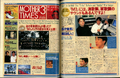
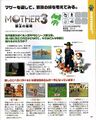
The game was officially unveiled at Space World 1996, where it showcased footage of multiple areas of the game along with screenshots of the environments and characters; the game's reception was highly positive. [32] During the year, the game was given the subtitle "Forest of the Chimera". In 1997, the game's subtitle was changed to "Forest of Strange Creatures", as someone had already trademarked the name "Chimera". [33] While the game was shown at Space World 1997, a playable demo was not provided. A demo not appearing was a last minute change, and a apology over this was included in the official booklet for the show. Footage was shown from the game however, including Lucas riding a cartoonishly-animated Pork Bean, the Claymen working at the Clayman Factory as slaves, the Pigmask army marching through a desert, and more. In May of 1998, the game was only shown in a sizzle reel for E3 1998, with all of the footage reused from the Space World 1997 showing. A magazine even claimed the game was "many times more impressive than Final Fantasy VII", based on the footage alone. [34] Only months later, EarthBound 64's development was transitioned over from the Nintendo 64DD add-on to the Nintendo 64 console.[35][36]
In 1999, the game's subtitle was altered to its final name: "The Fall of the Pig King". A trailer and playable demo were featured at Nintendo Space World 1999, with a projected release date of May 2000, the game being estimated to be around 50-55% complete by various magazines and Space World demo reviewers. [37] The game received moderate to immense critical praise from every attendee and reviewer, with the game being lauded for its vibrant graphics, its in-depth soundtrack, its unique control scheme, its gameplay, and its visually-stunning in-game cutscenes. One reviewer particularly highlighted the mine-cart cutscene: "It moved so fast and looked so good that for a minute we forgot it was on the N64."[38] However, following more delays (during which the EarthBound fan community petitioned the game's North American release on the fan-site Starmen.Net) Shigesato Itoi announced that EarthBound 64 had been cancelled on his website on August 22nd, 2000, with the first part of the announcement containing a personal letter to the EarthBound fans expecting the game[39]; the second part containing a roundtable discussion, during which Itoi, Iwata, and Miyamoto discussed EarthBound 64's development, history, and its cancellation; and the third and final part containing 24 screenshots and some music tracks from the final prototype build, which were available in both Mono and Stereo sound.
Despite EarthBound's commercial and critical failure in the United States, Nintendo of America were undeterred from planning a localisation for Mother 3, with the planned localised name of EarthBound 64, showcasing the game at E3 1998[40], and on various pages on their official website.[41][42][43] With the cancelation of the EarthBound 64, this English localized version of the game of course never materialised.
In the roundtable interview, Satoru Iwata estimated the game was about 30% complete, while Shigeru Miyamoto believed it was approximately 60% complete from a programming perspective. Apparently a complete script was produced but not perfected. In the interview was estimated that it would have taken around one to two more years of work for the game to be properly released [44], with Itoi stating in an interview with Yomiuri News Stream that "they were told" that the game would have required one more year of work to be completed. [45] Even though EarthBound 64's development was steadily progressing at a healthy pace, it apparently went astray when Iwata was unable to be on sight to act as a director/"game-play manager". The game's continued development also ran the risk of taking away resources from the then-in-development Nintendo GameCube. In the roundtable discussion, Iwata noted that if they had created what was essential and skipped the polishing, that the game could have been completed in a short amount of time. He also stated that the team had drastically reduced their original vision for the game halfway through development; if the team had reduced their version earlier, then the game might have been completed and released in 2000, like originally planned. The programming team was also unwilling to sacrifice even the littlest detail in the final game, instead trying to implement everything they could from their vision into the Nintendo 64 hardware.
No content from the game was properly released beyond the small samples from the 1999 Space World exhibition and Itoi's website, as the team believed that putting out the unfinished and buggy product would let down the high expectations set for the game. In the same interview, Itoi said that "the first half of the game runs pretty normally", with a large-scale twist occurring in the middle of the game. [46] During the interview, Itoi considered turning the game into a film, novel, or stage play, but later on refused specific requests about creating the game for the Game Boy Advance, believing the handheld to not be adequate for realizing his vision for the game. [47] The whereabouts of the few copies produced are largely unknown. At least one is believed to be with Brownie Brown, and some others may be circulating, but without a concrete trail. Four blue-colored 64DD disks were rumored to contain the 64DD version of Mother 3, but were revealed to actually be copies of Mario Artist, Doshin the Giant, another copy of Doshin the Giant, and SimCity 64.[48]
At least two post-1998 cartridge copies of EarthBound 64 were sent to Nintendo of America in early 2000, for the purposes of producing a localisation prototype. The whereabouts of these cartridges, as well as the amount of work finished for this localisation, is unknown.[49] In 2024, four more additional blue 64DD prototype disks resurfaced, one with a paper label suggesting it contained some sort of content relating to EarthBound 64. Upon being dumped the following year, it was revealed to be prototype Randnet software on the disks instead, although it is probable that data for EarthBound 64 was at one point present on the disks before being overwritten.[50][51]
According to an employee who worked on testing Mother 3, and played through most of the first chapter of EarthBound 64, "there is no mystery MOTHER game that was never released. You got MOTHER 3. When development was handed over to Brownie Brown, they were also given everything they needed to get the job done, including previous reference material. The GBA version is the final draft of a vision that took a long time to get out the door".[52]
The development for Mother 3 is continued over on the final version's development page...
| This article or section of the page is incomplete. The editor who added this tag believes this is the reason: Please add differences for every scene. Here is a TCRF source showing how this should look: https://tcrf.net/Prerelease:Mother_3/Differences Please help by contributing to it. |
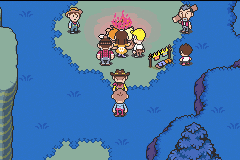
Below is a list of a comparison between screenshots of EarthBound 64, and the final released GBA version of Mother 3.
| N64 Version | GBA Version |
|---|---|
| 👁 Image |
👁 Image |
For the subject's image gallery, see Gallery:EarthBound 64
| This trivia section is excessively long. Relevant facts should be integrated into the body of the article and unnecessary ones should be removed. You can discuss this issue on the talk page or edit this page to improve it. |
| 👁 EarthBound |
|||||||||||||
|---|---|---|---|---|---|---|---|---|---|---|---|---|---|
|