|
VOOZH | about |
|
VOOZH | about |
| ||||||||||||||||
| ||||||||||||||||
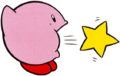
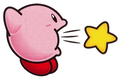
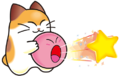
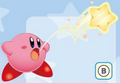
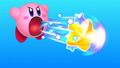
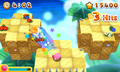
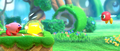
A Star Bullet (otherwise known as a Spit Star, Spitting Star, Exhaled Star or just Star in shorthand) is a glowing star-shaped projectile that Kirby can spit out after inhaling an enemy or object (notably the Dropped Star left by bosses). It is his primary method of attacking without a Copy Ability, and deals a considerable amount of damage to anything that is vulnerable to it.
To launch a Star Bullet, Kirby must first inhale something. Instead of swallowing, the player must then press the same button used to inhale to make Kirby spit the object back out as a yellow star. It will travel at significant speed in a straight direction until it hits something, upon which it will shatter, pass through, or be deflected, based on the power of the star, and the nature of the thing it hits.
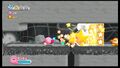
Star Bullets are capable of dealing a considerable amount of damage, more so in many cases than most Copy Ability attacks, but naturally, using them requires Kirby to inhale something first. Anything that can be inhaled can be shot as a Star Bullet, even Kirby's friends in Kirby's Return to Dream Land and Kirby Star Allies. The trajectory of the projectile can be influenced by some environmental hazards or by hitting enemies at a certain angle, though this is a rare occurrence. Star Bullets are also useful for clearing away blockades and hitting switches at a distance.
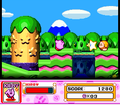
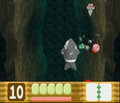
If a Star Bullet is launched underwater or into water, its properties change somewhat. In some older titles, launching a Star Bullet underwater will cause it to be affected by gravity and fall down instead, including UFO Kirby's Star Bullets in Kirby's Adventure. For example, if a Blaster Bullet is launched underwater in Kirby's Adventure, it will fire in a parabolic manner. From Kirby's Return to Dream Land onward, a Star Bullet will travel slower in the water.
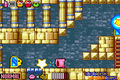
Starting with Kirby's Adventure, Kirby can swallow multiple objects at once to create a more powerful star that can pass through enemies as it hits them. This is referred to officially as 貫通星型弾 ("Piercing Star Bullet") in Japanese or a Blaster Bullet in English as described in Kirby's Blowout Blast.
Prior to Kirby: Squeak Squad, the Blaster Bullet remains the same if Kirby inhales more than 2 objects. From Kirby: Squeak Squad onward (except for Kirby Super Star Ultra), inhaling 3 or more objects makes the bullet even bigger and stronger, which is officially referred to as a ビッグ貫通星型弾 ("Big Piercing Star Bullet" or "Big Blaster Bullet") in Japanese.
Kirby Super Star introduced a game mechanic that a Star Bullet can do more damage if Kirby launches it while dashing. This has been featured in main series games since Kirby's Return to Dream Land, but is absent in Kirby and the Forgotten Land.
The following table lists the damage value of the Star Bullet and its variations in some Kirby games. Notably, Kirby Super Star (and its remake), Kirby's Return to Dream Land (and its remake), Kirby: Triple Deluxe, Kirby: Planet Robobot and Kirby Star Allies have the same damage scaling system, where a Star Bullet does 52 damage by default. However, games starting with Kirby's Return to Dream Land allow the Blaster Bullet's strength to grow considerably, reaching its maximum strength at 12 objects inhaled. The Star Bullet's power is increased in Kirby and the Forgotten Land, possibly to match the Powered Up ability stats, and the amount of inhaled objects required to reach the maximum damage output is much lower. However, its overall damage system is largely similar to the aforementioned titles.
| Star Bullet damage in the Kirby series | |||||
|---|---|---|---|---|---|
| Game | Star Bullet | Star Bullet (dash) | Blaster Bullet | Blaster Bullet (dash) | |
| 10 | 👁 No |
25 | 👁 No | ||
| 10 | 👁 No |
20 | 👁 No | ||
| 52 | 60 | 60 | 70 | ||
| 32 | 👁 No |
64 | 👁 No | ||
| 1 | 👁 No |
2 | 👁 No | ||
| 40 | 👁 No |
2 objects: 50 3 or more objects: 60 |
👁 No | ||
| 52 | 60 | 2 objects: 60 3 objects: 65 4 objects: 69 5 objects: 73 6 objects: 77 7 objects: 81 8 objects: 85 9 objects: 89 10 objects: 93 11 objects: 97 12 or more objects: 100 |
2 objects: 65 3 objects: 70 4 objects: 74 5 objects: 78 6 objects: 82 7 objects: 86 8 objects: 90 9 objects: 94 10 objects: 98 11 objects: 102 12 or more objects: 105 | ||
| 78 | 90 | 2 objects: 104 3 objects: 156 4 objects: 182 5 objects: 208 6 objects: 234 7 objects: 260 8 objects: 286 9 objects: 312 10 objects: 338 11 objects: 364 12 or more objects: 390 |
2 objects: 114 3 objects: 166 4 objects: 192 5 objects: 218 6 objects: 244 7 objects: 270 8 objects: 296 9 objects: 322 10 objects: 348 11 objects: 374 12 or more objects: 400 | ||
| 80 | 👁 No |
2 objects: 120 3 objects: 190 4 or more objects: 300 |
👁 No | ||
In the main series 2D games that use the damage system from Kirby Super Star, if a Star Bullet bounces off of an enemy or boss at an angle, then the resulting bullet will deal only 40 damage, no matter what.
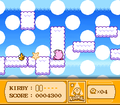
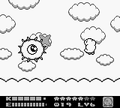
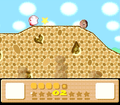
Star Bullets were first introduced in Kirby's Dream Land, where they were Kirby's only method of defeating most bosses. Since then, they have remained mostly unchanged throughout the Kirby series.
A few exceptions include:
| 👁 icon |
SmashWiki has more information about this subject here. |
In the Super Smash Bros. series, Kirby and King Dedede can inhale and shoot their opponents (or sometimes their teammates) out as star bullets, though they behave differently. They travel more slowly, always pass through enemies they hit, and the person transformed can revert back by button-mashing, or revert back normally after traveling some distance. The power of the star depends on the weight of the opponent spat out, meaning that an opponent like Jigglypuff would make for a weak star, while a fighter like Bowser would make for a very strong star.
| Language | Name | Meaning |
|---|---|---|
| English | Spit | - |
| Portuguese | Expelir Exalar[6] |
Expel Exhale |
| Latin American Spanish | Escupir | Spit |
| Language | Name | Meaning |
|---|---|---|
| Japanese | 星型弾 Hoshigatadan |
Star Bullet |
| English | Star Bullet | - |
| French | Tir étoile | Star shot |
| German | Wurfstern | Throw star |
| Korean | 별 총알[7] byeol chongal |
Star Bullet |
| Polish | Gwiezdna Kula[8] Gwiezdny Pocisk[9] |
Star Bullet (literally Star Ball) Star Bullet |
| Portuguese | Projétil estelar | Star projectile |
| Russian | Звездная пуля[10] Zvezdnaya pulya |
Star bullet |
| Language | Name | Meaning |
|---|---|---|
| Japanese | 貫通星型弾 Kantsū Hoshigatadan |
Piercing Star Bullet |
| English | Blaster Bullet | - |
| Traditional Chinese | 貫穿星形彈 Guànchuān xīng xíng dàn |
Penetrating star-shaped bullet |
| Simplified Chinese | 贯穿星形弹 Guànchuān xīng xíng dàn | |
| Dutch | Doorboorkogel | Piercing bullet |
| French | Tir puissant | Powerful shot |
| German | Durchschlagstern | Piercing star |
| Korean | 관통탄[7] gwantongtan |
Piercing Bullet |
| Portuguese | Projétil potente | Powerful projectile |
| Spanish | Bala Penetrante | Penetrating Bullet |
| ||||||||||||||||||||||